
विषयसूची
- 01Property transfer routes in Nepal
- 02Quick answer
- 03Sale or Rajinama
- 04Gift or Bakaspatra
- 05Family transfer and relinquishment
- 06Partition
- 07Inheritance and Namasari
- 08Court judgment or settlement
- 09Exchange and other transfers
- 10Transfer by company
- 11Power of attorney
- 12Foreign buyer or recipient
- 13Taxes and charges
- 14Post-transfer steps
- 15Choosing the correct route
- 16Review note
छिटो जवाफ
Choose the Nepal property-transfer document from the real legal event: sale for consideration, gift for a genuine gratuitous transfer, partition for common family property, Namasari after death, or the required record process for a final court order.
मुख्य तथ्यहरू
- ✓The legal deed must reflect the real transaction rather than the cheapest label.
- ✓Sale, gift, partition and inheritance create different rights and evidence requirements.
- ✓Every route requires title, authority, restriction and tax review.
- ✓A power of attorney must be specific, valid and accepted by the receiving office.
- ✓Registration must be followed by Dakhil Kharij and final record verification.
Property transfer routes in Nepal
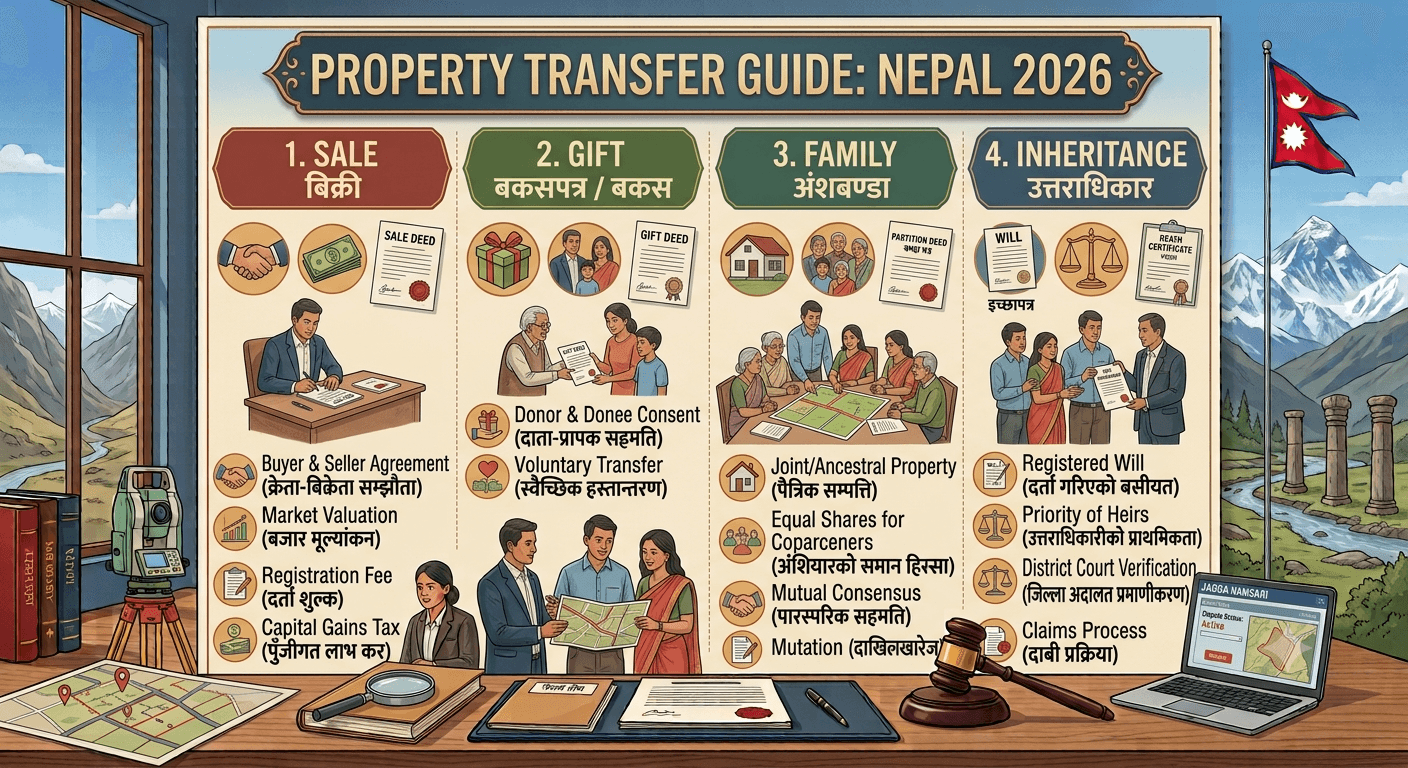
Property can change legal ownership through several routes. The correct deed and procedure depend on whether value is paid, a family gift is intended, common property is partitioned, an owner has died or a court order is being implemented.
Quick answer
Use a sale deed for a genuine purchase, a lawful gift instrument for a genuine gratuitous transfer, a partition deed for division among legally entitled coparceners, Namasari or succession documents after death, and the prescribed implementation process for a court order or settlement. Verify title, consent, tax, valuation and restrictions for every route and complete registration and Dakhil Kharij at the competent Land Revenue Office.
Sale or Rajinama
A sale transfers property for consideration. Confirm title and buyer eligibility, document the real price and payment, allocate taxes and charges, obtain required consent or company authority, and register the sale deed.
The agreement and deed should address deposit, conditions, mortgage discharge, possession, included structures, original documents, default and refund. Do not disguise the sale as a gift to reduce charges.
Gift or Bakaspatra
A gift is a voluntary transfer without sale consideration through the legally appropriate instrument. Verify donor ownership, capacity and free consent, recipient eligibility, family-property implications, tax or fee treatment and any condition or retained right.
An elderly or vulnerable donor should receive independent explanation. Preserve evidence of understanding and avoid a document produced through pressure or deception.
Family transfer and relinquishment
Transfers between spouses or relatives can involve gift, relinquishment, settlement, partition or another form depending on the legal purpose. Relationship-based fee concessions are governed by current provincial schedules and evidence requirements.
Do not select a family label merely because it is cheaper. The deed must match the actual change in rights.
Partition
Partition divides common family property among coparceners. Under the Civil Code, husband, wife, father, mother, son and daughter are recognised as coparceners subject to the chapter, and coparceners have equal partition rights within that framework.
Prepare a complete inventory, identify debts and prior partition, include every necessary coparcener and protect minors. A partition is different from succession after death and from a gift of private property.
Inheritance and Namasari
After an owner dies, first identify legal heirs and the actual estate share. Obtain death, relationship, citizenship and property evidence and complete the applicable Namasari or record-transfer process.
Disputed heirship, missing heirs, debts, foreign heirs or common-family property can require additional court and legal steps. One heir cannot safely transfer the entire property before entitlement is established.
Court judgment or settlement
A court judgment, partition decision or court-approved settlement can provide the legal basis for record change, but the Land Revenue Office still verifies the order against its register and performs the applicable Dakhil Kharij or registration work.
Use certified final documents and check appeal, stay or implementation status.
Exchange and other transfers
An exchange, mortgage, release, lease, government allocation, company restructuring or trust-related event has its own deed, approval and tax treatment. Do not force it into a standard sale template.
Transfer by company
Verify that the company owns the asset and may transfer it under its objects, governance and financing documents. Obtain board or shareholder approval as applicable, identify the authorised signatory, clear tax and mortgage issues, and assess related-party or foreign-investment requirements.
Power of attorney
A specific power can authorise a representative to sign or appear where current law and office practice permit. It should identify the property, transaction, price or authority, receipt powers and limits.
For a document signed abroad, confirm Nepali mission, diplomatic legalisation, translation and registration requirements. A general or expired power may be rejected and can create fraud risk.
Foreign buyer or recipient
Nepal restricts transfer of immovable property to foreigners without Government approval, subject to applicable NRN provisions. Nationality, citizenship status, source of funds and intended holding structure require review before any agreement or payment.
Using a nominee to hide foreign beneficial ownership creates serious legal risk.
Taxes and charges
The transfer can involve registration fee, service charge, capital-gains or income tax, local tax, mortgage-release charge and document expense. Rates vary with province, local level, deed type, value and relationship.
Use the current provincial schedule and official calculation. A historical rate from another province is not reliable.
Post-transfer steps
After registration: 1. verify deed, receipts and Dakhil Kharij; 2. collect the updated Lalpurja or ownership record; 3. check kitta, area, share and spelling; 4. update municipal property tax; 5. transfer utilities and building records; 6. update mortgage, company or insurance records; 7. take documented possession; and 8. store certified copies securely.
Choosing the correct route
Ask whether value is paid, who owns the property, whether it is private or common, whether the transferor is alive, which persons must consent, whether a dispute or debt exists, and what legal result the parties genuinely want.
Review note
This guide was reviewed on 21 July 2026. Deed forms, charges, valuations and office requirements should be checked for the property location and transfer date.
सामान्य प्रश्नहरू
बारम्बार सोधिने प्रश्नहरू
आधिकारिक स्रोतहरू
यो मार्गदर्शनको कानुनी समीक्षाका लागि प्रयोग गरिएका प्राथमिक सामग्री।
- 1.Nepal Law Commission - National Civil Code 2074पहुँच गरिएको २०२६ जुलाई २१
- 2.Nepal Law Commission - Land Revenue Act 2034पहुँच गरिएको २०२६ जुलाई २१
- 3.Department of Land Management - Registration Rate Calculatorपहुँच गरिएको २०२६ जुलाई २१
- 4.Survey Department - Mero Kittaपहुँच गरिएको २०२६ जुलाई २१
व्यावसायिक सहयोग
व्यावसायिक कानुनी सहयोग चाहिन्छ?
तपाईंको विषय, कागजात र अनुपालन आवश्यकता अनुसार अधिवक्ता-नेतृत्वको मार्गदर्शन प्राप्त गर्नुहोस्।
सम्बन्धित कानुनी सेवा हेर्नुहोस् →सम्पादकीय तथा कानुनी समीक्षा
समीक्षक: Wakil Nepal Legal Team
अन्तिम समीक्षा: २०२६ जुलाई २१
यो मार्गदर्शनले सामान्य कानुनी जानकारी प्रदान गर्छ। प्रक्रिया र आधिकारिक आवश्यकता परिवर्तन हुन सक्छन्, र विषय-विशेष सल्लाह आवश्यक हुन सक्छ।