
विषयसूची
- 01Land title due diligence in Nepal
- 02Quick answer
- 031. Verify seller identity and authority
- 042. Verify the title chain
- 053. Reconcile parcel records
- 064. Inspect and measure
- 075. Search restrictions and security interests
- 086. Verify legal access
- 097. Check land use and planning
- 108. Check buildings
- 119. Family and inheritance risk
- 1210. Price, tax and finance
- 13Red flags
- 14Due-diligence report structure
- 15Review note
छिटो जवाफ
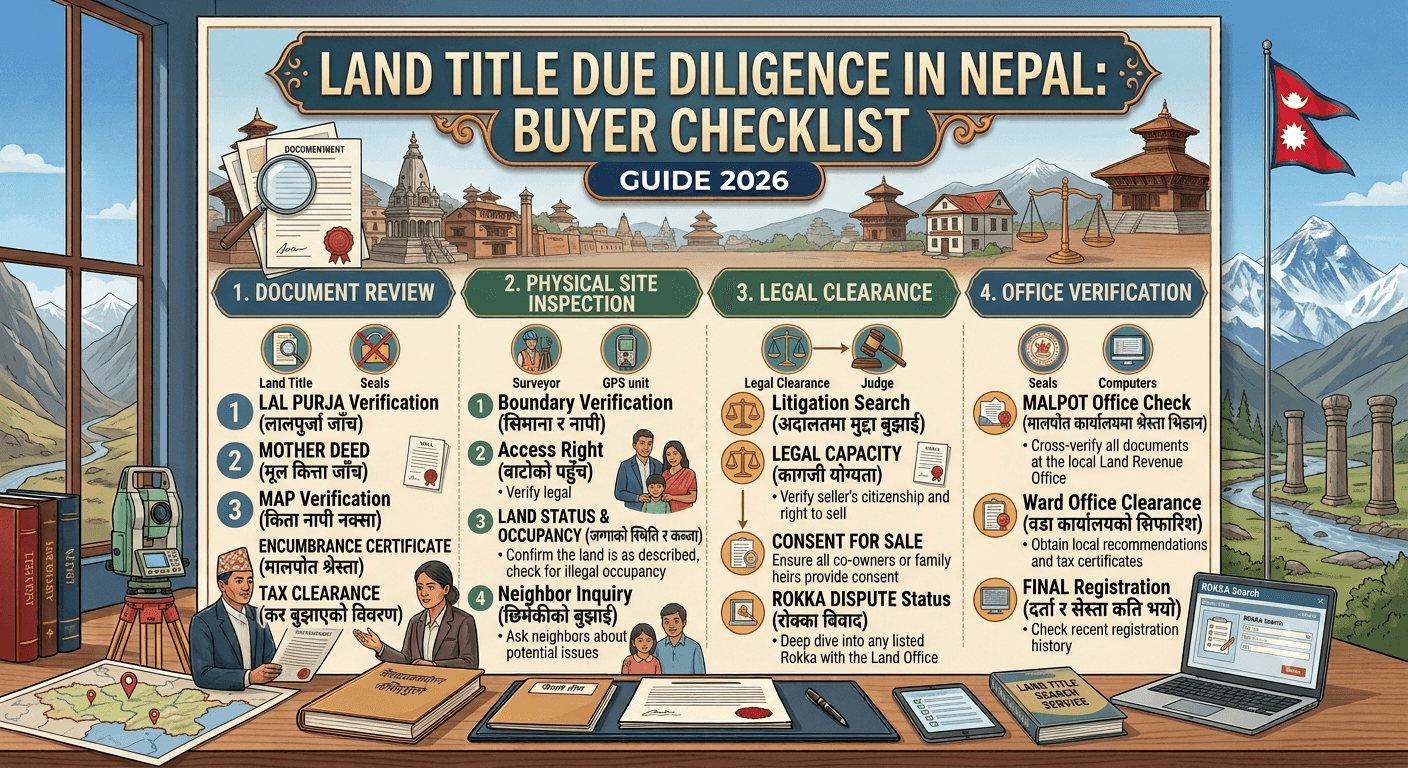
Before buying Nepal land, reconcile seller identity and title with Lalpurja, Shresta, kitta, cadastral and physical records; search restrictions, debt and disputes; verify access, use and buildings; and make registration conditional on clearing every material defect.
मुख्य तथ्यहरू
- ✓A Lalpurja photocopy is not a complete title investigation.
- ✓Ownership, cadastral and physical records must identify the same parcel and area.
- ✓Rokka, mortgage, litigation, family and tenancy risks require live searches.
- ✓Physical access is not always a registered legal right of way.
- ✓The agreement should make closing conditional on curing identified defects.
Land title due diligence in Nepal
A genuine Lalpurja is important but not sufficient. Safe purchase requires reconciliation of ownership, cadastral, physical, legal, financial and planning records before the buyer becomes committed.
Quick answer
Obtain current certified or verifiable ownership records; match the seller, share, kitta and area; compare the cadastral map, field book and physical boundaries; search Rokka, mortgages, cases and government restrictions; verify access, land use, tenancy and structures; assess family and company authority; calculate tax and finance conditions; and make closing conditional on correction of every material defect.
1. Verify seller identity and authority
Match the seller name, citizenship number, photograph and address to current land records. Investigate spelling, citizenship, marital or family discrepancies. Confirm whether the seller owns the whole parcel or only a fractional share.
For a company or institution, verify registration, legal capacity, board resolution, constitutional restrictions, tax status and signatory. For an agent, review the original specific power of attorney and its continuing validity.
2. Verify the title chain
Review the present Lalpurja and ownership register together with the deed or legal event by which the seller acquired title. Examine earlier transfers where risk, recency, family history or record inconsistency justifies it.
Ask whether title arose by sale, gift, partition, inheritance, court order, settlement or government allocation. Each source has distinct consent, heir, coparcener and challenge risks.
3. Reconcile parcel records
Match district, local level, ward, map sheet, kitta, area, land category and ownership share across: - Lalpurja; - ownership register or Shresta; - cadastral map; - field book; - plot register; - prior deed; - tax receipt; and - physical site.
A small number mismatch can identify a different parcel or an unresolved subdivision.
4. Inspect and measure
Visit the property with a competent technical person where appropriate. Confirm boundaries, access, possession, structures, encroachment, slope, drainage, utilities and neighbour occupation.
An online image or broker boundary is not an official demarcation. Where boundary or area is material, use the applicable Survey or Napi procedure.
5. Search restrictions and security interests
Confirm whether the property is subject to: - Rokka or transfer restriction; - bank mortgage or charge; - court order or pending litigation; - government acquisition or road expansion; - tax or revenue restriction; - family or succession dispute; - lease, tenancy or occupancy claim; - Guthi, trust, public or religious status; or - sector-specific transfer restriction.
A promise to clear a mortgage later should become a controlled closing condition with creditor documents and payment sequencing.
6. Verify legal access
Physical use of a path does not necessarily establish registered or enforceable access. Check the cadastral map, deed, public-road records, easement or right-of-way documents and on-site width.
Confirm whether planned road expansion or setback affects buildable area.
7. Check land use and planning
Review land classification, zoning, subdivision, plotting approval, municipal planning, environmental or special-area restrictions and the proposed buyer use. Agricultural, residential, commercial, industrial, forest-border or protected-area issues can differ.
Do not purchase based only on a promise that conversion or building approval will be obtained later.
8. Check buildings
For developed property, review municipal building permit, approved drawings, completion or regularisation record, property tax, floor and area consistency, utilities, structural concerns, common areas and occupancy.
The land title does not automatically prove that every structure is approved or included in the transaction.
9. Family and inheritance risk
Investigate whether the property is common family property, private property, inherited property or subject to prior partition. Identify any spouse, coparcener, heir, minor or other person whose right or consent affects transfer.
Possession of all originals by one relative does not establish exclusive entitlement.
10. Price, tax and finance
Compare agreed price, minimum government valuation, financing and current tax or registration implications. Coordinate the bank valuation and release process without allowing loan timing to replace independent title review.
Use traceable payment, holdback or simultaneous discharge controls for mortgage or document risk.
Red flags
- seller refuses certified record checks; - only a blurred Lalpurja copy is shown; - physical area differs from the map; - access exists only through neighbour permission; - a recent gift or inheritance omits family members; - original title is held by a lender or unknown person; - price is conditioned on a false deed value; - broker promises immediate correction after purchase; or - seller demands full cash before office verification.
Due-diligence report structure
Record the property and proposed transaction, documents reviewed, official searches, ownership conclusion, restrictions, map and site findings, authority and consent, tax issues, open conditions and a proceed, proceed-with-conditions or do-not-proceed recommendation.
Review note
This guide was reviewed on 21 July 2026. Due diligence should use live official records close to completion because restrictions and ownership entries can change.
सामान्य प्रश्नहरू
बारम्बार सोधिने प्रश्नहरू
आधिकारिक स्रोतहरू
यो मार्गदर्शनको कानुनी समीक्षाका लागि प्रयोग गरिएका प्राथमिक सामग्री।
- 1.Nepal Law Commission - Land Revenue Act 2034पहुँच गरिएको २०२६ जुलाई २१
- 2.Nepal Law Commission - National Civil Code 2074पहुँच गरिएको २०२६ जुलाई २१
- 3.Survey Department - Mero Kittaपहुँच गरिएको २०२६ जुलाई २१
- 4.Department of Land Management and Archiveपहुँच गरिएको २०२६ जुलाई २१
व्यावसायिक सहयोग
व्यावसायिक कानुनी सहयोग चाहिन्छ?
तपाईंको विषय, कागजात र अनुपालन आवश्यकता अनुसार अधिवक्ता-नेतृत्वको मार्गदर्शन प्राप्त गर्नुहोस्।
सम्बन्धित कानुनी सेवा हेर्नुहोस् →सम्पादकीय तथा कानुनी समीक्षा
समीक्षक: Wakil Nepal Legal Team
अन्तिम समीक्षा: २०२६ जुलाई २१
यो मार्गदर्शनले सामान्य कानुनी जानकारी प्रदान गर्छ। प्रक्रिया र आधिकारिक आवश्यकता परिवर्तन हुन सक्छन्, र विषय-विशेष सल्लाह आवश्यक हुन सक्छ।