
विषयसूची
- 01Land ownership and title fraud disputes in Nepal
- 02Quick answer
- 03First verify the exact problem
- 04Secure certified records
- 05Forgery and impersonation
- 06Powers of attorney and authority
- 07Rokka and urgent protection
- 08Civil relief and necessary parties
- 09Before buying disputed land
- 10Limitation and delay
- 11Review note
छिटो जवाफ
In a Nepal land-title dispute, secure the complete certified title chain and disputed deed, verify authority and restrictions, prevent further dealings through a lawful route, and seek civil record relief while separately addressing provable forgery or deception.
मुख्य तथ्यहरू
- ✓The latest Lalpurja alone may not reveal the title defect.
- ✓A police complaint does not automatically cancel a registered deed or restore ownership.
- ✓Forgery evidence and civil title remedies must be preserved and coordinated.
- ✓Verify the source and continuing status of every Rokka.
- ✓Claim-specific parties, relief and limitation rules require early review.
Land ownership and title fraud disputes in Nepal
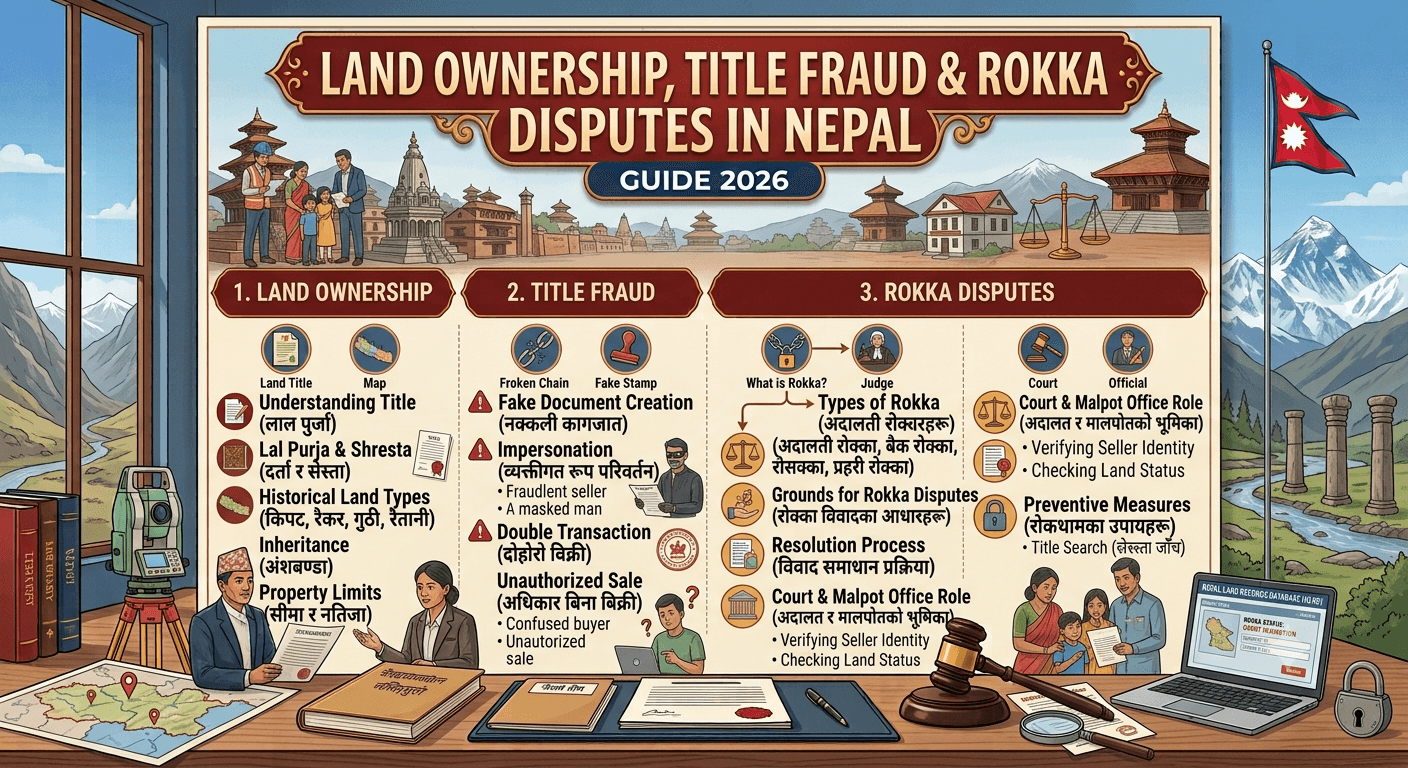
Title disputes concern the legal right to land, not merely its physical boundary. Common cases involve a forged or impersonated deed, an unauthorised power of attorney, sale by one co-owner, concealed inheritance rights, conflicting records, an undisclosed mortgage, or an improper transfer or restriction.
Quick answer
Obtain certified copies of the current ownership record, disputed deed, earlier chain of title, registration log, identity and authority documents, survey records and every Rokka entry. Preserve payment and communication evidence. Assess urgent lawful protection against further transfer, then coordinate the correct civil, administrative and—where genuine forgery or deception is evidenced—criminal routes. A police complaint alone may not cancel a registered deed.
First verify the exact problem
Ask whether the dispute concerns: - ownership itself or only possession; - authenticity of a signature, thumbprint, identity or deed; - authority under a power of attorney or corporate approval; - family, spouse, coparcener or inheritance rights; - duplicate, missing or inconsistent records; - mortgage, court Rokka or other restriction; - a sale, gift, partition, Namasari or auction; or - a cadastral error rather than a title defect.
The answer determines the authority, defendants, evidence and relief.
Secure certified records
Request the complete relevant chain rather than only the latest Lalpurja. It may include prior deeds, registration details, Dakhil Kharij history, ownership register, Namasari or partition papers, Rokka and release communications, identity records, powers of attorney, witness details, tax material and cadastral documents.
For a company or organisation, collect registration records, governing documents, board resolutions, delegated authority and beneficial ownership material. For a deceased owner, collect death, relationship and succession records.
Forgery and impersonation
Do not make a public fraud accusation before preserving the evidence. Compare originals or certified copies, registration attendance, photographs or biometrics where lawfully available, signatures, thumbprints, witness and payment records. A qualified forensic examination may be needed.
Forgery, impersonation or deceptive transfer can raise criminal issues, while title declaration, cancellation, restoration and injunction are civil or record consequences. These routes may proceed differently and must be coordinated so that one filing does not omit necessary relief.
Powers of attorney and authority
Check execution, authentication, territorial and time validity, revocation, the precise property and permitted act. General wording may not authorise the disputed transaction. A corporate signatory also needs valid institutional authority; possession of a company stamp is not enough.
Rokka and urgent protection
Search the official record to learn whether a Rokka exists, who requested it, its scope and whether it remains effective. If the property is at risk of onward sale, mortgage, subdivision or construction, seek immediate advice about a legally available Malpot request or court interim order. Obtain written confirmation after any restriction is entered.
A wrongful Rokka should be challenged through the route appropriate to its source. Malpot generally cannot disregard a continuing order from a competent court or authority merely because an owner asks orally.
Civil relief and necessary parties
Possible relief may include a declaration of right, cancellation or invalidation, restoration or correction of records, injunction, possession, partition, damages and implementation directions. Join the transferor, transferee, affected co-owners or heirs, lender and relevant record authority where procedure and relief require them.
A decree that does not address the operative deed or record may fail to restore practical title.
Before buying disputed land
Do not treat a discounted price as compensation for uncertain title. Verify the entire chain, pending cases, certified Rokka search, family rights, authority, possession and boundary. A seller promise to “clear the case later” is not equivalent to marketable title.
Limitation and delay
Different claims have different limitation rules, often connected to the act or date of knowledge. Obtain advice immediately. Do not assume a suspicious old deed can always be challenged whenever discovered, or that an entry is valid merely because time has passed.
Review note
This guide was legally reviewed on 21 July 2026. The correct remedy depends on the deed, chain of title, parties and procedural history.
सामान्य प्रश्नहरू
बारम्बार सोधिने प्रश्नहरू
आधिकारिक स्रोतहरू
यो मार्गदर्शनको कानुनी समीक्षाका लागि प्रयोग गरिएका प्राथमिक सामग्री।
- 1.Nepal Law Commission - National Civil Code 2074पहुँच गरिएको २०२६ जुलाई २१
- 2.Nepal Law Commission - Land Revenue Act 2034पहुँच गरिएको २०२६ जुलाई २१
- 3.Nepal Law Commission - National Civil Procedure Code 2074पहुँच गरिएको २०२६ जुलाई २१
व्यावसायिक सहयोग
व्यावसायिक कानुनी सहयोग चाहिन्छ?
तपाईंको विषय, कागजात र अनुपालन आवश्यकता अनुसार अधिवक्ता-नेतृत्वको मार्गदर्शन प्राप्त गर्नुहोस्।
सम्बन्धित कानुनी सेवा हेर्नुहोस् →सम्पादकीय तथा कानुनी समीक्षा
समीक्षक: Wakil Nepal Legal Team
अन्तिम समीक्षा: २०२६ जुलाई २१
यो मार्गदर्शनले सामान्य कानुनी जानकारी प्रदान गर्छ। प्रक्रिया र आधिकारिक आवश्यकता परिवर्तन हुन सक्छन्, र विषय-विशेष सल्लाह आवश्यक हुन सक्छ।