
विषयसूची
- 01Legal heirs and succession priority in Nepal
- 02Quick answer
- 03Why priority matters
- 04Prepare the family tree
- 05Sons and daughters
- 06Surviving spouse
- 07Parents and other relatives
- 08Care and maintenance
- 09Disqualification
- 10Missing and overseas heirs
- 11Minors and protected persons
- 12How shares are calculated
- 13Evidence checklist
- 14Common mistakes
- 15Review note
छिटो जवाफ
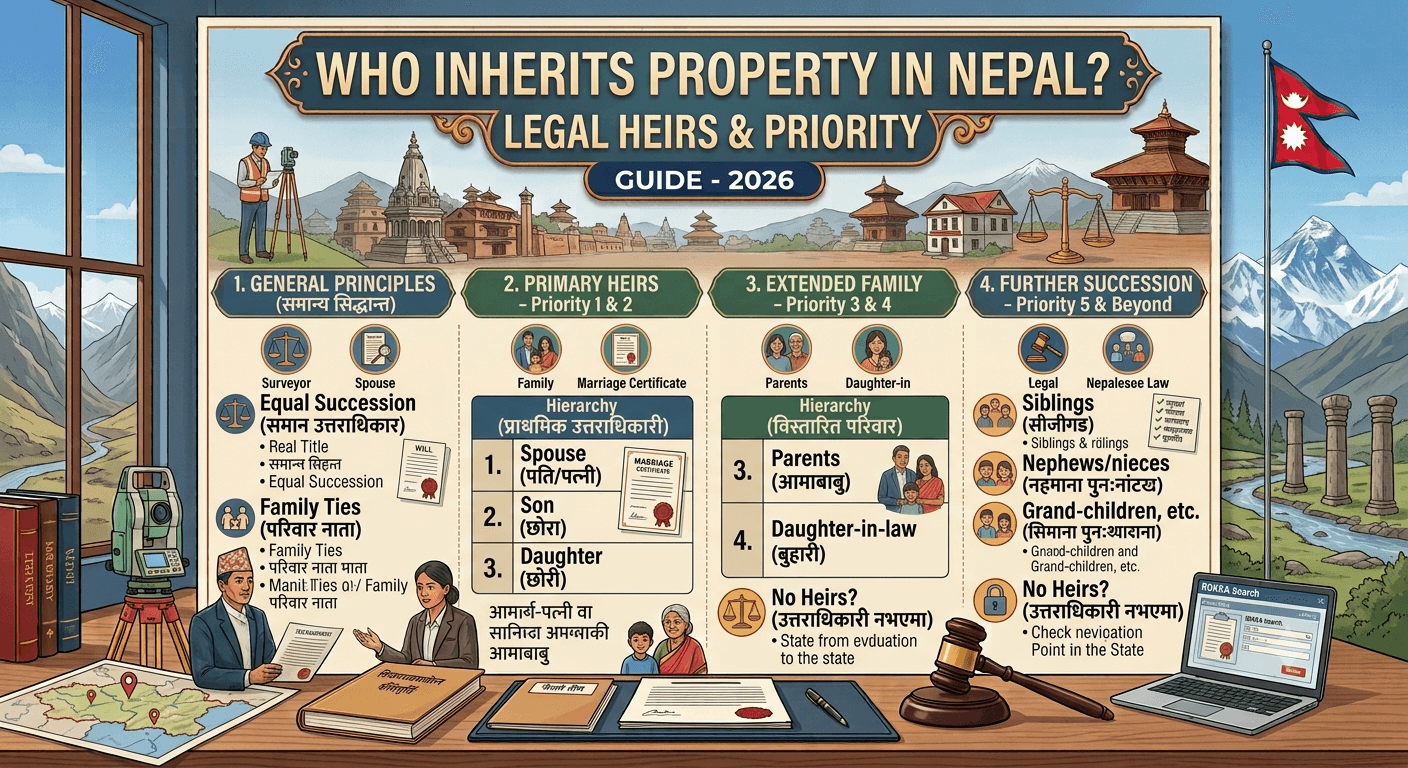
Nepal identifies heirs through a statutory order of priority, not a single universal equal-share rule. Establish the family tree, qualifying persons, estate ownership, care or cohabitation facts and disqualification before calculating any share.
मुख्य तथ्यहरू
- ✓The current Civil Code order must be applied before calculating shares.
- ✓A daughter should not be excluded merely because she is female or married.
- ✓A spouse has important rights, but the result depends on statutory and family facts.
- ✓Overseas, missing and minor heirs must still be identified and protected.
- ✓Possession of documents or property does not by itself establish sole heirship.
Legal heirs and succession priority in Nepal
The closest family member is not always determined by everyday language. Nepal applies a statutory order of priority together with rules on relationship, cohabitation, care, surrender and disqualification.
Quick answer
Build a verified family tree, identify the highest applicable class in the Civil Code, confirm which persons within that priority qualify on the facts, and only then calculate the estate share. Do not exclude a daughter because she is married, assume a spouse automatically receives everything, or move to a distant relative while a higher-priority heir remains legally entitled.
Why priority matters
Succession law determines who steps into the estate when a person dies. The answer affects land transfer, bank release, company shares, debt, litigation and every later sale. If one heir is hidden or omitted, the resulting transfer can be challenged.
The Code provides an order of preference. People in a later order generally should not displace a person in a higher order who qualifies, but the exact section and family facts must be read before stating a result.
Prepare the family tree
Record: - surviving husband or wife; - sons and daughters, including legally relevant adopted or parentage relationships; - parents and grandparents; - brothers, sisters and their family lines where relevant; - prior spouse, divorce or judicial separation; - deceased relatives in the family line; - persons who cared for or were maintained by the deceased; and - every relative living abroad.
Support the tree with citizenship, birth, marriage, relationship, adoption, divorce and death records. Resolve spelling, date and parentage discrepancies before filing.
Sons and daughters
Nepal law should not exclude a child solely because the child is female or married. Sons and daughters must be analysed under the present Civil Code rather than older discriminatory assumptions.
However, an inheritance question can be confused with partition, private property, a prior transfer or another legal category. Equality within partition does not mean that every item labelled ancestral automatically belongs to every relative after death.
Surviving spouse
A surviving spouse can have succession rights, but no universal statement that the spouse always receives the entire estate or always shares equally is safe. The statutory order, living arrangement, divorce or separation history, maintenance and competing heirs require review.
Marriage must be legally established. Conflicting marriage, citizenship or relationship records should be resolved before asset transfer.
Parents and other relatives
Parents, grandparents, siblings and more distant relatives can become relevant according to the statutory order when a higher-priority heir is absent or disqualified. Do not jump directly to siblings merely because they possess the property documents.
Representation through a deceased relative, the position of a widowed family member and specific dependency facts may require careful Code analysis.
Care and maintenance
The Civil Code makes care and maintenance legally relevant in particular succession situations. A person who actually cared for the deceased may have an issue to raise where statutory heirs failed in their duties, but caregiving is not a simple receipt-based purchase of the estate.
Keep evidence of residence, treatment, expenses, communication and caregiving. The claim remains fact-specific.
Disqualification
The Code contains circumstances in which a person may be disqualified from succession. Serious misconduct should not be alleged casually. Identify the exact statutory ground and reliable evidence, provide procedural fairness and distinguish disqualification from a family disagreement.
Missing and overseas heirs
An overseas heir does not disappear from the family tree. Establish identity, relationship, citizenship or nationality and current address. A properly drafted power of attorney may help with Nepal procedure, but it must meet the receiving office and authentication rules.
If a person is missing or cannot be served, obtain advice on the required notice or court procedure rather than filing a false consent.
Minors and protected persons
Where an heir is a minor or lacks capacity, guardianship, court approval and protection of property can affect settlement and transfer. An adult family agreement cannot simply waive the protected share or misuse the property.
How shares are calculated
First establish the estate; second identify the applicable priority; third identify every qualifying person within it; fourth account for valid debts and legal adjustments; and only then calculate distribution.
Do not calculate percentages before deciding whether the asset belonged entirely to the deceased or partly to a common family or co-owner.
Evidence checklist
1. Official death registration. 2. Citizenship or passport of deceased and claimants. 3. Birth, marriage, adoption and relationship certificates. 4. Divorce, separation and prior court records. 5. Prior partition, transfer, gift and ownership documents. 6. Evidence of cohabitation, maintenance or caregiving where relevant. 7. Records concerning a deceased, missing or overseas relative. 8. Complete list of assets, debt and persons in possession.
Common mistakes
- using an old family custom instead of the current Code; - excluding daughters or overseas heirs; - treating possession as ownership; - confusing nomination with final beneficial entitlement; - hiding a marriage or child; - calculating shares before separating common and private property; or - signing a family settlement without complete disclosure.
Review note
This guide was reviewed on 21 July 2026. The exact Nepali statutory priority and all family facts should be checked before giving an entitlement opinion.
सामान्य प्रश्नहरू
बारम्बार सोधिने प्रश्नहरू
आधिकारिक स्रोतहरू
यो मार्गदर्शनको कानुनी समीक्षाका लागि प्रयोग गरिएका प्राथमिक सामग्री।
- 1.Nepal Law Commission - National Civil Code 2074पहुँच गरिएको २०२६ जुलाई २१
- 2.Nepal Law Commission - Partition Chapter of the Civil Codeपहुँच गरिएको २०२६ जुलाई २१
- 3.Nepal Law Commission - Civil Procedure Code 2074पहुँच गरिएको २०२६ जुलाई २१
व्यावसायिक सहयोग
व्यावसायिक कानुनी सहयोग चाहिन्छ?
तपाईंको विषय, कागजात र अनुपालन आवश्यकता अनुसार अधिवक्ता-नेतृत्वको मार्गदर्शन प्राप्त गर्नुहोस्।
सम्बन्धित कानुनी सेवा हेर्नुहोस् →सम्पादकीय तथा कानुनी समीक्षा
समीक्षक: Wakil Nepal Legal Team
अन्तिम समीक्षा: २०२६ जुलाई २१
यो मार्गदर्शनले सामान्य कानुनी जानकारी प्रदान गर्छ। प्रक्रिया र आधिकारिक आवश्यकता परिवर्तन हुन सक्छन्, र विषय-विशेष सल्लाह आवश्यक हुन सक्छ।