
विषयसूची
- 01Patent registration in Nepal
- 02Quick answer
- 031. Keep the invention confidential
- 042. Identify the inventor and applicant
- 053. Search before drafting
- 064. Prepare the patent specification
- 075. Assemble the filing documents
- 086. File with DOI
- 097. Examination and expert review
- 108. Acceptance, fee and certificate
- 119. Plan protection outside Nepal
- 12Filing checklist
- 13Review note
छिटो जवाफ
Register a Nepal patent through the Department of Industry by securing confidentiality and ownership, searching prior art, preparing an enabling specification with claims and drawings, filing the documents, responding to examination and paying the registration fee after acceptance.
मुख्य तथ्यहरू
- ✓File strategically before public disclosure of enabling technical details.
- ✓DOI administers patent registration through its Industrial Property Section.
- ✓Current published fees are NPR 2,000 to apply and NPR 10,000 after approval.
- ✓Claims, specification, drawings and ownership documents must be consistent.
- ✓A foreign or PCT filing does not automatically protect an invention in Nepal.
Patent registration in Nepal
A patent is a territorial industrial-property right for a qualifying invention. In Nepal, patents are registered by the Department of Industry (DOI), Industrial Property Section, under the Patent, Design and Trade Mark Act, 2022 (1965), as amended.
Quick answer
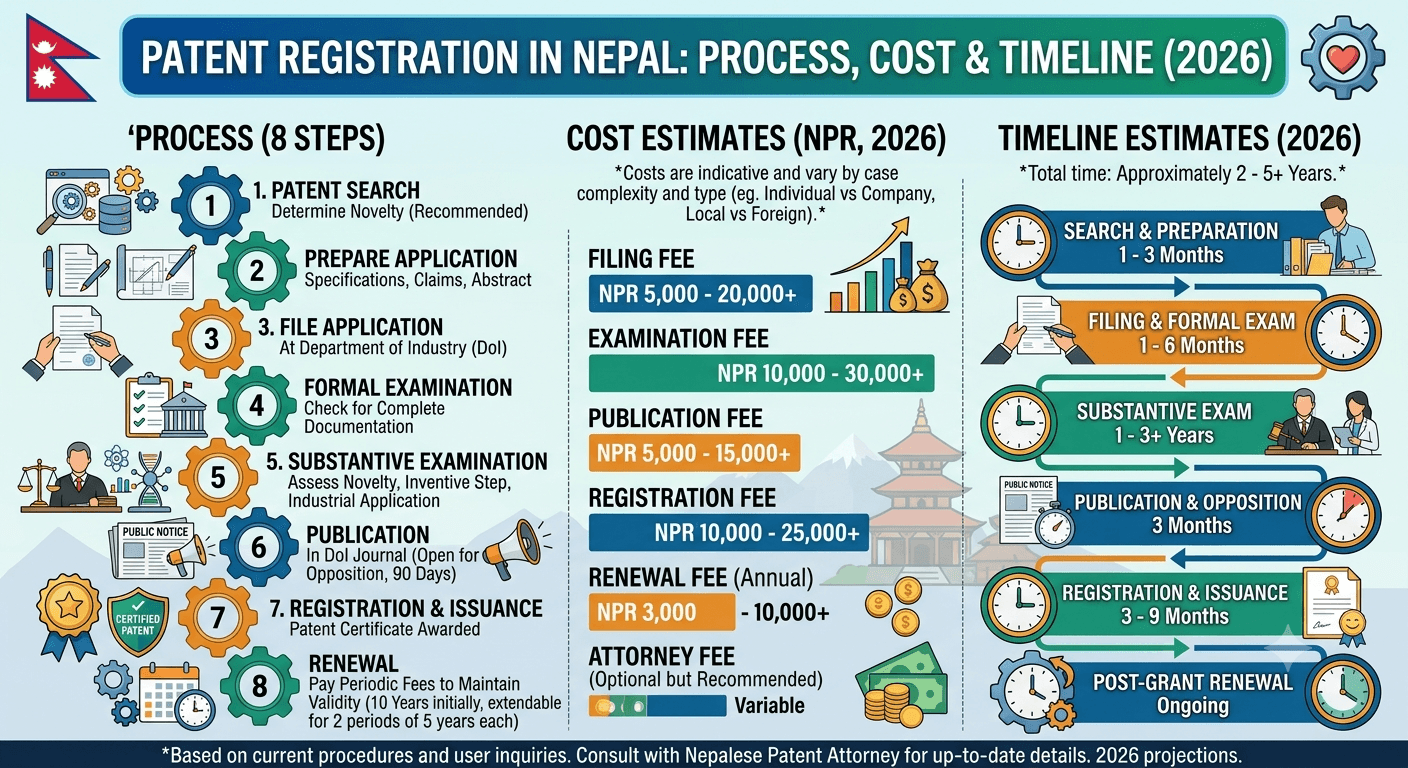
Start before publicly disclosing the invention. Confirm the inventor and intended owner, search relevant prior art, prepare a complete specification explaining how the invention is made, operated or used, include an abstract, claims and drawings where needed, then file with DOI and pay the application fee. DOI may investigate and obtain expert advice. If accepted, pay the registration fee and obtain the certificate.
DOI's current published schedule lists NPR 2,000 as the patent application fee and NPR 10,000 as the registration fee after approval. Verify amounts and payment instructions on the filing date.
1. Keep the invention confidential
Do not publish, demonstrate, sell, pitch or upload enabling technical details before assessing the filing strategy. Use non-disclosure and controlled-access arrangements with employees, contractors, manufacturers, investors and testing partners.
Record any unavoidable earlier disclosure, including its date, audience and exact content. Public disclosure can affect patent strategy in Nepal and other countries, even where the disclosure came from the inventor.
2. Identify the inventor and applicant
List every person who contributed to the inventive concept. The inventor and patent owner may differ, but the applicant must have a defensible right to apply. Review employment terms, founder arrangements, university policies, funding conditions and assignments.
If a company will own the patent, complete written transfers and corporate authority before filing. Payment for prototype work does not automatically settle every ownership issue.
3. Search before drafting
A prior-art search reviews earlier patents, technical literature, products and public disclosures. Search internationally as well as in available Nepal sources. The objective is to identify what is genuinely new, avoid unsupported claims and decide whether patenting is commercially worthwhile.
A search cannot guarantee registration or freedom to operate. Patentability asks whether your invention can receive protection; freedom to operate asks whether commercialising it may infringe somebody else's rights.
4. Prepare the patent specification
DOI's domestic-patent checklist requires a patent description containing: - an abstract; - the method of making, operating or using the invention; - details of any theory or formula on which it is based; - necessary maps, drawings or diagrams; - a statement of the claims for which protection is requested; - inventor name, address and occupation; and - patent-owner name and address.
The description should enable a technically informed reader to understand and practise the invention. Claims require particular care because they define the requested boundary of protection. Avoid a vague business idea, marketing description or unexplained result.
5. Assemble the filing documents
Prepare the prescribed application, complete specification, inventor and applicant details, ownership or assignment evidence where needed, power of attorney if a representative is appointed, and fee receipt. Corporate applicants should maintain signer authority and registration evidence.
Foreign-patent applications require additional documents. DOI currently lists proof relating to the original foreign applicant and priority date, and a certified copy of the foreign patent certificate where the patent is already registered abroad.
6. File with DOI
Submit the documents to DOI's Industrial Property Section using the current filing route. Obtain dated filing evidence, payment receipt and an internal docket recording the application number, invention title, applicant, inventor, priority claim, correspondence and deadlines.
Do not confuse a Nepal patent filing with a company, industry, design, trademark or copyright registration. Each protects a different legal interest.
7. Examination and expert review
The Act allows DOI to investigate whether the invention is new, useful to the public and legally registrable, and to obtain expert advice. DOI may request clarification, technical documents, corrected drawings or amendments.
The current citizen charter does not promise a dependable short completion period; its patent entry indicates a process that may extend substantially because of investigation. Treat any estimate as case-specific.
8. Acceptance, fee and certificate
If DOI accepts the application, pay the prescribed registration fee and retain the certificate with the exact filed specification, drawings, claims and correspondence. Check all names and details promptly.
9. Plan protection outside Nepal
Patents are territorial. Nepal is a Paris Convention member but, as of 21 July 2026, WIPO does not list Nepal as a Patent Cooperation Treaty contracting state. A foreign or PCT filing does not automatically create a Nepal patent. International priority deadlines can be strict, so obtain advice before the first filing or disclosure.
Filing checklist
1. Stop uncontrolled disclosure. 2. Record inventors and intended ownership. 3. Search prior art and assess commercial value. 4. Draft the enabling description, abstract, claims and drawings. 5. Assemble authority, ownership and priority evidence. 6. File with the current official fee. 7. Track examination and answer DOI notices. 8. Pay the registration fee after acceptance. 9. Calendar renewals and foreign deadlines.
Review note
This guide was reviewed on 21 July 2026. Patentability, priority, ownership and international filing are fact-sensitive; verify current DOI forms and fees before filing.
सामान्य प्रश्नहरू
बारम्बार सोधिने प्रश्नहरू
आधिकारिक स्रोतहरू
यो मार्गदर्शनको कानुनी समीक्षाका लागि प्रयोग गरिएका प्राथमिक सामग्री।
- 1.Department of Industry - Citizen Charterपहुँच गरिएको २०२६ जुलाई २१
- 2.Department of Industry - Industrial Property Sectionपहुँच गरिएको २०२६ जुलाई २१
- 3.Nepal Law Commission - Patent, Design and Trade Mark Actपहुँच गरिएको २०२६ जुलाई २१
- 4.WIPO INSPIRE - Nepal patent-system profileपहुँच गरिएको २०२६ जुलाई २१
व्यावसायिक सहयोग
व्यावसायिक कानुनी सहयोग चाहिन्छ?
तपाईंको विषय, कागजात र अनुपालन आवश्यकता अनुसार अधिवक्ता-नेतृत्वको मार्गदर्शन प्राप्त गर्नुहोस्।
सम्बन्धित कानुनी सेवा हेर्नुहोस् →सम्पादकीय तथा कानुनी समीक्षा
समीक्षक: Wakil Nepal Legal Team
अन्तिम समीक्षा: २०२६ जुलाई २१
यो मार्गदर्शनले सामान्य कानुनी जानकारी प्रदान गर्छ। प्रक्रिया र आधिकारिक आवश्यकता परिवर्तन हुन सक्छन्, र विषय-विशेष सल्लाह आवश्यक हुन सक्छ।