
विषयसूची
छिटो जवाफ
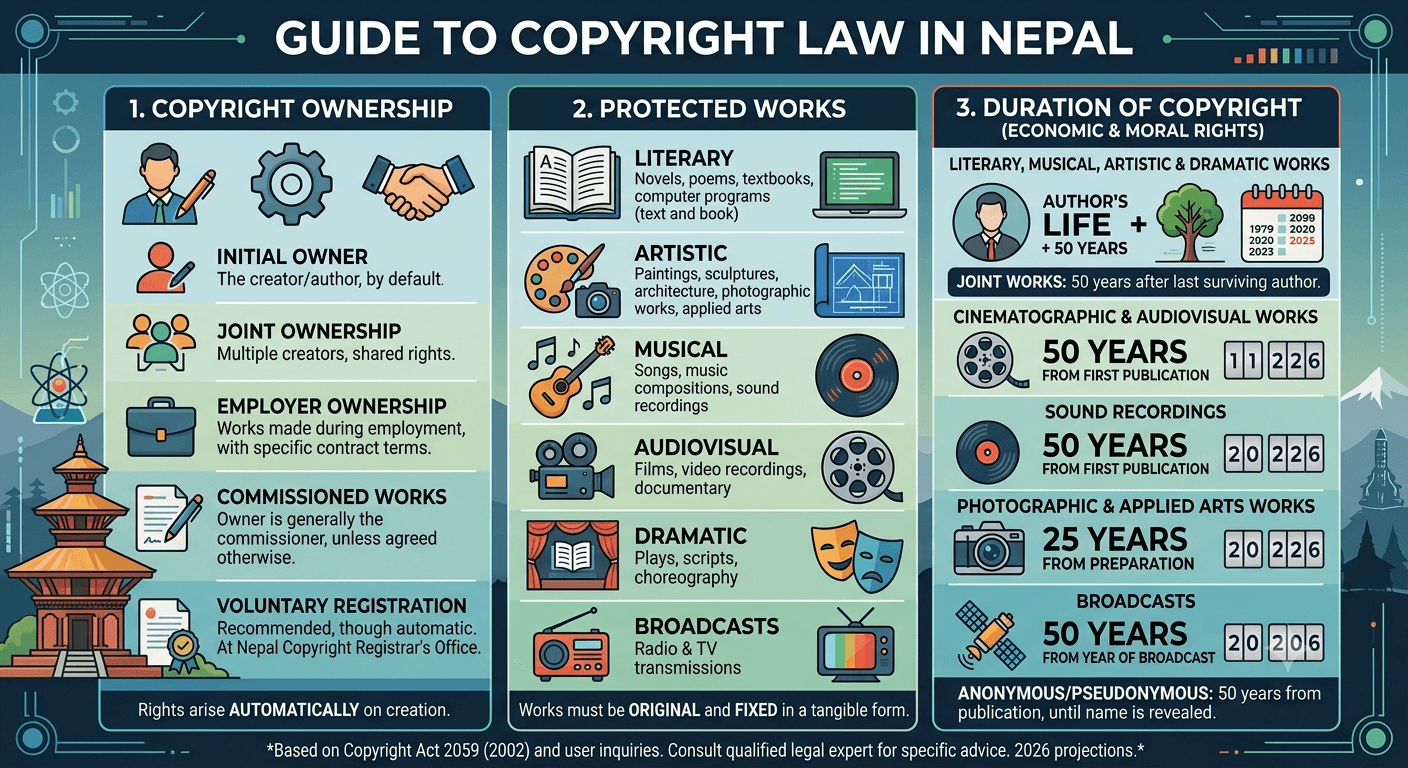
Copyright generally arises automatically in Nepal, but a creator or owner can voluntarily register a work with the Nepal Copyright Registrar to create an official record. Prepare ownership and nationality evidence, two copies and the current filing materials.
मुख्य तथ्यहरू
- ✓Registration is voluntary; it does not create originality or cure ownership defects.
- ✓The official online service currently lists a Rs. 100 fee and two work copies.
- ✓The application should match the real author, owner and chain of title.
- ✓Software filings have additional deposit and developer-agreement requirements.
- ✓Verify the live government checklist and timeline before submitting.
Copyright registration in Nepal
Nepal protects original creative expression under the Copyright Act, 2059 (2002) and Copyright Rules, 2061 (2004). Registration is administered by the Nepal Copyright Registrar's Office in Narayanhiti, Kathmandu.
Quick answer
Copyright generally exists without registration; registration is not what creates an original author's rights. A creator or right owner may nevertheless register a work to create an official record useful for ownership, licensing and disputes. The Registrar's current online guidance asks for the application, proof of ownership, nationality evidence, two copies of the work and a Rs. 100 revenue payment. It states that a certificate is issued within 35 days after a complete application if the work is registrable. Confirm the live checklist before filing.
1. Confirm the work and owner
Identify the specific version being registered and the person or organisation claiming ownership. The Copyright Act covers original intellectual creations in literature, art, knowledge and science, including books and articles, music, dramatic works, paintings, photographs, architecture, audiovisual works, computer programs and databases expressed through original selection or arrangement.
Copyright protects expression, not a bare idea, method, concept, principle, court judgment, administrative decision, folk expression or general data. Registration cannot turn excluded subject matter or copied material into protected work.
Authorship and ownership are not always identical. Before filing for a company, check employment terms, commissioning agreements, assignments and permissions from co-authors. A registration record should not contradict the underlying chain of title.
2. Preserve creation evidence
Keep dated drafts, source files, version history, publication records, contracts and correspondence. For collaborative work, record each contributor's role and obtain a written agreement. For transferred rights, retain the signed assignment and scope of rights transferred.
This evidence remains important even after registration because a certificate does not independently resolve every authorship, originality or contractual dispute.
3. Prepare the application package
The current online service lists: - the prescribed application details; - documents or evidence supporting ownership; - documents showing the applicant's nationality; - two copies of the work; - Rs. 100 registration revenue; - organisation registration evidence or the author's permission where an organisation applies; and - relevant approvals or transfers for contributors to a sound recording.
For software, the service specifically requests the version, source code, flowchart, graphical user interface and developer agreement. Protect confidential material by seeking advice on what must be deposited before disclosing sensitive source code.
4. Apply to the Registrar
The official website provides an online application portal and a downloadable Schedule 1 form. The form asks for author or right-owner details, address, nationality, date of birth, work title and pages, language, completion date, first-publication details, copies published and ownership evidence.
Ensure names, dates, title and ownership details match every attachment. Keep the submission acknowledgement and payment evidence.
5. Examination and certificate
The Registrar reviews whether the submission and work are registrable. The online portal currently states a 35-day target from receipt of the application and required documents. This is an administrative statement, not a guaranteed completion date for incomplete, disputed or unusual filings.
Respond promptly to requests for clarification. When issued, check the certificate immediately and preserve the original and a secure digital copy.
6. Use registration properly
Place ownership and permitted-use terms in contracts, licences and website notices. Registration does not replace assignments from creators, music clearances, model or location releases, trademark clearance, privacy compliance or sector licences.
Update your evidence when a work changes materially. A new edition, software version, recording or artwork may require a separate filing assessment.
Practical filing checklist
1. Identify the exact work and owner. 2. Verify originality and contributor permissions. 3. Assemble ownership and nationality evidence. 4. Prepare two deposit copies and work-specific materials. 5. Complete the current form accurately. 6. Pay the current official revenue and retain the receipt. 7. Track questions and inspect the certificate.
Important date note
This guide was legally reviewed on 21 July 2026. Government forms, fees, portal requirements and processing times can change; verify them on the Registrar's official website on the filing date.
सामान्य प्रश्नहरू
बारम्बार सोधिने प्रश्नहरू
आधिकारिक स्रोतहरू
यो मार्गदर्शनको कानुनी समीक्षाका लागि प्रयोग गरिएका प्राथमिक सामग्री।
- 1.Nepal Copyright Registrar - Official website and publicationsपहुँच गरिएको २०२६ जुलाई २१
- 2.Nepal Copyright Registrar - Online application requirementsपहुँच गरिएको २०२६ जुलाई २१
- 3.Nepal Copyright Registrar - Schedule 1 registration formपहुँच गरिएको २०२६ जुलाई २१
- 4.Nepal Law Commission - Copyright Act 2059पहुँच गरिएको २०२६ जुलाई २१
व्यावसायिक सहयोग
व्यावसायिक कानुनी सहयोग चाहिन्छ?
तपाईंको विषय, कागजात र अनुपालन आवश्यकता अनुसार अधिवक्ता-नेतृत्वको मार्गदर्शन प्राप्त गर्नुहोस्।
सम्बन्धित कानुनी सेवा हेर्नुहोस् →सम्पादकीय तथा कानुनी समीक्षा
समीक्षक: Wakil Nepal Legal Team
अन्तिम समीक्षा: २०२६ जुलाई २१
यो मार्गदर्शनले सामान्य कानुनी जानकारी प्रदान गर्छ। प्रक्रिया र आधिकारिक आवश्यकता परिवर्तन हुन सक्छन्, र विषय-विशेष सल्लाह आवश्यक हुन सक्छ।