
विषयसूची
- 01What can be patented in Nepal?
- 02Quick answer
- 03Patent, design, trademark or copyright?
- 04Is an idea enough?
- 05Newness and usefulness
- 06Prior-art search versus freedom to operate
- 07Structure of a patent specification
- 08Abstract
- 09Detailed description
- 10Method of making, operating or using
- 11Theory or formula
- 12Drawings
- 13Claims
- 14Required domestic-filing documents
- 15Additional foreign-patent documents
- 16Common drafting failures
- 17Patentability assessment checklist
- 18Review note
छिटो जवाफ
A useful new technical product, process, material combination or method may be patentable in Nepal when it is explained in enabling detail. Search prior art, settle ownership and draft supported claims, specifications and drawings before filing.
मुख्य तथ्यहरू
- ✓A workable technical invention is different from a bare idea or business concept.
- ✓Patent, design, trademark, copyright and secrecy protect different features.
- ✓Prior-art searching shapes claims but does not guarantee registration.
- ✓The specification must teach how to make, operate or use the invention.
- ✓Foreign applicants need priority and certified foreign documents where applicable.
What can be patented in Nepal?
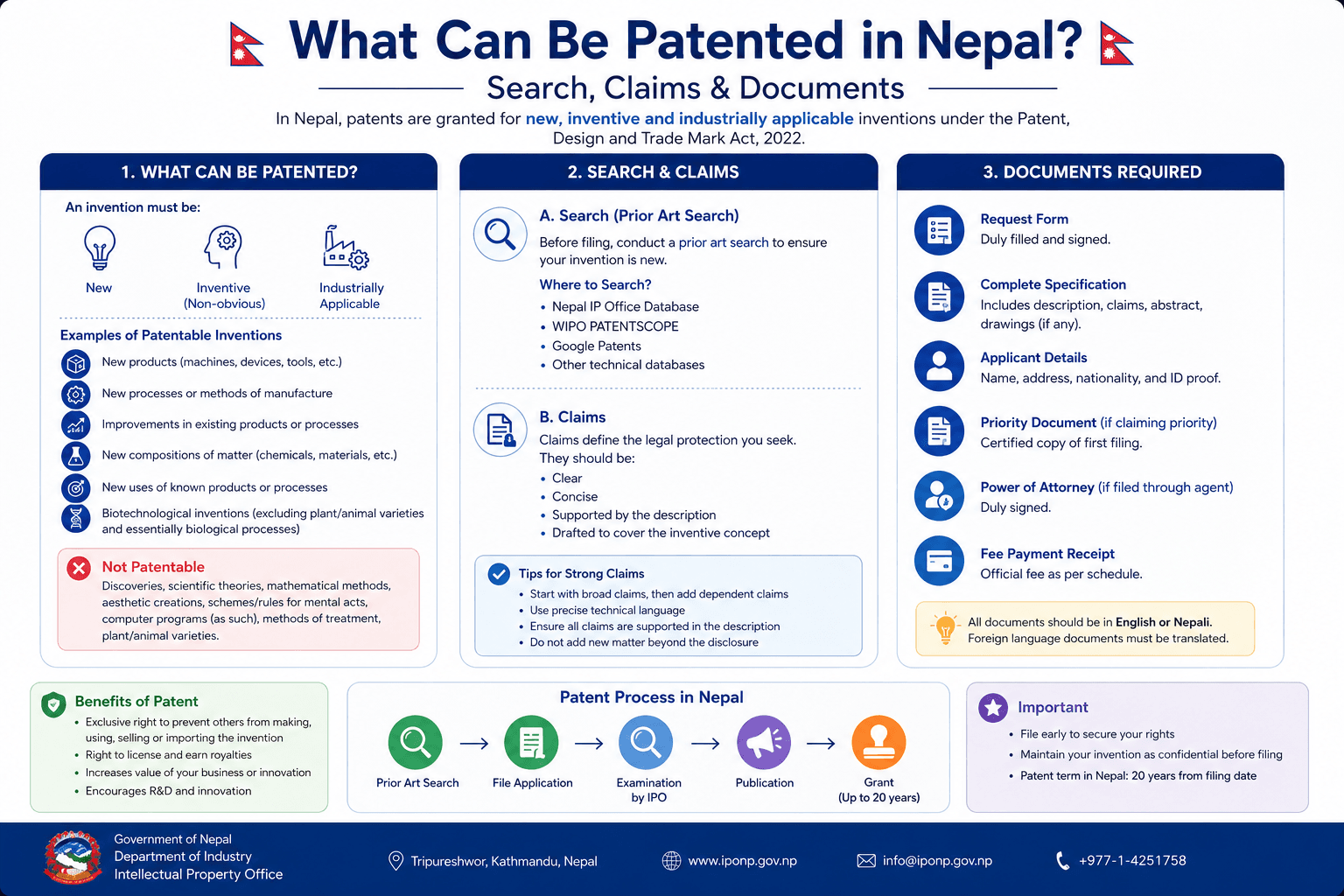
Nepal's current Patent, Design and Trade Mark Act describes a patent as a useful invention relating to a new method or process of manufacture, operation or transmission of materials, a useful combination of materials, or an invention based on a new theory or formula.
Quick answer
A product, machine, manufacturing process, material combination or technical method may be a patent candidate when it is new, useful and explained in enough detail to work. A bare idea, brand name, decorative appearance, copied technology or unexplained desired result is not a strong patent filing. Patentability should be tested through confidential technical intake and prior-art research before claims are drafted.
Patent, design, trademark or copyright?
Choose protection by what you need to protect: - patent: qualifying technical function, product, process or material combination; - industrial design: visual shape or appearance of a manufactured article; - trademark: name, logo or sign distinguishing goods or services; - copyright: original expression such as drawings, manuals, software code, photographs or text; and - trade-secret controls: valuable information kept confidential rather than disclosed in a patent.
One product can require several rights. A machine may involve a patent for function, a design registration for appearance, a trademark for its brand and copyright in drawings or software.
Is an idea enough?
No strong application can be built from a slogan such as “a device that saves energy.” The filing must explain the technical problem, components or steps, relationships, operation, alternatives and how to make or use the invention.
Develop prototypes, test data and drawings where they materially support the explanation, but avoid unnecessary public testing or disclosure.
Newness and usefulness
DOI may investigate whether an invention is new and useful to the public and may obtain expert advice. Search relevant Nepal information and international patent databases, academic papers, standards, catalogues, products, videos and other public material.
The statutory Nepal analysis and the search strategy are not identical. International searching helps expose risk, improve drafting and support foreign planning even where the Nepal Act uses its own legal test.
Prior-art search versus freedom to operate
A patentability search focuses on whether your proposed claims are new and defensible. A freedom-to-operate review focuses on whether making, using or selling the product may interfere with another party's enforceable claims in each target country.
Neither search can give an absolute guarantee. Databases have delays, unpublished applications may exist and claim interpretation is legal and technical.
Structure of a patent specification
Abstract
A concise technical summary. It should help identify the invention without replacing the detailed description.
Detailed description
Explain the problem, components, process steps, connections, materials, operation, variations and best practical implementation known to the applicant. Define technical terms consistently.
Method of making, operating or using
DOI expressly requests this information. Describe the invention so it is usable, not merely aspirational.
Theory or formula
Where the invention depends on a theory or formula, explain it and connect it to the practical invention.
Drawings
Use clear, consistent reference numbers, views, flowcharts or diagrams where they help explain the invention. Avoid decorative ambiguity.
Claims
Claims state the protection requested. Each important element must be supported by the description and drawings. Overbroad claims may collide with earlier technology; overly narrow claims may be commercially easy to avoid.
Required domestic-filing documents
DOI's current checklist includes a proper application, patent description containing the listed technical parts, inventor and patent-owner details, power of attorney where a representative is appointed, and the application-fee receipt.
Also retain evidence of the applicant's right to apply: assignments, employment clauses, research agreements, founder documents and corporate authorization as relevant.
Additional foreign-patent documents
DOI lists evidence relating to the first foreign applicant and priority date, plus a certified copy of the foreign patent certificate when already registered abroad. Translation, notarisation, legalisation and representative requirements should be confirmed for the particular document and country.
Nepal's Paris Convention membership may support a priority claim, but the filing deadline and evidence require immediate review. Nepal is not currently a PCT contracting state.
Common drafting failures
- describing the market benefit without teaching the technical solution; - inconsistent names or reference numbers; - claims unsupported by the description; - omitting alternatives and practical variants; - copying a foreign template without adapting it to the invention and Nepal procedure; - disclosing the invention before the filing plan is set; and - filing in the wrong owner's name.
Patentability assessment checklist
1. What precise technical problem is solved? 2. What features create the solution? 3. Who conceived those features and who owns them? 4. What has already been disclosed, used or sold? 5. What earlier patents and publications are closest? 6. Can a skilled reader make and use it from the description? 7. Which features must competitors not copy? 8. Which countries matter commercially? 9. Would secrecy be more valuable than disclosure?
Review note
This guide was reviewed on 21 July 2026 and is general information. A patentability conclusion requires technical facts, a defined search and current legal analysis.
सामान्य प्रश्नहरू
बारम्बार सोधिने प्रश्नहरू
आधिकारिक स्रोतहरू
यो मार्गदर्शनको कानुनी समीक्षाका लागि प्रयोग गरिएका प्राथमिक सामग्री।
- 1.Department of Industry - Industrial Property Section patent checklistपहुँच गरिएको २०२६ जुलाई २१
- 2.Department of Industry - Citizen Charterपहुँच गरिएको २०२६ जुलाई २१
- 3.Nepal Law Commission - Patent, Design and Trade Mark Actपहुँच गरिएको २०२६ जुलाई २१
- 4.WIPO PATENTSCOPEपहुँच गरिएको २०२६ जुलाई २१
व्यावसायिक सहयोग
व्यावसायिक कानुनी सहयोग चाहिन्छ?
तपाईंको विषय, कागजात र अनुपालन आवश्यकता अनुसार अधिवक्ता-नेतृत्वको मार्गदर्शन प्राप्त गर्नुहोस्।
सम्बन्धित कानुनी सेवा हेर्नुहोस् →सम्पादकीय तथा कानुनी समीक्षा
समीक्षक: Wakil Nepal Legal Team
अन्तिम समीक्षा: २०२६ जुलाई २१
यो मार्गदर्शनले सामान्य कानुनी जानकारी प्रदान गर्छ। प्रक्रिया र आधिकारिक आवश्यकता परिवर्तन हुन सक्छन्, र विषय-विशेष सल्लाह आवश्यक हुन सक्छ।