
Table of contents
- 01VAT in Nepal
- 02Quick answer
- 03Who should register for VAT?
- 04Taxable, exempt and zero-rated supplies
- 05How output and input VAT work
- 06VAT invoices and records
- 07VAT return and payment deadline
- 08Imported and digital services
- 09VAT registration checklist
- 10Common VAT mistakes
- 11Cancellation and suspension
- 12Legal update
Quick answer
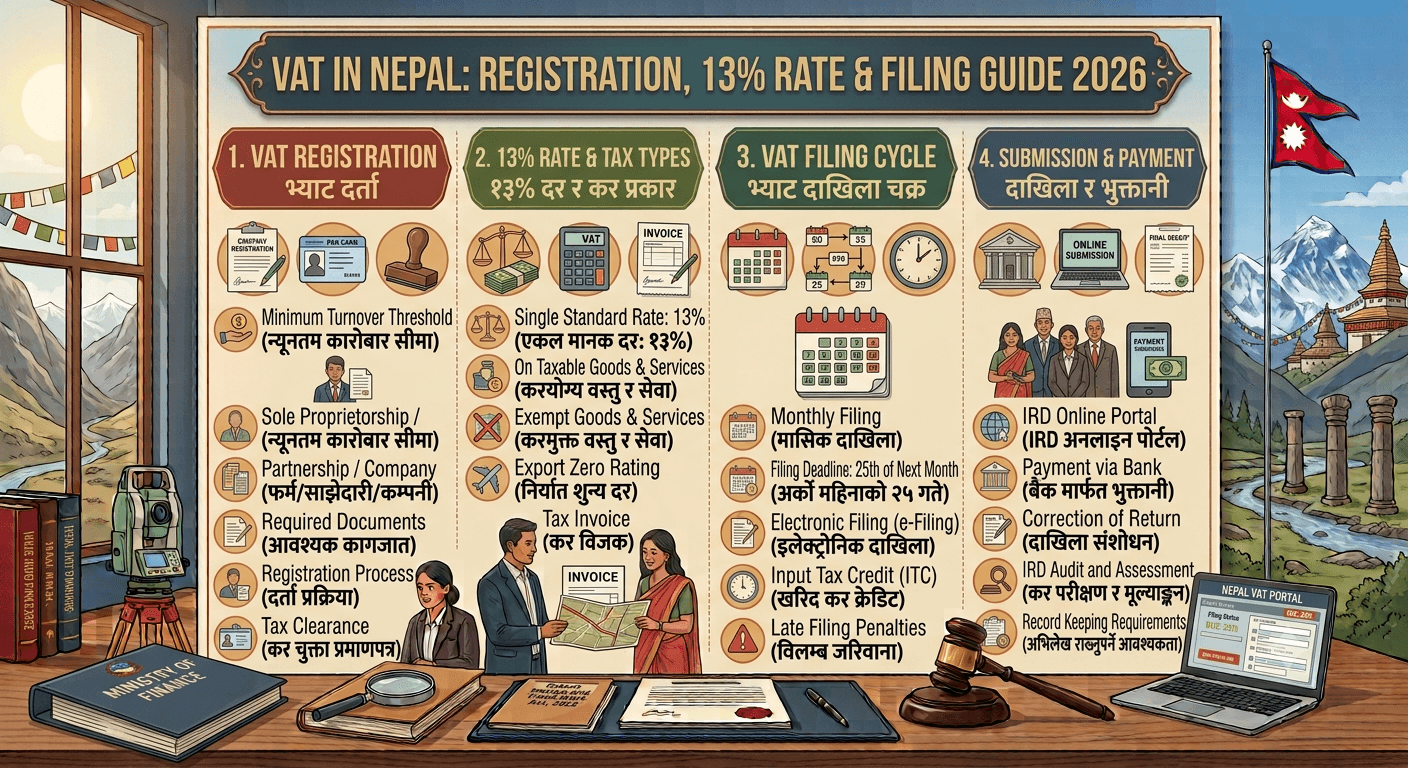
Nepal applies a 13 percent standard VAT rate. The IRD identifies general registration thresholds of NPR 5 million for taxable goods and NPR 1 million for taxable services, while special categories and non-resident digital services require separate checks. Returns are generally due within 25 days after the tax period.
Key facts
- ✓The standard VAT rate in Nepal is 13 percent.
- ✓IRD materials identify general thresholds of NPR 5 million for goods and NPR 1 million for services.
- ✓Exempt supplies and zero-rated supplies have different input-credit consequences.
- ✓VAT returns are generally due within 25 days after the assigned tax period.
- ✓Valid tax invoices and business use are central to input-credit support.
- ✓Imported and non-resident digital services can trigger special VAT rules.
VAT in Nepal
Value added tax is imposed on taxable supplies and imports under the Value Added Tax Act, 2052. A VAT-registered business generally charges output VAT on taxable sales, may claim eligible input VAT supported by valid purchases, and pays the difference after statutory adjustments.
VAT is not a tax on accounting profit. It can create a payment obligation even when a business has made a commercial loss, and a refund or carried-forward credit may require verification.
Quick answer
Nepal's standard VAT rate is 13 percent. The IRD has described general compulsory-registration thresholds of NPR 5 million for taxable goods and NPR 1 million for taxable services, but special businesses, mixed transactions, imports, non-resident digital services and later legal amendments can produce different outcomes. Registered taxpayers generally file the prescribed VAT return within 25 days after the end of their tax period.
Who should register for VAT?
A business should first determine whether its goods or services are taxable, exempt or zero-rated. It should then calculate relevant turnover over the statutory measurement period and check whether a compulsory category applies regardless of the ordinary threshold.
The IRD's published reform materials identify general thresholds of NPR 5 million for goods and NPR 1 million for services. Do not automatically apply the goods threshold to a service or combine mixed supplies without analysis. A person whose taxable activity starts or crosses an applicable threshold should complete registration within the statutory period; the IRD FAQ refers to an application within 30 days in the relevant circumstances.
Voluntary registration can sometimes support input-credit recovery and business-to-business contracting, but it also creates recurring invoice, filing, payment and record obligations. Register only after considering the transaction model.
Taxable, exempt and zero-rated supplies
A taxable supply ordinarily bears VAT at 13 percent. Exempt supplies fall under the statutory exemption schedule and generally do not carry ordinary output VAT; related input-tax recovery can be restricted. Zero-rated supplies are taxable at zero percent under Schedule 2, which is legally different from exemption and can permit input-credit or refund treatment subject to evidence.
Never decide treatment from a marketing label. Classify the actual goods, service, customer, destination, contract and statutory schedule.
How output and input VAT work
Output VAT is tax charged on taxable sales. Input VAT is qualifying tax paid or payable on business purchases and imports. The periodic position starts with output tax minus admissible input credit, followed by adjustments required by law.
An invoice does not guarantee credit. Check supplier registration, invoice form, buyer details, transaction date, business use, payment evidence and restrictions. Personal expenditure, exempt activity, invalid invoices and blocked categories may not produce a valid credit.
VAT invoices and records
Issue the invoice type authorised for the taxpayer and preserve sequential records. Reconcile invoice totals to sales ledgers, inventory, bank receipts and filed returns. Purchase records should identify the supplier PAN, invoice, taxable value, VAT and business purpose.
Credit notes, debit notes, returns, cancellations and bad debts require consistent treatment. Do not delete a transaction from accounting software merely to correct a filed period; retain the audit trail and make the legally appropriate adjustment.
VAT return and payment deadline
The IRD's filing guidance states that a VAT return is generally submitted by the 25th day after the end of the tax period. The assigned period may be monthly or another authorised interval. Payment and return preparation should begin before the deadline so invoice mismatches can be corrected.
A nil return may still be required from a registered taxpayer. Late filing, late payment, missing records and incorrect invoices can lead to fees, interest, additional tax or assessment under the applicable provisions.
Imported and digital services
The VAT Act contains a reverse-charge mechanism for services received from a person outside Nepal. The tax point and credit position should be examined together rather than assuming a foreign invoice is outside VAT.
Non-resident suppliers of taxable digital services to Nepal consumers have a separate registration procedure. The IRD's current procedure identifies a NPR 2 million threshold for relevant non-resident digital services and applies the statutory 13 percent VAT rate. Business-to-business imported services can follow different rules.
VAT registration checklist
- Legal registration and exact business details. - PAN and authorised representative information. - Business address, lease or ownership evidence. - Activity description and expected turnover. - Banking and ownership information where requested. - Contracts, invoices or import evidence supporting the activity. - IRD portal application and verification documents.
Requirements can vary by taxpayer and office. Provide genuine, consistent documents rather than placeholder invoices.
Common VAT mistakes
Frequent problems include registering under the wrong activity, charging VAT before valid registration, treating exemption as zero rating, claiming credit from invalid invoices, missing reverse-charge VAT, filing figures that do not reconcile to accounts, and continuing to use cancelled or suspended suppliers without checking status.
Cancellation and suspension
Stopping business does not automatically end VAT obligations. A registered person seeking cancellation should complete the prescribed process, settle returns and liabilities, and consider stock or asset adjustments. Continue filing until the registration status is formally resolved.
Legal update
This guide was reviewed on 21 July 2026 against official IRD materials. Thresholds, schedules and procedures can change. Confirm the amended VAT Act, rules, Finance Act and current IRD notices before registering or filing.
Common questions
Frequently asked questions
Official sources
Primary materials used for the legal review of this guide.
- 1.Inland Revenue Department - Value Added Tax Act, 2052, English textAccessed July 21, 2026
- 2.Inland Revenue Department - VAT taxpayer FAQsAccessed July 21, 2026
- 3.Inland Revenue Department - VAT on Digital Services ProcedureAccessed July 21, 2026
- 4.Inland Revenue Department - Reform Plan and VAT threshold overviewAccessed July 21, 2026
Professional assistance
Need professional legal assistance?
Get advocate-led guidance tailored to your matter, documents and compliance requirements.
View related legal service →Editorial and legal review
Reviewed by: Wakil Nepal Legal Team
Last reviewed: July 21, 2026
This guide provides general legal information. Procedures and official requirements can change, and case-specific advice may be necessary.