
Table of contents
- 01Notary public services in Nepal
- 02Quick answer
- 03What does notarisation do?
- 04Documents commonly presented to a notary
- 05Documents and information to prepare
- 06Signing and personal appearance
- 07Certified true copies
- 08Notarised translations
- 09What notarisation does not do
- 10Cost and processing time
- 11Practical checklist
- 12Legal update
Quick answer
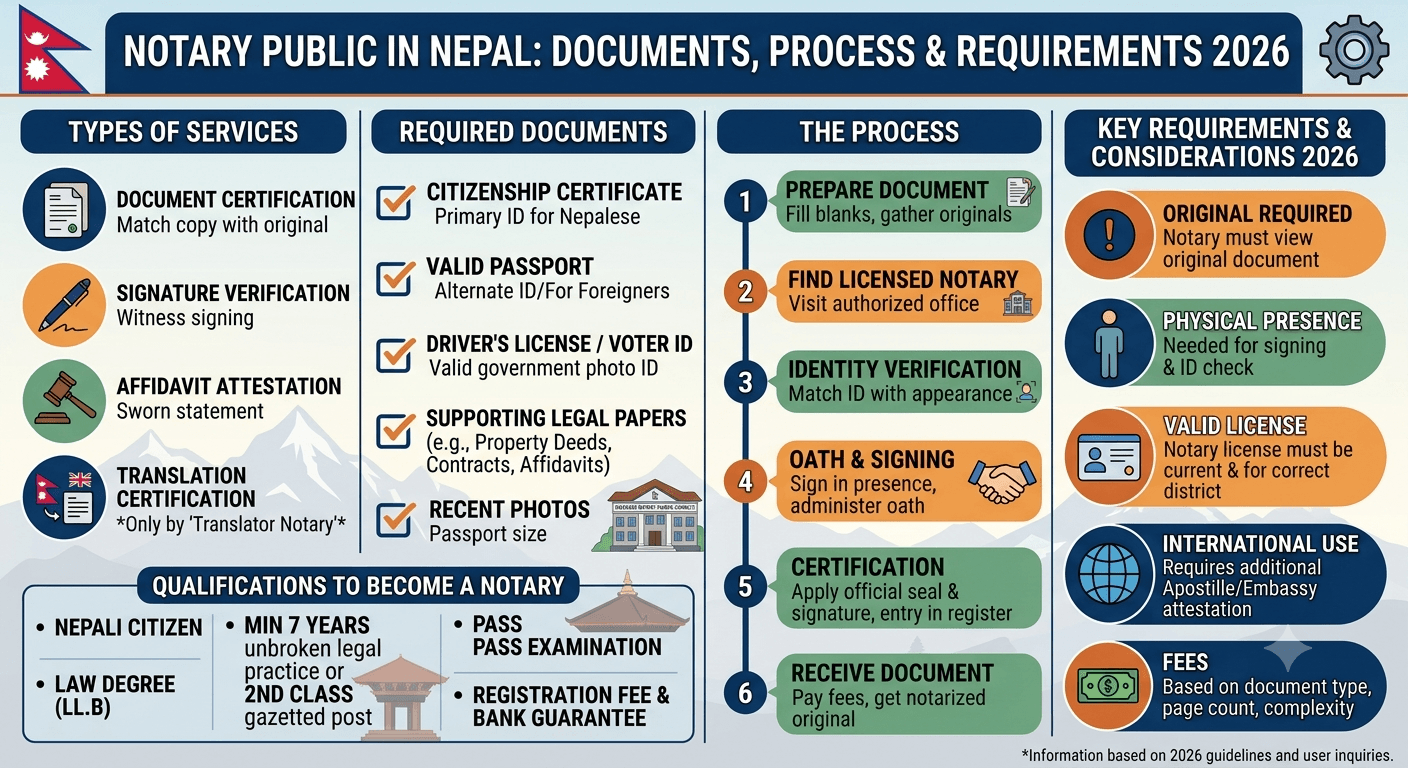
An authorised Nepal notary can certify document execution, copies or translations through the applicable statutory procedure. Bring the final document, originals, identity evidence, authority documents and required witnesses. Notarisation does not replace registration or consular legalisation.
Key facts
- ✓Nepal regulates notaries under the Notary Public Act, 2063.
- ✓Only a properly certificated notary may perform notary-public work.
- ✓Signature, copy and translation certification are different notarial acts.
- ✓Original identification and supporting originals should be reviewed before certification.
- ✓Section 27 provides a statutory certification process involving identity and witnesses.
- ✓Notarisation alone does not guarantee acceptance in Nepal or abroad.
Notary public services in Nepal
Notarisation helps establish who signed a document, whether the signer was properly identified and whether a certified copy or translation follows the applicable notarial procedure. Nepal regulates the profession through the Notary Public Act, 2063 and the Nepal Notary Public Council.
Only a person holding the required certificate under the Act may perform notary-public work. A stamp from an unlicensed person, a lawyer's ordinary office seal or a photocopy labelled "verified" is not automatically a valid notarial act.
Quick answer
To notarise a document in Nepal, first identify the exact notarial act required, prepare the final unsigned document where signature witnessing is needed, bring original identification and supporting originals, and attend before an authorised notary with any witnesses required by law or the transaction. Notarisation does not prove that every statement is true, cure an illegal document or replace registration, consular attestation or embassy legalisation.
What does notarisation do?
The Notary Public Act was enacted to identify the real person signing a document, reduce fraud and forgery, and provide an accessible system for document translation. Depending on the request, a notary may certify execution of an instrument, administer the statutory process for an affidavit, certify a copy against an original, or certify a translation within the notary's authorised scope.
The certificate should be read carefully. Certifying a signature is different from certifying that a copy matches an original, and both are different from confirming a translation. The receiving authority may require one particular act.
Documents commonly presented to a notary
Common examples include: - affidavits and declarations; - general or specific powers of attorney; - consent and authorisation letters; - commercial agreements and acknowledgements; - company resolutions and corporate documents; - copies of citizenship certificates, passports or licences; - academic, employment and civil-status records; - Nepali-English or English-Nepali translations.
Not every document can or should be notarised. Some transactions require registration before a court, land office or another authority; some public records must be verified by the issuing authority; and some documents for foreign use need consular steps beyond notarisation.
Documents and information to prepare
Bring the complete final document, not an incomplete signature page. Carry the signer's original citizenship certificate, passport or other accepted identification. If the document refers to another record, bring the supporting original. A company representative should bring evidence of incorporation and signing authority, such as a board decision or delegation.
Section 27 of the Notary Public Act sets a certification procedure that includes an application and, in the statutory circumstances, two identifying witnesses with their identity documents. The exact witnesses and appearance requirements should be confirmed before the appointment because the document and current rules matter.
Names, dates of birth, document numbers and addresses should match across the instrument and identification. Resolve a spelling discrepancy before certification instead of asking the notary to overlook it.
Signing and personal appearance
If the notary must witness or confirm execution, do not sign the document prematurely. The signer should appear, establish identity, understand the document and sign or acknowledge it through the required procedure. A representative must show valid authority.
A notary should not certify blank pages, incomplete documents, suspicious alterations, an absent signer's signature or a transaction outside the notary's authority. Do not use correction fluid or replace pages after certification.
Certified true copies
For a certified copy, present the original and a clear complete copy. The notary compares them and certifies only the copy covered by the certificate. Notarisation of a copy does not make the underlying original genuine if it was forged, cancelled or issued without authority.
Some receiving bodies insist on a fresh original or a copy verified by the issuing institution. The Department of Consular Services, for example, requires appropriate issuing-authority verification and states that it does not attest a document merely because a notary certified it.
Notarised translations
Section 28 of the Act regulates document translation and requires the notary to examine whether the document is authentic before translating and certifying it. Translation must preserve names, dates, numbers, seals, qualifications and material layout accurately.
A notarised translation does not replace the source document. Submit both unless the receiving authority expressly says otherwise. Ask whether transliteration, bilingual formatting, sealed envelopes or translation by a specifically listed professional is required.
What notarisation does not do
Notarisation does not automatically: - make an unlawful contract enforceable; - transfer land or register a transaction; - prove the truth of every factual statement; - confirm that a public authority issued the underlying record; - provide consular legalisation for foreign use; - create an apostille; or - guarantee acceptance by an embassy, university, bank or government office.
The destination authority determines what it will accept. Obtain its written checklist before spending money on unnecessary steps.
Cost and processing time
Notary charges can depend on the act, pages, signers, copies, drafting, translation and urgency. Government, issuing-authority, consular, embassy and courier fees are separate. Ask for a written breakdown rather than assuming one stamp covers the full legalisation chain.
Straightforward work may be completed promptly when documents, identities and witnesses are ready, but no timeline should be promised before review.
Practical checklist
- Identify the receiving authority and purpose. - Confirm whether signature, copy or translation certification is required. - Bring final documents, originals and valid identification. - Confirm witnesses and representative authority in advance. - Keep every certified page together and unaltered. - Check whether registration or consular legalisation must follow.
Legal update
This guide was reviewed on 21 July 2026 against the Notary Public Act and official consular guidance. Requirements may vary by document and receiving authority. Obtain a destination-specific checklist before proceeding.
Common questions
Frequently asked questions
Official sources
Primary materials used for the legal review of this guide.
- 1.Nepal Law Commission - Notary Public Act, 2063Accessed July 21, 2026
- 2.Nepal Law Commission Repository - Notary Public Act, certification and translation procedureAccessed July 21, 2026
- 3.Department of Consular Services - Document Attestation FAQsAccessed July 21, 2026
Professional assistance
Need professional legal assistance?
Get advocate-led guidance tailored to your matter, documents and compliance requirements.
View related legal service →Editorial and legal review
Reviewed by: Wakil Nepal Legal Team
Last reviewed: July 21, 2026
This guide provides general legal information. Procedures and official requirements can change, and case-specific advice may be necessary.