
Table of contents
- 01Trademark registration in Nepal
- 02Quick answer
- 031. Identify the correct trademark owner
- 042. Choose what to register
- 053. Conduct a clearance search
- 064. Select the correct classes
- 075. Prepare the documents
- 086. File with the Department of Industry
- 097. Department examination
- 108. Publication and objection
- 119. Registration fee and certificate
- 12How long does registration take?
- 13Validity, use and renewal
- 14Foreign trademarks
- 15Common mistakes
- 16Legal update
Quick answer
Trademark registration in Nepal requires the correct owner, a similarity search, separate applications for relevant classes, four specimens, business and tax documents, DOI examination, publication, a 35-day objection stage, payment and a certificate. Registration lasts seven years and can be renewed.
Key facts
- ✓Statutory trademark title in Nepal is acquired through DOI registration.
- ✓Different goods or services classes require separate applications.
- ✓The DOI checklist requires four mark specimens and business-registration evidence.
- ✓The statutory complaint period after publication is 35 days, not 90 days.
- ✓Registration lasts seven years and is renewable for further seven-year periods.
- ✓Foreign registration or a Madrid registration does not automatically protect a mark in Nepal.
Trademark registration in Nepal
A trademark identifies the commercial source of goods or services. It may consist of a word, name, label, logo, symbol or combination capable of distinguishing one business from another. In Nepal, trademark registration is administered by the Department of Industry under the Patent, Design and Trade Mark Act, 2022 (1965).
Section 16 of the Act links statutory title to registration in Nepal. Registering a company name, domain name or social-media handle does not by itself register that name as a trademark.
Quick answer
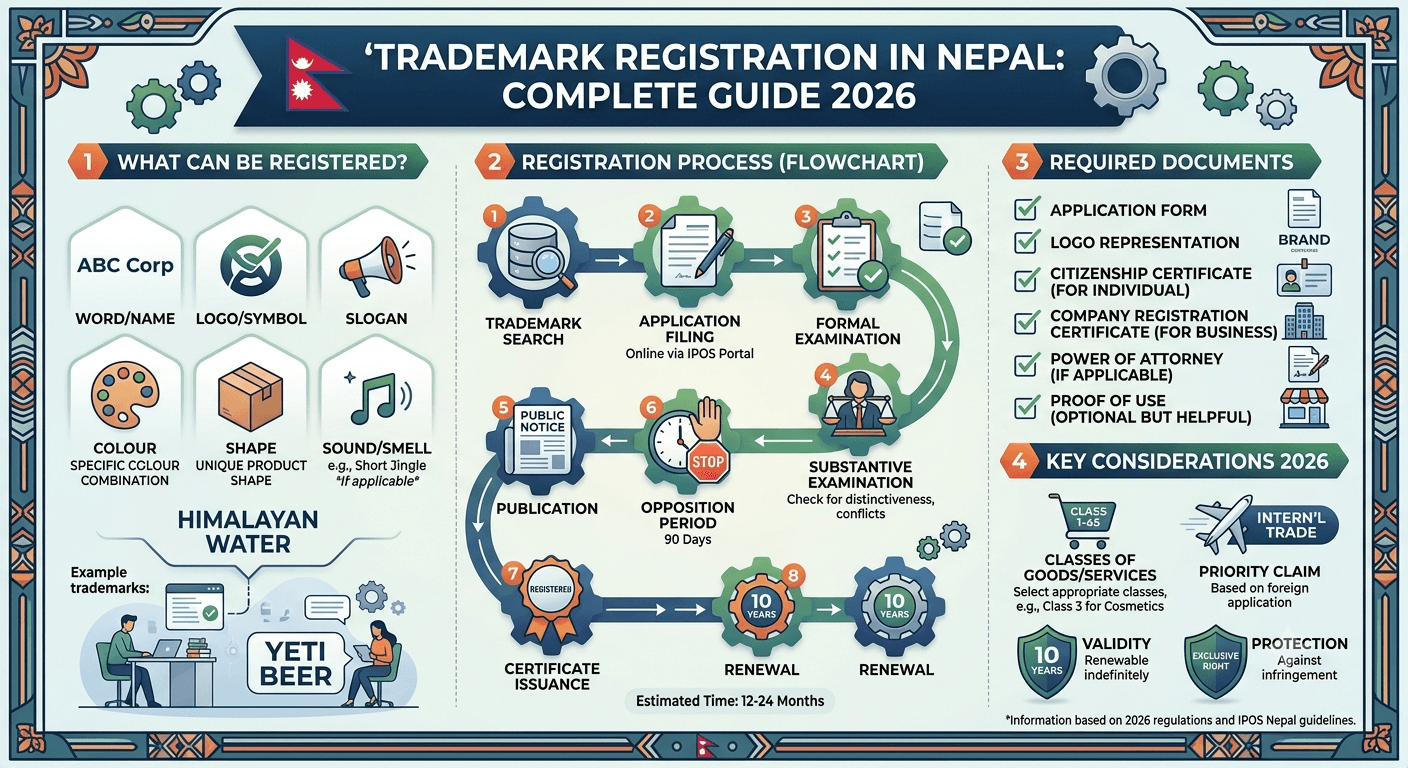
To register a trademark in Nepal, confirm the correct owner, search for identical and confusingly similar marks, select every relevant goods or services class, prepare four compliant specimens and the applicant's business and tax documents, file separate applications where different classes are involved, respond to Department examination, complete publication and the 35-day objection stage, pay the registration fee and obtain the certificate.
1. Identify the correct trademark owner
File in the name of the person or legal entity that genuinely owns and controls the brand. A founder, company, distributor and manufacturer are different legal persons. Filing in a director's personal name when the company owns the business can create assignment, investment and enforcement problems later.
Before filing, confirm ownership of the logo artwork, brand name and packaging. Obtain written assignments from designers, agencies, employees or collaborators where necessary.
2. Choose what to register
A word mark protects the verbal element independently of one stylisation, while a device or composite mark protects the filed visual representation. A business may need separate applications for its core name and logo.
File the mark actually intended for use. Avoid unnecessary taglines, addresses or temporary design features that may change. Do not add the registered symbol before registration.
3. Conduct a clearance search
A search should cover identical and confusingly similar words, spellings, pronunciations, translations and visual elements in relevant and related classes. Search the complete mark and its dominant components.
A company-name approval or internet search is not a DOI trademark clearance. Search results are risk analysis, not a guarantee of registration. Earlier applications, reputation, public interest and statutory objections can still affect the outcome.
4. Select the correct classes
Section 18A permits classification of goods and services and requires separate applications for marks falling in different classes. Protection is tied to the specification filed, so a broad business description is not enough.
List the actual goods or services in clear commercial language. Include planned near-term expansion where defensible, but avoid unrelated classes without a genuine strategy. If the same mark covers clothing, retail and software services, multiple applications may be needed.
5. Prepare the documents
The Department's current Industrial Property Section checklist for a domestic application includes: - completed application; - business or industry operating-registration evidence; - PAN or VAT registration evidence; - four trademark specimens, generally not exceeding 8 by 8 centimetres; - details of the goods or services and applicant; - government-fee receipt; and - Power of Attorney where a representative is appointed.
The specimen, owner name, address and goods/services should match across every page. Corporate applicants should keep authority evidence for the signer.
6. File with the Department of Industry
Section 17 requires the prescribed application and four specimens. Obtain dated filing evidence and maintain a docket showing the mark, owner, class, filing number, correspondence and deadlines.
Different classes generally require separate applications and fees. Do not assume a single payment protects the brand across all activities.
7. Department examination
The Department examines the application and may seek clarification or object. Under section 18, a mark may be refused where it harms the prestige of a person or institution, adversely affects public conduct or morality, undermines national interest or another mark's reputation, or is already registered in another person's name.
Respond to the actual objection with legal submissions, search evidence, amendments where permissible and honest information about use. Silence or inconsistent responses can delay or defeat the file.
8. Publication and objection
Section 21A requires publication of registered marks and allows a person to file a complaint within 35 days from publication. This statutory period is not 90 days.
Monitor the relevant Industrial Property Bulletin and preserve the publication details. If an objection is filed, the Department investigates and the parties may need evidence on ownership, similarity, use, reputation and market overlap.
9. Registration fee and certificate
After the applicable acceptance and publication stages, pay the registration amount required by the Department and obtain the certificate. Check that the owner, representation, class, goods/services and dates are accurate.
The DOI citizen charter available in July 2026 lists NPR 1,000 as the domestic application fee and NPR 5,000 as the registration fee. However, an English Act PDF hosted by DOI displays NPR 2,000 as the application amount in its schedule. Because official materials are inconsistent and section 26A permits fee changes by Gazette notice, confirm the current revenue amount and heading immediately before payment.
How long does registration take?
The law does not guarantee one universal completion time. Search quality, Department backlog, examination objections, publication timing, opposition and document corrections affect duration. Treat fixed online promises such as "guaranteed in 30 days" or "always 12 months" cautiously.
The filing receipt is not a registration certificate. Use pending status accurately until registration is complete.
Validity, use and renewal
Section 18D gives a registered trademark a seven-year term from registration. Section 23B permits repeated renewal for further seven-year periods. The Act sets a 35-day ordinary renewal window after expiry and a further six-month late period with the applicable fine, after which registration is automatically cancelled if not renewed.
Section 18C requires the registered mark to be brought into use within one year and permits inquiry and cancellation for non-use. Keep dated invoices, packaging, advertising, website captures, distribution agreements and customer records showing genuine use of the mark as registered.
Foreign trademarks
Section 21B states that foreign registration is not valid in Nepal unless the mark is registered in Nepal. Foreign applicants generally need a current home-registration certificate, Power of Attorney, Nepal address for service and certified or legalised documents under current DOI practice.
Nepal is not listed as a Madrid System member in WIPO's current member information, so a Madrid designation does not replace a national Nepal application.
Common mistakes
- Filing in the wrong owner's name. - Launching before a similarity search. - Selecting the wrong class or vague specification. - Assuming company registration protects the brand. - Treating the application receipt as registration. - Missing Department correspondence or publication monitoring. - Changing the logo after filing without a new strategy. - Failing to use the mark within one year. - Missing renewal, assignment or address recordals.
Legal update
This guide was reviewed on 21 July 2026. Fees, forms, portal practice and bulletin procedures may change. Verify the current Department checklist and revenue instruction before filing.
Common questions
Frequently asked questions
Official sources
Primary materials used for the legal review of this guide.
- 1.Department of Industry - Patent, Design and Trade Mark Act, English textAccessed July 21, 2026
- 2.Nepal Law Commission - Patent, Design and Trade Mark Act, 2022Accessed July 21, 2026
- 3.Department of Industry - Citizen CharterAccessed July 21, 2026
- 4.Department of Industry - Industrial Property Section checklistsAccessed July 21, 2026
Professional assistance
Need professional legal assistance?
Get advocate-led guidance tailored to your matter, documents and compliance requirements.
View related legal service →Editorial and legal review
Reviewed by: Wakil Nepal Legal Team
Last reviewed: July 21, 2026
This guide provides general legal information. Procedures and official requirements can change, and case-specific advice may be necessary.