
Table of contents
- 01TDS in Nepal
- 02Quick answer
- 03Who is responsible for TDS?
- 04Payments commonly requiring review
- 05How to choose the correct rate
- 06When to deduct
- 07e-TDS filing deadline
- 08e-TDS workflow
- 09TDS certificates and recipient credits
- 10Corrections and late compliance
- 11Non-resident payments and treaties
- 12Monthly control checklist
- 13Legal update
Quick answer
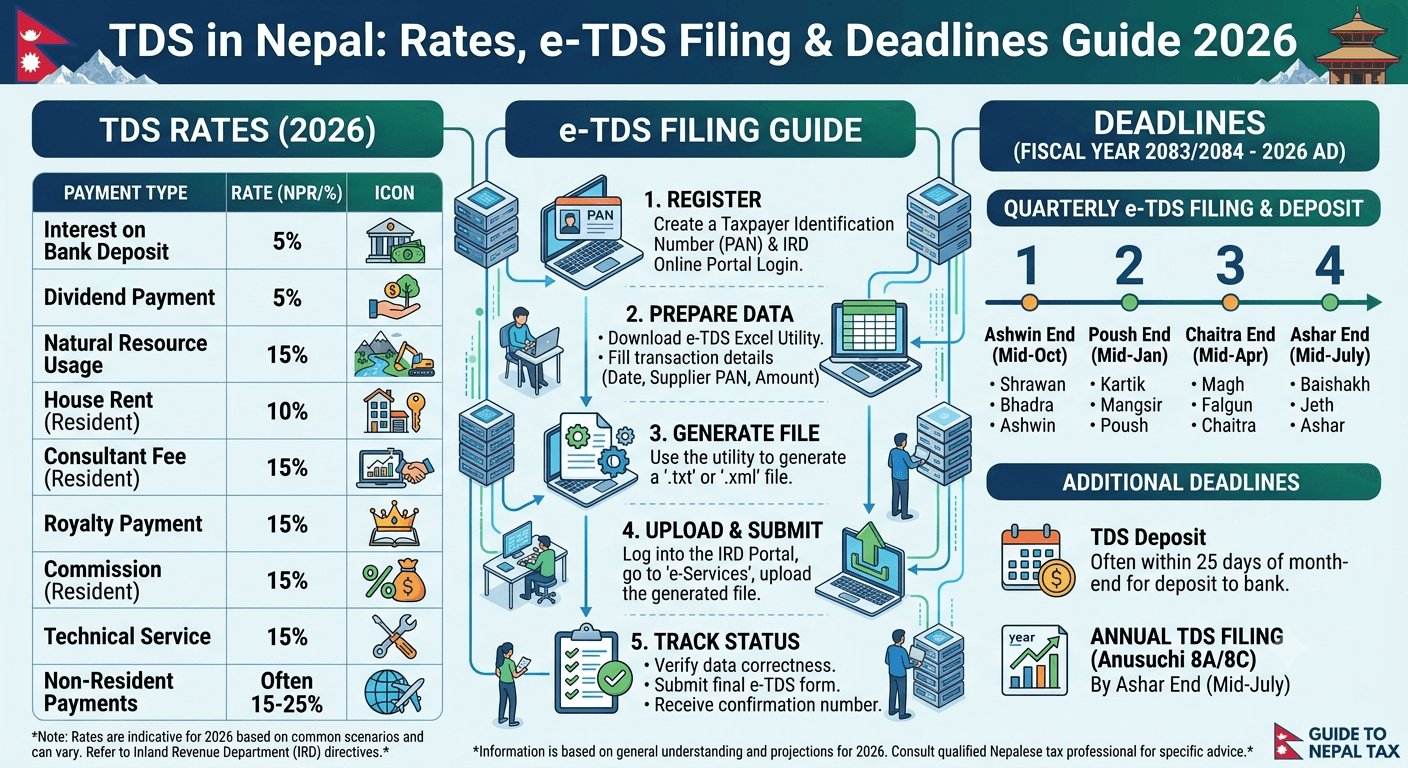
TDS in Nepal requires a payer to classify covered payments, deduct the applicable tax, deposit it for the recipient, file and verify e-TDS, and retain proof. IRD guidance generally sets the deadline within 25 days after the end of the payment month.
Key facts
- ✓TDS is deducted by the payer from payments covered by Chapter 17 of the Income Tax Act.
- ✓The correct rate depends on payment type, residence, PAN, VAT status and current law.
- ✓IRD guidance generally requires deposit and e-TDS filing within 25 days after month-end.
- ✓A submitted return should be verified and reconciled to the bank voucher and ledger.
- ✓Correct recipient PAN details are essential for tax-credit visibility.
- ✓Non-resident payments require domestic-law, treaty and remittance analysis.
TDS in Nepal
Tax deducted at source, also called advance tax withholding, is a collection mechanism under Chapter 17 of the Income Tax Act, 2058. The payer deducts the prescribed tax from a covered payment, deposits it for the recipient and reports the transaction through e-TDS.
TDS is not one universal rate. The correct treatment depends on the payment, payer, recipient, residence, VAT registration, contractual relationship and current Finance Act. The recipient may receive a tax credit, or the withholding may be final, depending on the statutory category.
Quick answer
A person making a covered payment should determine the payment category and recipient status before payment, deduct the correct amount, deposit it under the correct revenue details, file and verify e-TDS, and provide evidence to the recipient. The IRD generally requires the amount and details within 25 days after the end of the month in which the payment was made.
Who is responsible for TDS?
The person making a payment covered by the withholding provisions is responsible for deduction. This can include companies, partnerships, employers, institutions and other prescribed payers. Tax-exempt status of the payer does not necessarily remove its withholding duties.
The contract should state whether an amount is tax-inclusive or tax-exclusive, but private wording cannot override a statutory duty. A gross-up clause changes the economics between parties; it does not erase the obligation to deduct and deposit.
Payments commonly requiring review
Review withholding before processing: - salary and employment benefits; - service and professional fees; - interest, royalties and natural-resource payments; - rent and equipment hire; - commission and sales bonuses; - contract and works payments; - dividends and investment returns; - payments to non-residents; - retirement payments and casual gains.
This is not a complete list. A payment described as reimbursement can still contain a service or benefit component, while a genuine pass-through cost supported by evidence may require different analysis.
How to choose the correct rate
Begin with the current consolidated Income Tax Act and Finance Act. Identify the statutory section, then verify the recipient's residence, PAN, VAT status and whether the payment is final withholding.
The consolidated Act illustrates why classification matters: it provides a general 15 percent rule for several categories such as interest, royalty, service charge and commission, while specified exceptions include 1.5 percent for certain service fees paid to resident VAT-registered providers and 10 percent for specified rent. These are not a substitute for a current rate check. Employment, contracts, securities, insurance, non-residents, treaty cases and special recipients can follow different rules.
Use a documented rate matrix approved for the current income year. Record the legal basis and update it whenever the Finance Act changes.
When to deduct
Withholding can be triggered when a covered payment is made or when the expenditure is accounted for, depending on the provision and facts. Do not postpone review until bank payment if the liability has already been recognised.
For each voucher, preserve the invoice, contract, PAN, residency evidence, tax calculation, approval and payment proof. For non-residents, add treaty, beneficial-ownership, permanent-establishment and foreign-remittance documents where relevant.
e-TDS filing deadline
The IRD states that deducted tax and the related details should generally be deposited and filed within 25 days after the end of the month of payment. The filer uses the IRD taxpayer portal and should complete verification rather than leaving a return only in draft or submission status.
Match the voucher date, income year, period, recipient PAN, payment code, gross amount, rate, withheld amount, bank voucher and revenue heading. A wrong PAN can prevent the recipient from seeing or claiming the credit.
e-TDS workflow
1. Close the monthly payment register. 2. Separate covered and non-covered payments. 3. Verify recipients and tax classifications. 4. Calculate withholding and reconcile to the ledger. 5. Deposit tax under the correct details. 6. Upload or enter the e-TDS schedule. 7. Verify the filing and retain its acknowledgement. 8. Reconcile recipient credits and issue certificates.
TDS certificates and recipient credits
The payer should provide evidence showing the recipient, gross payment, tax deducted, period and deposit. The recipient should compare it to the IRD account and follow up on missing or incorrect credits promptly.
A payer's expense and the recipient's credit can both be affected by non-compliance. Contracts should allocate responsibility for PAN information, certificates, corrections and tax gross-up clearly.
Corrections and late compliance
Do not file a second unrelated entry merely to conceal an incorrect one. Identify whether the error concerns the recipient, amount, period, payment type, voucher or rate, then follow the IRD correction process with supporting evidence.
Late deduction, deposit or filing can create interest, fees, assessment exposure and disputes with recipients. Obtain the taxpayer ledger and reconcile all months before applying for tax clearance.
Non-resident payments and treaties
Payments abroad need enhanced review. Nepal-source rules, domestic withholding, the applicable double-tax treaty, beneficial ownership, permanent establishment, service location, royalties and remittance documents can change the result.
A treaty rate is not automatic. Confirm treaty residence, the relevant article, limitations and required evidence before payment. Coordinate the tax position with the bank and regulator documentation needed for remittance.
Monthly control checklist
- No payment is released without PAN and classification checks. - The approved current-year rate matrix is used. - Ledger expenses reconcile to the TDS schedule. - Bank deposits reconcile to withheld amounts. - e-TDS is verified within the deadline. - Certificates and recipient corrections are tracked. - Non-resident files contain treaty and remittance support.
Legal update
This guide was reviewed on 21 July 2026. Rate examples explain the statutory structure and are not a complete current-year rate table. Confirm the applicable Finance Act, consolidated Income Tax Act, treaty and IRD notices before deduction.
Common questions
Frequently asked questions
Official sources
Primary materials used for the legal review of this guide.
- 1.Inland Revenue Department - Income Tax Act, 2058, amended through Finance Act 2082Accessed July 21, 2026
- 2.Inland Revenue Department - Income Tax Act, English consolidated textAccessed July 21, 2026
- 3.Inland Revenue Department - TDS FAQsAccessed July 21, 2026
- 4.Inland Revenue Department - General taxpayer FAQ and payment deadlinesAccessed July 21, 2026
Professional assistance
Need professional legal assistance?
Get advocate-led guidance tailored to your matter, documents and compliance requirements.
View related legal service →Editorial and legal review
Reviewed by: Wakil Nepal Legal Team
Last reviewed: July 21, 2026
This guide provides general legal information. Procedures and official requirements can change, and case-specific advice may be necessary.