
Table of contents
- 01Document legalisation in Nepal
- 02Quick answer
- 03Nepal apostille status
- 04Step 1: Ask the receiving authority
- 05Step 2: Obtain the proper document
- 06Step 3: Complete issuing-authority verification
- 07Step 4: Department of Consular Services attestation
- 08Step 5: Destination-country legalisation
- 09Foreign documents for use in Nepal
- 10Notarised documents and translations
- 11Common documents legalised for overseas use
- 12Common mistakes
- 13Legal update
Quick answer
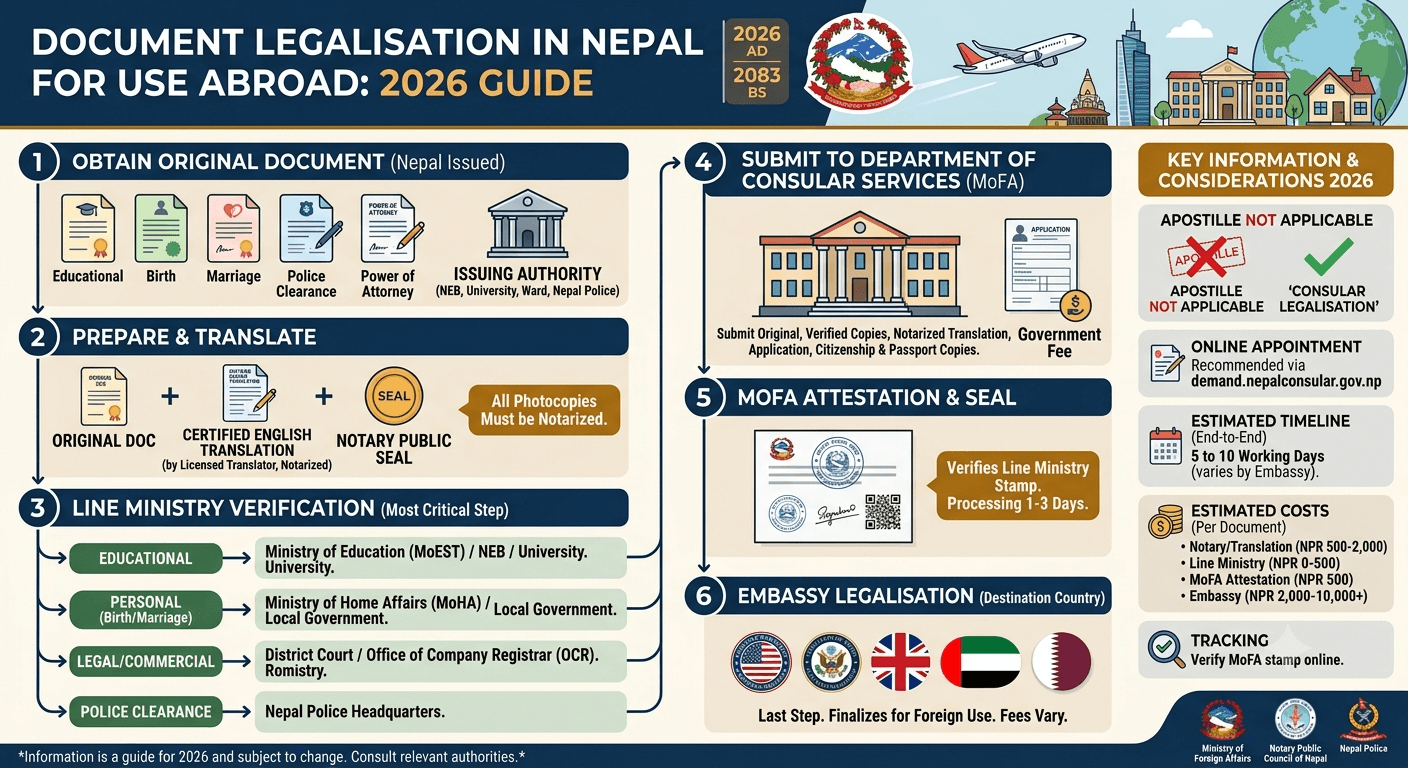
Legalising a Nepali document for overseas use generally starts with the correct original and verification by its issuing or designated authority, followed where required by Department of Consular Services attestation and destination-country embassy legalisation. Nepal does not currently issue apostilles.
Key facts
- ✓The receiving authority determines the exact legalisation chain.
- ✓Notarisation and governmental consular attestation are different acts.
- ✓The Department requires document-specific issuing-authority verification.
- ✓Its current FAQ lists NPR 500 per document and same-day processing guidance for eligible complete files.
- ✓The Department says notarised documents alone are not accepted for its attestation.
- ✓Nepal is not currently a contracting party to the Apostille Convention.
Document legalisation in Nepal
Document legalisation is a chain of authentication used to help a document issued in one country be accepted in another. The correct chain depends on the document, issuing authority, destination country and receiving institution. Notarisation, issuing-authority verification, consular attestation and embassy legalisation are separate steps.
Quick answer
For a Nepali document intended for use abroad, first obtain the correct original and verification from the issuing or designated authority. Then complete Department of Consular Services attestation where required and follow the destination country's embassy or consular instructions. Nepal is not listed as a contracting party to the Apostille Convention as of the HCCH status table updated 30 June 2026, so Nepal does not currently issue apostilles.
Nepal apostille status
An apostille is a simplified certificate used between contracting parties to the 1961 Hague Apostille Convention. It is not a generic synonym for notarisation or attestation.
The official HCCH status table, updated 30 June 2026, lists 130 contracting parties and does not list Nepal. Therefore, a claim that Nepal's Ministry of Foreign Affairs issues a Nepal apostille is incorrect as of this review. A foreign authority may still issue an apostille for a document originating in its own contracting jurisdiction, but that does not turn Nepal into a Convention party or automatically settle acceptance in Nepal.
Step 1: Ask the receiving authority
Obtain a written checklist from the embassy, university, employer, bank, regulator, court or registry receiving the document. Ask: - must it be an original or certified copy? - how recently must it have been issued? - which authority must verify it first? - is translation required and by whom? - is Department attestation required? - is destination-embassy legalisation required? - must the document remain sealed?
Destination-first checking prevents completing the wrong chain.
Step 2: Obtain the proper document
Use a fresh original from the authorised issuing office where required. Local civil records should follow the official format and be verified by the designated municipal official. Photocopies, scans and laminated records may be unsuitable unless the authority specifically accepts them.
Names, dates and identification details should be consistent. If records differ, resolve the discrepancy through the proper issuing authority instead of changing a translation.
Step 3: Complete issuing-authority verification
The Department of Consular Services identifies different prior authorities for different records. Its current guidance includes: - local civil records: relevant municipality or designated official; - bank or financial records: Nepal Rastra Bank; - medical records: Department of Health Services; - academic records: the applicable education authority; - company-record copies: Office of the Company Registrar; - commercial origin records: the relevant commerce authority.
The precise route can change and document-specific instructions prevail.
Step 4: Department of Consular Services attestation
The Department states that consular legalisation or attestation for documents submitted abroad is performed at Tripureshwor, Kathmandu. Its FAQ published a fee of NPR 500 per document and an average service time of approximately 30 to 40 minutes after payment for a complete eligible submission. The citizen charter also describes same-day service for listed documents.
Treat the fee and timing as official published guidance, not a guarantee. Verify the current fee, submission hours, original-document rules and holiday schedule before attending.
The Department expressly says it does not attest a document merely because a notary public certified it. It accepts authentication performed through appropriate Nepal or foreign government and diplomatic channels.
Step 5: Destination-country legalisation
After Nepal-side attestation, the destination country's embassy or consulate may require a further legalisation step. Some institutions waive it or impose their own verification portal. Confirm the order: doing embassy work before the required Nepal authority can lead to rejection.
Embassy charges, appointments, translations, copies and processing times are separate from the Department fee.
Foreign documents for use in Nepal
The Department states that an original issued by a foreign government may be presented after attestation or legalisation by the Nepali mission in that country or the foreign country's mission in Nepal. If there is no resident mission, an accredited mission may be relevant.
Foreign academic records may additionally require verification by the issuing-country authority, diplomatic attestation and an equivalence certificate from the education authority in Nepal. Company, court, civil-status and power-of-attorney documents require purpose-specific checking.
Notarised documents and translations
Notarisation may be useful for a private instrument, copy or translation but is not a substitute for governmental authentication of a public record. Where a translation is required, keep it attached to the verified source in the manner requested by the destination authority.
Do not translate or alter a seal, number or qualification inaccurately. Transliteration of names should match passports and prior records.
Common documents legalised for overseas use
- birth, marriage, death and divorce records; - relationship and marital-status certificates; - police and character records; - school, university and professional qualifications; - medical and health certificates; - bank and financial records; - company certificates and commercial documents; - powers of attorney, consents and authorisations; - court and administrative records.
Each category can have a different preliminary authority.
Common mistakes
Avoid relying on an internet checklist for another country, requesting a Nepal apostille, presenting only a notarised copy to the Department, skipping issuing-authority verification, using an expired record, translating inconsistent names, separating attached pages, or paying embassy fees before confirming sequence.
Legal update
This guide was reviewed on 21 July 2026 against Department of Consular Services and HCCH primary materials. Consular and embassy processes change frequently. Reconfirm the destination checklist and Nepal's Convention status before submission.
Common questions
Frequently asked questions
Official sources
Primary materials used for the legal review of this guide.
- 1.Department of Consular Services - Document Attestation FAQsAccessed July 21, 2026
- 2.Department of Consular Services - Consular Authentication requirementsAccessed July 21, 2026
- 3.HCCH - Apostille Convention status tableAccessed July 21, 2026
- 4.Department of Consular Services - New formats for local documentsAccessed July 21, 2026
Professional assistance
Need professional legal assistance?
Get advocate-led guidance tailored to your matter, documents and compliance requirements.
View related legal service →Editorial and legal review
Reviewed by: Wakil Nepal Legal Team
Last reviewed: July 21, 2026
This guide provides general legal information. Procedures and official requirements can change, and case-specific advice may be necessary.