
Table of contents
- 01Trademark protection after filing in Nepal
- 02Quick answer
- 03Publication and the 35-day complaint period
- 04Preparing or defending a complaint
- 05Seven-year registration term
- 06Renewal deadline and documents
- 07One-year use requirement
- 08Assignment and authorised use
- 09Foreign trademarks in Nepal
- 10Is Nepal part of the Madrid System?
- 11Priority claims
- 12Monitoring and enforcement
- 13Portfolio calendar
- 14Common mistakes
- 15Legal update
Quick answer
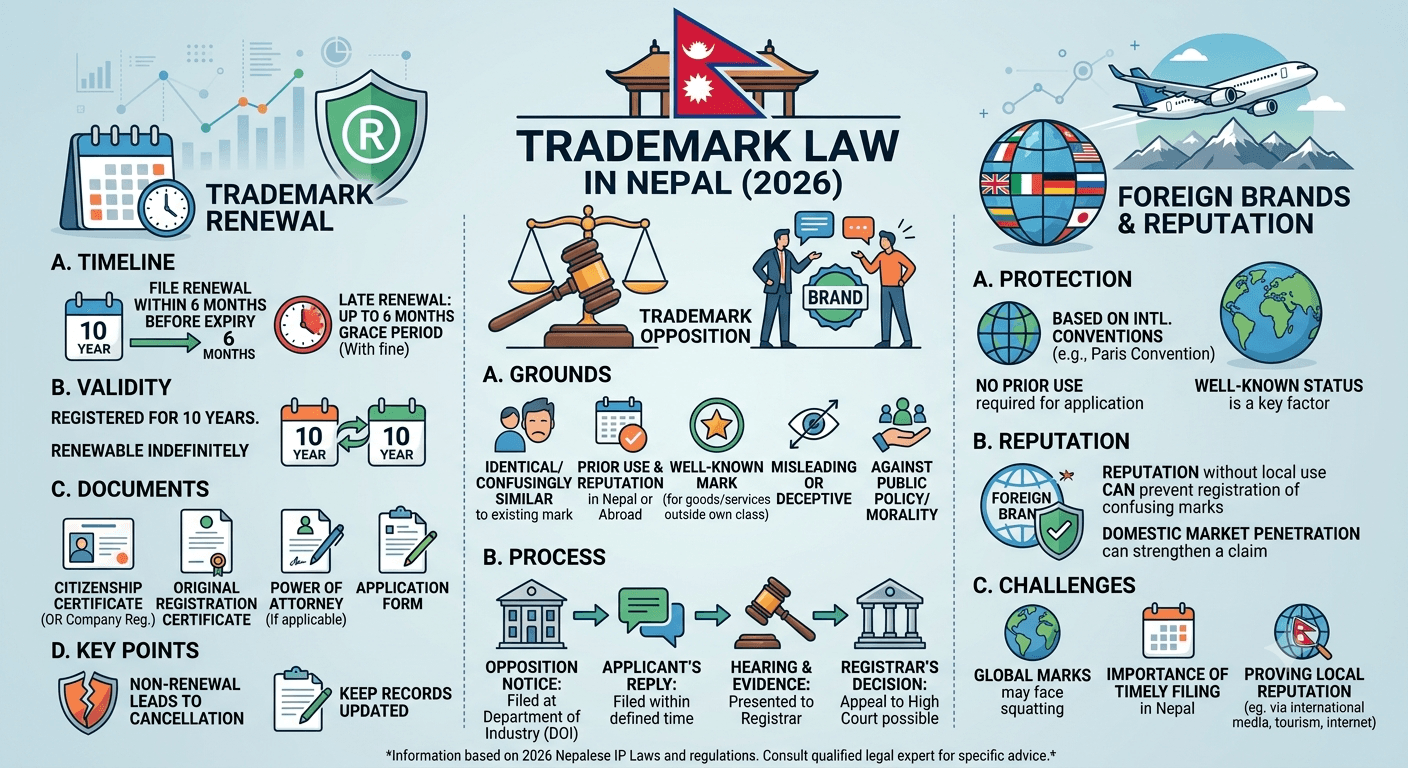
A Nepal trademark lasts seven years from registration and can be renewed repeatedly. Renewal is ordinarily due within 35 days after expiry, with a six-month late route. Published marks face a 35-day complaint period, and foreign registration alone does not protect the mark in Nepal.
Key facts
- ✓Trademark publication complaints must be filed within 35 days.
- ✓A Nepal trademark registration lasts seven years from registration.
- ✓Renewal is available repeatedly for further seven-year periods.
- ✓The Act provides a 35-day renewal window and a six-month late period.
- ✓A registered mark should be brought into use within one year.
- ✓Foreign and Madrid registrations do not automatically create protection in Nepal.
Trademark protection after filing in Nepal
Trademark work continues after an application is submitted. Owners must monitor publication, answer complaints, use the mark, renew every seven years, record ownership changes and act consistently against confusing use.
Foreign owners face an additional territorial rule: registration abroad does not itself create trademark title in Nepal.
Quick answer
A registered Nepal trademark lasts seven years from registration and may be renewed repeatedly for seven-year periods. Renewal is ordinarily due within 35 days after expiry, with a further six-month late period and fine. Published particulars can be challenged within 35 days. Use the registered mark within one year, retain proof, monitor conflicts and record assignments or authorised use with DOI.
Publication and the 35-day complaint period
Section 21A requires DOI to publish registered trademark particulars, renewals and cancellations for public information. A person may file a complaint within 35 days from publication, after which DOI investigates.
Owners should monitor the Industrial Property Bulletin for their own mark and potentially conflicting marks. Record the publication date and calculate deadlines immediately. Do not confuse this statutory 35-day period with longer opposition periods used in other countries.
Preparing or defending a complaint
Useful evidence can include: - registration and filing records; - adoption and first-use chronology; - invoices, packaging, advertising and market reach; - consumer base and trade channels; - visual, phonetic and conceptual comparisons; - correspondence showing knowledge or copying; - ownership and assignment documents; - reputation and confusion evidence.
A complaint should identify the legal and factual conflict, not merely state that two marks share a word. A response should address the dominant elements, goods/services, consumers and market context.
Seven-year registration term
Section 18D provides a seven-year term from the date of registration. The registration date on the certificate controls; do not calculate automatically from filing unless the official record says so.
Section 23B allows a trademark to be renewed any number of times for further seven-year periods. Build reminders well before expiry and verify the DOI record, owner name, address and classes before preparing renewal.
Renewal deadline and documents
The Act provides an ordinary renewal period of 35 days after expiry and permits late renewal within a further six months with the statutory fine. If it is not renewed within that route, registration is automatically cancelled.
The current DOI checklist requests the renewal application, original registration certificate, fee receipt, renewed business or industry evidence, tax-clearance evidence in the citizen charter, and proof that the trademark remains in use. Requirements and fees should be verified before submission.
The 2026 citizen charter lists NPR 3,500 within 35 days after expiry and NPR 4,500 from day 36 through the six-month late period. Confirm the current Gazette fee and revenue heading immediately before payment.
One-year use requirement
Section 18C provides that if a registered mark is not brought into use within one year from registration, DOI shall inquire and cancel the registration. Owners should retain dated and mark-specific evidence from launch.
Useful evidence includes invoices, product labels, packaging, advertising, catalogues, website archives, app listings, distributor agreements, customs documents, tax records and photographs showing the mark on the relevant goods or services.
Use should correspond to the registered mark and covered specification. If the brand is materially redesigned or expands to new classes, consider additional filings.
Assignment and authorised use
Section 21D permits ownership transfer or written approval for use, with a joint application and prescribed fee for DOI recordal. A private assignment or licence should clearly address the mark, classes, territory, quality control, consideration, enforcement and termination.
Record changes in owner name, address, merger, assignment or licence as required. An outdated register can obstruct renewal, enforcement, due diligence and transactions.
Foreign trademarks in Nepal
Section 21B states that title to a trademark registered abroad is not valid in Nepal unless registered here. Section 21C addresses registration of foreign marks and Paris Convention facilities.
DOI guidance requests a certified copy of a valid foreign registration, priority document where claimed, Power of Attorney, local correspondence address and representative identity, in addition to the domestic filing materials. The foreign owner's name must match throughout the home certificate, Power of Attorney and Nepal application.
Is Nepal part of the Madrid System?
WIPO's current Madrid System member information does not list Nepal as a member as of July 2026. A Madrid international registration cannot currently designate Nepal as a substitute for national registration.
Foreign owners should file a national Nepal application and separately protect other target markets through their available national, regional or Madrid routes.
Priority claims
Section 21C refers to Paris Convention facilities. A foreign applicant claiming priority should prepare the official priority evidence within the applicable period and ensure applicant, mark and goods/services correspond. Do not claim priority merely because a foreign registration exists.
Monitoring and enforcement
Registration is not self-enforcing. Monitor new DOI publications, marketplaces, shops, company names, domains, social platforms and advertising for confusing marks and counterfeits.
Preserve evidence before sending a notice. Capture URLs, dates, invoices, samples, seller identity and customer confusion. Investigate ownership and registration status before alleging infringement.
Section 16 restricts unauthorised copying or use of another's registered mark. Section 19 provides DOI sanctions for illegal use, while section 25 addresses compensation. The appropriate route depends on the conduct, evidence and urgency.
Portfolio calendar
- Filing and priority dates. - Examination and response deadlines. - Publication and 35-day complaint monitoring. - Registration date and one-year use deadline. - Seven-year renewal deadline with early reminders. - Late-renewal long-stop date. - Assignment, licence, name and address recordals. - Quarterly marketplace and bulletin monitoring.
Common mistakes
- Assuming overseas registration protects Nepal. - Treating Madrid registration as a Nepal designation. - Missing the 35-day publication complaint period. - Calculating renewal from the wrong date. - Keeping no evidence of use during the first year. - Renewing the company but not the trademark. - Failing to record an assignment or owner-name change. - Sending infringement threats without preserving evidence.
Legal update
This guide was reviewed on 21 July 2026. DOI bulletins, fees, recordal requirements and WIPO membership can change. Verify current official records before any deadline-sensitive action.
Common questions
Frequently asked questions
Official sources
Primary materials used for the legal review of this guide.
- 1.Department of Industry - Patent, Design and Trade Mark Act, English textAccessed July 21, 2026
- 2.Department of Industry - Citizen CharterAccessed July 21, 2026
- 3.Department of Industry - Industrial Property Section checklistsAccessed July 21, 2026
- 4.WIPO - Madrid System MembersAccessed July 21, 2026
Professional assistance
Need professional legal assistance?
Get advocate-led guidance tailored to your matter, documents and compliance requirements.
View related legal service →Editorial and legal review
Reviewed by: Wakil Nepal Legal Team
Last reviewed: July 21, 2026
This guide provides general legal information. Procedures and official requirements can change, and case-specific advice may be necessary.