
Table of contents
- 01Power of Attorney in Nepal
- 02Quick answer
- 03General and specific powers
- 04Information the document should contain
- 05Review the receiving authority first
- 06Signing and notarisation in Nepal
- 07Powers issued abroad for use in Nepal
- 08Nepali powers for use abroad
- 09Corporate Powers of Attorney
- 10Property, court and banking matters
- 11Revocation and expiry
- 12Fraud-prevention checklist
- 13Legal update
Quick answer
A Power of Attorney for use in Nepal should precisely identify the principal, attorney and permitted acts, limit risky powers, and complete every required signature, witness, notarisation, registration or consular step. The receiving authority determines the required form.
Key facts
- ✓A specific Power of Attorney is usually safer than unrestricted general authority.
- ✓The receiving institution should be consulted before drafting and signing.
- ✓The final document, original identification and authority evidence should be presented for notarisation.
- ✓Property, court, banking and company matters can require additional formalities.
- ✓Cross-border powers require a destination-specific authentication and legalisation chain.
- ✓Revocation should include provable notice to the attorney and affected third parties.
Power of Attorney in Nepal
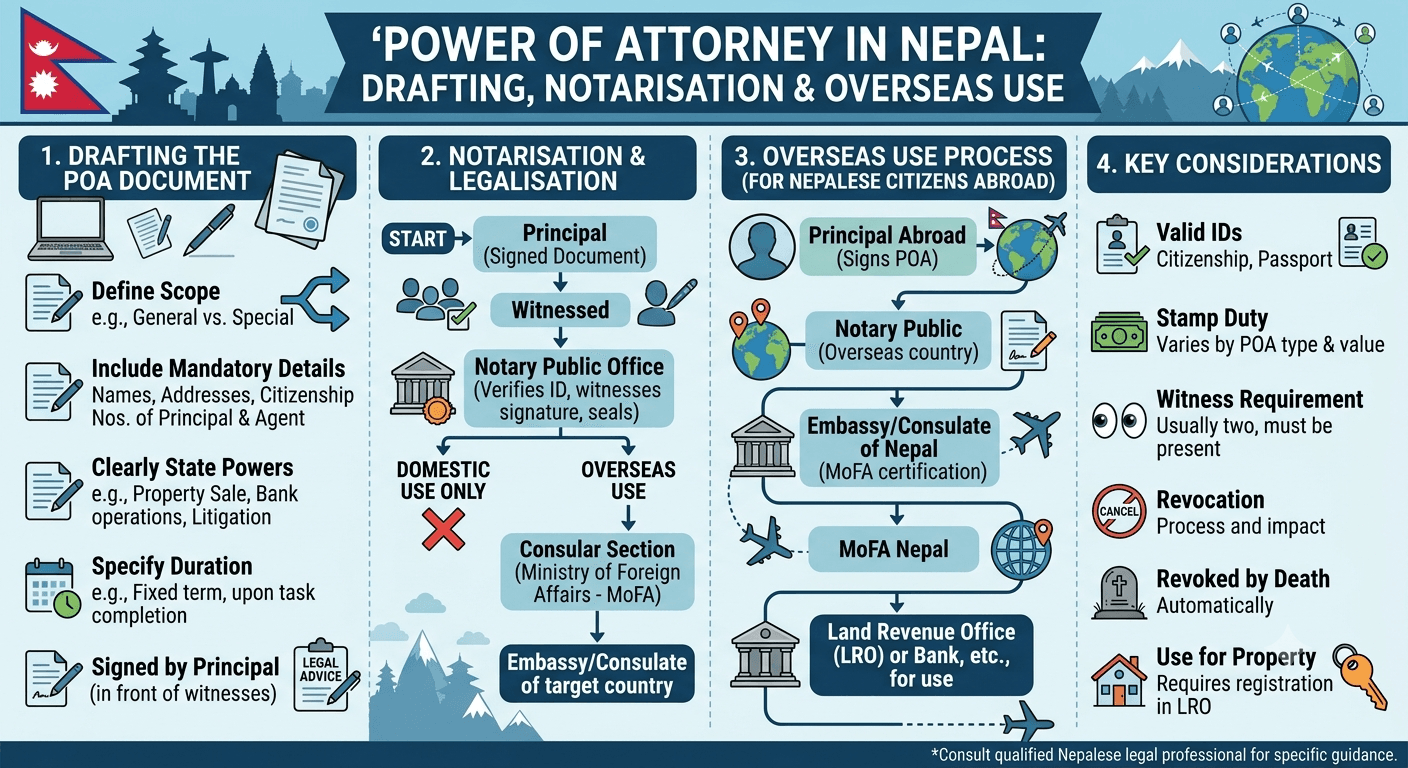
A Power of Attorney authorises another person to act for the principal. It can be broad or limited to a specific transaction, but it should never be treated as a generic form. The receiving bank, court, land office, company registry, government agency or foreign authority may require particular wording, execution and authentication.
Quick answer
A valid and useful Power of Attorney should identify the principal and attorney precisely, state each authorised act, define limits and duration, address delegation and revocation, and follow every signing, witness, notarisation, registration or consular formality required for its purpose. A notarised Power of Attorney is not automatically sufficient for every property, court, banking or cross-border transaction.
General and specific powers
A general power gives wide authority and creates significant risk. A specific power limits the attorney to a defined transaction, such as filing a company application, operating a stated bank process, appearing in identified litigation, collecting a document or signing a particular instrument.
Use the narrowest authority that achieves the purpose. Avoid phrases such as "all necessary acts" unless the surrounding clauses clearly define the transaction and safeguards.
Information the document should contain
The draft should normally identify: - full legal name, citizenship or passport details and address of the principal; - corresponding details of the attorney; - purpose and specific authorised acts; - property, account, case, company or transaction identifiers; - authority to sign, file, receive, pay or collect; - whether substitution or delegation is allowed; - geographic and institutional scope; - start date, expiry or completion event; - revocation and notice mechanics; - governing language and counterparts; - signature, witness and certification blocks.
Do not include unnecessary authority to sell, borrow, receive money, compromise claims or appoint substitutes.
Review the receiving authority first
Before drafting, ask the receiving body for its current form. A land or court matter may require registration or special execution beyond ordinary notarisation. Banks often use internal formats and require specimen signatures or direct verification. Corporate filings may need a board resolution alongside the Power of Attorney.
If the document will be used abroad, obtain embassy or foreign-authority instructions before it is signed. A document may need bilingual text, a particular witness statement or a specific legalisation chain.
Signing and notarisation in Nepal
The principal should use the final complete document and valid original identification. Where the notary is certifying execution, the principal should sign or acknowledge the document through the notarial procedure rather than sending a pre-signed page.
Section 27 of the Notary Public Act includes an application, identity verification and statutory witness process. The principal, witnesses and corporate representative should carry their identity and authority documents. The notary should refuse blank, suspicious, altered or unauthorised documents.
Notarisation confirms the relevant notarial act; it does not prove that the attorney's future conduct is lawful or that the receiving authority must accept the instrument.
Powers issued abroad for use in Nepal
A Power of Attorney signed outside Nepal may need notarisation or official execution in the issuing country, authentication by the relevant foreign authority, attestation by a Nepali mission or the foreign mission handling Nepal, and translation. The chain depends on the place of issue and intended use.
The Department of Consular Services states that foreign-government documents may be presented after diplomatic legalisation through the appropriate resident or accredited mission. A private Power of Attorney can have additional receiving-office requirements, so confirm the route with both the mission and Nepal authority.
Nepal is not currently a party to the Apostille Convention. Do not assume an apostille is the only or final requirement for a foreign-issued Power of Attorney intended for Nepal; ask the Nepali receiving authority what it will accept.
Nepali powers for use abroad
For a document made in Nepal, the destination may require notarisation, issuing or governmental verification, Department of Consular Services attestation and destination-embassy legalisation. The correct sequence is destination-specific.
Do not describe Department attestation as an apostille. The official HCCH table does not list Nepal as a contracting party as of 30 June 2026.
Corporate Powers of Attorney
A company should confirm its constitutional and board authority before appointing an attorney. The Power should identify the company by registered name and number and state the signer's capacity. Attach or retain the board resolution, delegation and relevant corporate records.
A director's title alone may not establish authority for every act. The transaction may require shareholder, regulator or lender approval.
Property, court and banking matters
High-risk powers should identify the exact asset, case or account and permitted acts. Property powers may need special form and registration. Litigation authority should align with procedural law. Banking authority should follow the bank's mandate and safeguards.
Legal review is particularly important where the attorney may receive sale proceeds, create security, settle claims or transfer assets.
Revocation and expiry
State when authority ends. A principal wishing to revoke should follow the document, contract and applicable law, give provable notice to the attorney and every relevant third party, and complete cancellation or registration steps required by the receiving authority.
Recover originals where possible, but do not assume physical recovery alone protects third parties who were not notified. Death, incapacity, completion and conflict rules require case-specific advice.
Fraud-prevention checklist
- Never sign a blank or incomplete Power of Attorney. - Keep a complete certified copy and list every original issued. - Limit money receipt, transfer, borrowing and delegation powers. - Verify the attorney's identity and contact details independently. - Use transaction identifiers and an expiry date where practical. - Notify institutions promptly after revocation. - Confirm foreign-use formalities before signing.
Legal update
This guide was reviewed on 21 July 2026. Power-of-Attorney requirements depend heavily on purpose, authority and destination. Obtain transaction-specific advice and the receiving body's current checklist.
Common questions
Frequently asked questions
Official sources
Primary materials used for the legal review of this guide.
- 1.Nepal Law Commission - Notary Public Act, 2063Accessed July 21, 2026
- 2.Department of Consular Services - Document Attestation FAQsAccessed July 21, 2026
- 3.Department of Consular Services - Consular Authentication requirementsAccessed July 21, 2026
- 4.HCCH - Apostille Convention status tableAccessed July 21, 2026
Professional assistance
Need professional legal assistance?
Get advocate-led guidance tailored to your matter, documents and compliance requirements.
View related legal service →Editorial and legal review
Reviewed by: Wakil Nepal Legal Team
Last reviewed: July 21, 2026
This guide provides general legal information. Procedures and official requirements can change, and case-specific advice may be necessary.