
Table of contents
- 01Trademark search and filing preparation in Nepal
- 02Quick answer
- 03Why a trademark search matters
- 04Search beyond exact matches
- 05Word marks and logo marks
- 06Preliminary and official searches
- 07Understanding trademark classes
- 08How to choose classes
- 09Drafting the specification
- 10Domestic applicant documents
- 11Foreign applicant documents
- 12Specimen requirements
- 13Search-risk categories
- 14Filing-readiness checklist
- 15Legal update
Quick answer
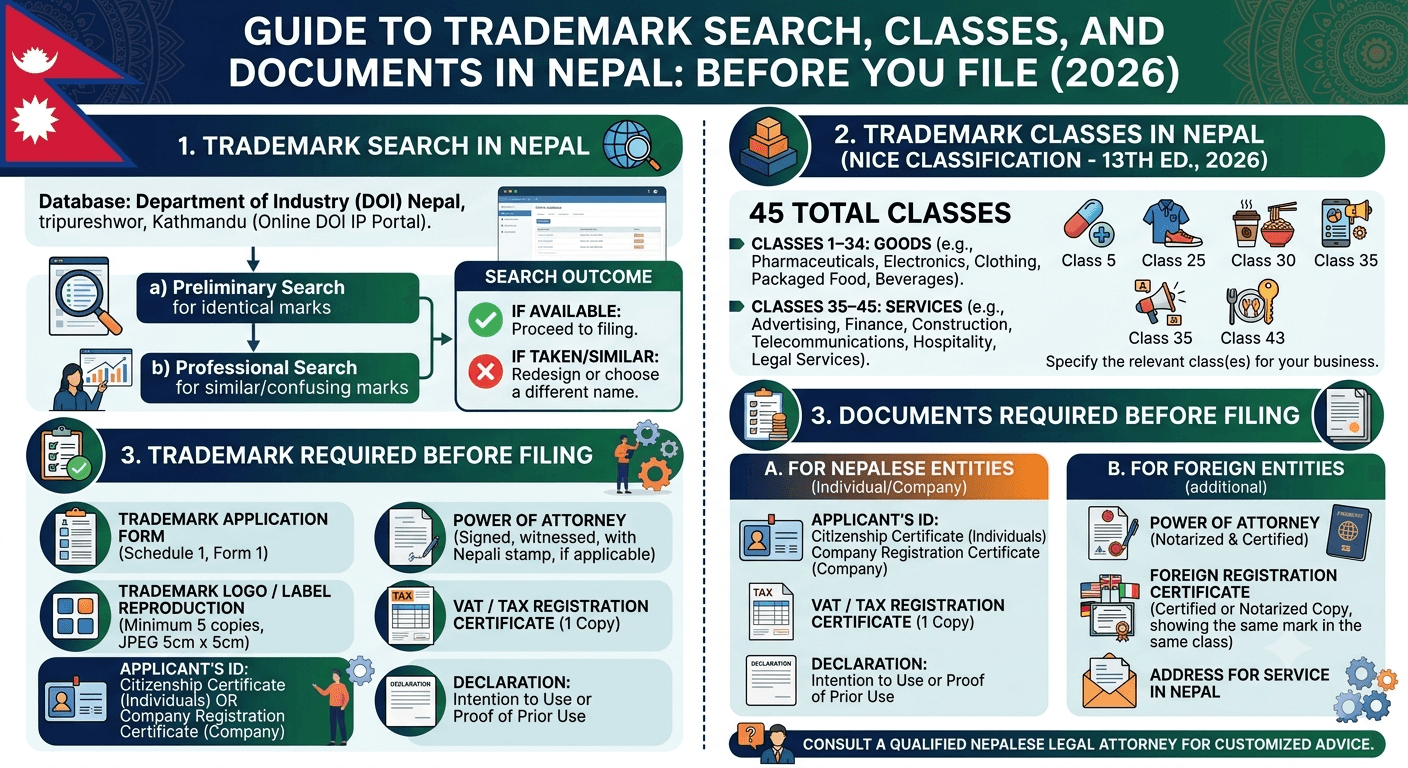
A Nepal trademark clearance should search exact, phonetic, spelling, translation and visual variants in relevant and related classes. After confirming the owner and specification, prepare separate class applications, four consistent specimens, business and tax records, and representative authority where applicable.
Key facts
- ✓Company-name and domain availability do not establish trademark availability.
- ✓A search should cover phonetic, translation, spelling and visual similarities.
- ✓Section 18A requires separate applications for different classes.
- ✓Specifications should describe the actual goods or services, not only broad corporate objects.
- ✓The DOI checklist requires four consistent trademark specimens.
- ✓Foreign applicants need additional home-registration and representative documents.
Trademark search and filing preparation in Nepal
A strong trademark application begins before the form is filed. Clearance searching, owner verification, class strategy and specimen consistency determine whether the filing matches the business and whether foreseeable conflicts can be addressed early.
An available company name, domain or social-media handle does not mean the trademark is available. Each database answers a different legal question.
Quick answer
Search the proposed word and device mark across identical, phonetic, spelling, translation and visual variants; review pending and registered marks in relevant and related classes; identify the true owner; describe the actual goods and services; then prepare four consistent specimens, business or industry registration, PAN/VAT evidence, fee receipt and Power of Attorney if represented.
Why a trademark search matters
Rebranding after packaging, signage, apps, advertising and customer acquisition is expensive. A pre-filing search can reveal direct conflicts, crowded wording and weak elements while changes are still commercially possible.
A search cannot guarantee registration. DOI examination can identify records not visible in a basic search, and another owner may object based on publication, reputation or evidence not found online.
Search beyond exact matches
An exact-word search is only the first layer. Review: - spacing, plural and grammatical variants; - phonetic equivalents and transliterations; - Nepali and English meanings or translations; - abbreviations and reordered words; - dominant logo shapes and device elements; - common prefixes or suffixes; - related goods, services and trade channels; - marks owned by connected businesses or distributors.
Consumers remember overall commercial impressions, not database punctuation. A visually different spelling can still create confusion when spoken.
Word marks and logo marks
Search the core name separately from the complete logo. Decorative styling may not overcome a conflict in the dominant word. Conversely, a device search should consider recurring shapes and arrangement.
If budget and strategy justify it, separate word and logo applications can provide cleaner portfolio coverage. Filing only a complex composite can make later design changes harder to manage.
Preliminary and official searches
A preliminary search can cover web results, domain names, company names, marketplaces, social platforms and accessible trademark records. It identifies obvious risk but is not an official clearance.
An official DOI record search or information request may require a prescribed fee. Preserve the search date, queries, classes and results. Trademark registers change continuously.
Understanding trademark classes
Goods and services are organised into classes for registration. Section 18A requires separate applications for marks covering different categories. A class heading does not automatically protect every item within that class; the specification should identify the commercial goods or services.
Examples include products such as cosmetics, pharmaceuticals, machinery, software and clothing, and services such as advertising, finance, construction, telecommunications, education and legal services. Classification can be technical where software, retail, consulting, digital platforms, food services or mixed products are involved.
How to choose classes
Start with current revenue sources, then include realistic near-term expansion. Review where the mark appears: on a product, packaging, storefront, app, marketplace, invoice or service contract.
Ask three questions: 1. What does the customer buy? 2. Is it a product, a service, or both? 3. Which entity actually supplies it under the mark?
Do not file unrelated classes merely to occupy the register. Nepal's one-year use rule makes evidence and genuine plans important.
Drafting the specification
Use precise, recognised descriptions. "All business activities" is not a useful substitute for identifying goods or services. A narrow specification can leave important activity uncovered, while an incoherent broad list can create objections and future non-use problems.
Keep terminology consistent with business registration and actual operations, but do not copy a corporate-object clause blindly. Corporate objects and trademark classification serve different purposes.
Domestic applicant documents
The current DOI checklist identifies: - completed prescribed application; - business, firm or industry registration or operating permit; - PAN or VAT registration evidence; - four mark specimens, no larger than the stated DOI format; - goods/services and owner details; - fee receipt; and - Power of Attorney and representative identity where applicable.
If the owner is a company, confirm its exact registered name and the signer's authority. If a designer created the logo, retain the copyright assignment.
Foreign applicant documents
DOI guidance requires additional material for a foreign mark, including a certified copy of a valid home-country registration, priority documentation if claimed, Power of Attorney, Nepal address for correspondence and representative identity. The Trademark Directive form indicates foreign authority documents may require notarisation or legalisation.
Prepare consistent translations and confirm whether the original, certified copy or legalised document is needed. Do not wait until examination to resolve ownership differences between the home registration and Nepal application.
Specimen requirements
The DOI checklist calls for four specimens, generally up to 8 by 8 centimetres. Use the same clean representation on every copy. Avoid screenshots, pixelated artwork, unapproved colour variations or one specimen containing details absent from the others.
The mark on the application, specimens and future commercial use should align. Material redesign may call for a new filing.
Search-risk categories
Classify results as: - direct conflict: identical or near-identical mark for overlapping goods/services; - high risk: similar dominant element and related market; - moderate risk: shared element but meaningful differences; - low risk: remote field or weak/common shared matter; - watch item: pending application or emerging use requiring monitoring.
Legal analysis should consider both similarity and market relationship. A class number alone does not decide confusion.
Filing-readiness checklist
- Owner name and address verified. - Word and logo ownership documented. - Exact, variant and related-class searches recorded. - Goods/services specification approved. - Separate class applications mapped. - Four identical compliant specimens prepared. - Corporate, tax and authority documents consistent. - Filing fee verified immediately before payment. - Monitoring responsibility and contact address assigned.
Legal update
This guide was reviewed on 21 July 2026. DOI search access, classifications, forms and fees can change. Re-run searches immediately before filing and verify the current Department checklist.
Common questions
Frequently asked questions
Official sources
Primary materials used for the legal review of this guide.
- 1.Department of Industry - Industrial Property Section checklistsAccessed July 21, 2026
- 2.Department of Industry - Trademark Directive, 2072Accessed July 21, 2026
- 3.Department of Industry - Patent, Design and Trade Mark Act, English textAccessed July 21, 2026
- 4.Department of Industry - Procedural ManualAccessed July 21, 2026
Professional assistance
Need professional legal assistance?
Get advocate-led guidance tailored to your matter, documents and compliance requirements.
View related legal service →Editorial and legal review
Reviewed by: Wakil Nepal Legal Team
Last reviewed: July 21, 2026
This guide provides general legal information. Procedures and official requirements can change, and case-specific advice may be necessary.