
Table of contents
- 01What makes a contract enforceable in Nepal?
- 02Agreement and acceptance
- 03Certainty of essential terms
- 04Legal capacity
- 05Lawful object and purpose
- 06Free and informed consent
- 07Signatory and representative authority
- 08Writing and registration requirements
- 09Electronic records and digital signatures
- 10Consideration and reciprocal performance
- 11Compliance with licences and approvals
- 12Enforceable restraint clauses
- 13Governing law in cross-border contracts
- 14Court jurisdiction or arbitration
- 15Breach and remedies
- 16Limitation periods
- 17Practical enforceability checklist
- 18Legal update and caution
Quick answer
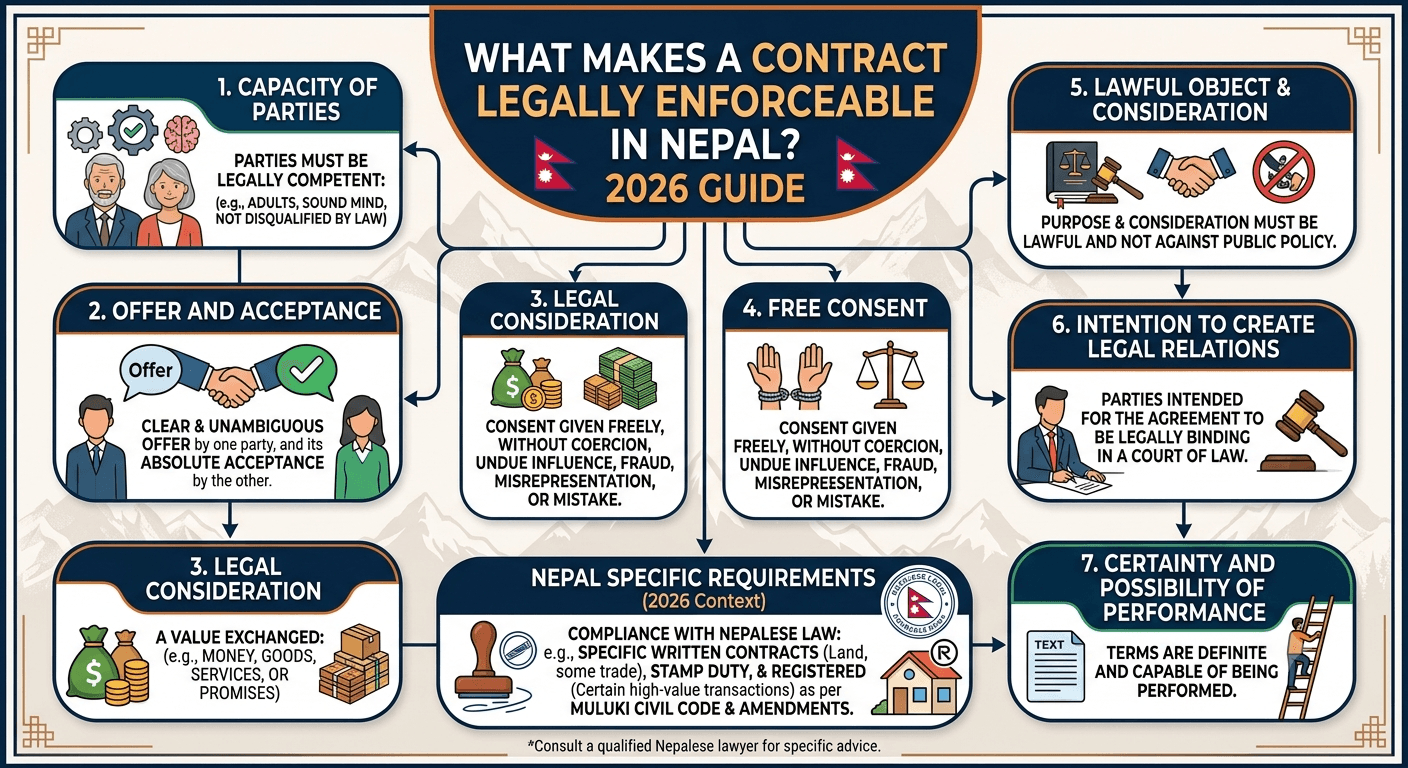
A contract is legally enforceable in Nepal when capable parties reach a certain agreement for a lawful purpose, communicate proposal and acceptance, give genuine consent, sign through proper authority and complete every writing, registration, approval or execution formality required for that transaction.
Key facts
- ✓Section 504 of the National Civil Code defines formation through an enforceable agreement and acceptance.
- ✓Illegal, impossible, incurably uncertain or capacity-defective contracts may be void under section 517.
- ✓Coercion, undue influence, fraud and misrepresentation can make a contract voidable under section 518.
- ✓Missing required writing, registration, procedure or authority can prevent court enforcement under section 519.
- ✓The Electronic Transactions Act recognises qualifying electronic records and digital signatures.
- ✓Section 520 contains short contract-claim periods, so advice should be obtained promptly.
What makes a contract enforceable in Nepal?
A contract is generally enforceable when legally capable parties reach a sufficiently certain agreement to do or not do a lawful act, communicate proposal and acceptance, give genuine consent, act through proper authority and complete any writing, registration or other formality required by law.
The National Civil Code, 2074 distinguishes a valid contract from a void contract, a voidable contract and a contract that exists but cannot be enforced through court because a required formality or authority is missing.
Agreement and acceptance
Section 504 provides that an agreement enforceable by law between two or more persons to do or not do an act is a contract. Acceptance of the proposal creates the contract and binding legal relations.
Drafts, negotiations and term sheets do not always prove final acceptance. Record the final version, acceptance method, date and conditions clearly, especially where parties negotiate by email or execute counterparts.
Certainty of essential terms
The parties should be able to identify the subject, obligations and essential commercial terms. Section 517 treats an agreement as void where the subject cannot be ascertained or performed, was impossible from the outset, is imaginary or is too vague to receive a reasonable meaning.
Use definitions, specifications, milestones, price formulas and objective standards. An agreement to agree later may leave the most important obligation unresolved.
Legal capacity
Each party must be legally capable of contracting. Verify age and legal capacity for individuals and legal existence and permitted activity for organisations.
For companies and institutions, capacity and internal approval are separate from the representative's signature authority. Review constitutional documents, board decisions and delegation.
Lawful object and purpose
Section 517 treats contracts contrary to law, involving prohibited or illegal acts, immoral purpose, public order or public interest as void. The section also addresses certain restraints and denial of access to legal rights.
A clause cannot become enforceable merely because both parties signed it. Mandatory statutes, licences, tax, labour, foreign-exchange, competition, consumer, land and sector rules may override inconsistent terms.
Free and informed consent
Section 518 makes contracts affected by coercion, undue influence, fraud or misrepresentation voidable at the request of the harmed party. The contract operates until set aside, subject to the statutory framework.
Keep accurate disclosures, negotiation history and authority records. Do not conceal material facts, pressure a vulnerable party or use a document different from the agreement represented during negotiation.
Signatory and representative authority
Confirm that the signer binds the named party. Section 519 treats a representative's act outside actual authority as a reason the contract may not be enforced against the principal.
For companies, retain the board resolution, delegation, office evidence or power of attorney. For public bodies and regulated entities, confirm procurement and approval authority as well.
Writing and registration requirements
Not every contract requires the same form. Section 519 states that where law requires a contract in writing, an unwritten agreement is not court-enforceable. It also addresses omitted mandatory formalities, procedures and registration.
The relevant transaction law must be checked for deeds, land, security, company, employment, consumer, government, foreign-investment and other specialised arrangements. Notarisation alone does not replace a registration or approval required by statute.
Electronic records and digital signatures
The Electronic Transactions Act, 2063 gives legal recognition to electronic records and to digital signatures completed through its statutory process. Electronic records should remain accessible, capable of accurate reproduction and protected against unauthorised alteration.
A scanned signature, typed name, platform click and certified digital signature may carry different authentication and evidential features. Define the agreed execution method and preserve the complete audit trail.
Consideration and reciprocal performance
The contract should state what each party gives, does or promises and how reciprocal obligations interact. Payment, delivery, approval, access and cooperation conditions should be clear.
Avoid making one party's obligation entirely illusory or dependent on uncontrolled discretion. Define conditions precedent and the consequence if they are not satisfied.
Compliance with licences and approvals
An agreement cannot authorise an activity prohibited by law. Identify regulator consent, board approval, foreign-investment approval, foreign-exchange permission, tax documentation, environmental clearance and professional licence requirements.
Use conditions precedent where approval must occur before completion or performance. Allocate responsibility, deadlines, cooperation and termination if approval is refused.
Enforceable restraint clauses
Section 517 generally treats restraints on a lawful profession, trade or business as void, while recognising specified exceptions such as certain goodwill, partnership and service-related restraints within the statutory conditions.
Non-compete and non-solicitation language should be narrow, justified and reviewed against the exact statutory exception. Overbroad copied restraints create a false sense of protection.
Governing law in cross-border contracts
Section 709 recognises the governing law selected by the parties. If they make no selection, the Code applies connecting rules based on place of performance or formation.
Party choice does not necessarily displace mandatory Nepali law, regulatory approval or public policy. Coordinate governing law with forum, arbitration seat, language, assets and enforcement strategy.
Court jurisdiction or arbitration
The dispute clause must identify a workable forum. If arbitration is chosen, comply with the Arbitration Act, 2055 and state the seat, tribunal, procedure or rules, language and dispute scope.
Avoid simultaneously granting exclusive court jurisdiction and mandatory arbitration over the same disputes without clarifying court support and interim relief.
Breach and remedies
Define breach, materiality, notice, cure, suspension and termination. The Civil Code provides a framework for performance, termination and compensation, while the available remedy depends on the agreement, loss, causation, mitigation and applicable law.
Draft liquidated or pre-estimated consequences carefully and do not assume every penalty-like amount will operate exactly as written. Preserve evidence of performance, notice and loss.
Limitation periods
Section 520 provides that a claim concerning a void contract may be brought at any time, a claim to set aside a voidable contract generally within one year from the relevant cause, and another contract claim generally within two years from accrual of the cause of action.
Other statutes, dispute clauses and facts may affect deadlines. Seek advice promptly after breach rather than relying on the contractual negotiation period to stop time.
Practical enforceability checklist
Confirm exact parties, legal capacity and authority. Confirm proposal, acceptance and the final version. Define lawful and certain obligations, reciprocal performance and payment. Check consent and disclosure. Complete required writing, registration, witnessing, approval and electronic authentication.
Then test termination, remedies, governing law, forum, notices, evidence, assets and limitation. A technically valid contract can still be commercially difficult to enforce if the counterparty, forum or remedy is poorly chosen.
Legal update and caution
This guide was reviewed in July 2026 against the National Civil Code, Electronic Transactions Act and Arbitration Act. Enforceability depends on facts and transaction-specific law. Obtain advice immediately when validity, authority, formality, breach or limitation is disputed.
Common questions
Frequently asked questions
Official sources
Primary materials used for the legal review of this guide.
- 1.Nepal Law Commission — National Civil Code, 2074 (Contract Formation and Validity)Accessed July 21, 2026
- 2.Nepal Law Commission — Electronic Transactions Act, 2063Accessed July 21, 2026
- 3.Nepal Law Commission — Arbitration Act, 2055Accessed July 21, 2026
Professional assistance
Need professional legal assistance?
Get advocate-led guidance tailored to your matter, documents and compliance requirements.
View related legal service →Editorial and legal review
Reviewed by: Wakil Nepal Legal Team
Last reviewed: July 21, 2026
This guide provides general legal information. Procedures and official requirements can change, and case-specific advice may be necessary.