
Table of contents
- 01Contract review checklist for Nepal
- 021. Verify the correct parties
- 032. Verify signing authority
- 043. Confirm offer, acceptance and certainty
- 054. Confirm lawful purpose and capacity
- 065. Look for consent problems
- 076. Define the scope
- 087. Add acceptance criteria
- 098. Reconcile price and payment
- 109. Review term and renewal
- 1110. Review change control
- 1211. Test representations and warranties
- 1312. Review confidentiality
- 1413. Review data protection and security
- 1514. Review intellectual property
- 1615. Review indemnities
- 1716. Review limitation of liability
- 1817. Review insurance
- 1918. Review suspension and termination
- 2019. Review force majeure
- 2120. Review compliance and licences
- 2221. Review governing law
- 2322. Review courts or arbitration
- 2423. Check notices and boilerplate
- 2524. Check execution formalities
- 2625. Check deadlines and limitation
- 27Red flags requiring negotiation
- 28How to record the review
- 29Legal update and caution
Quick answer
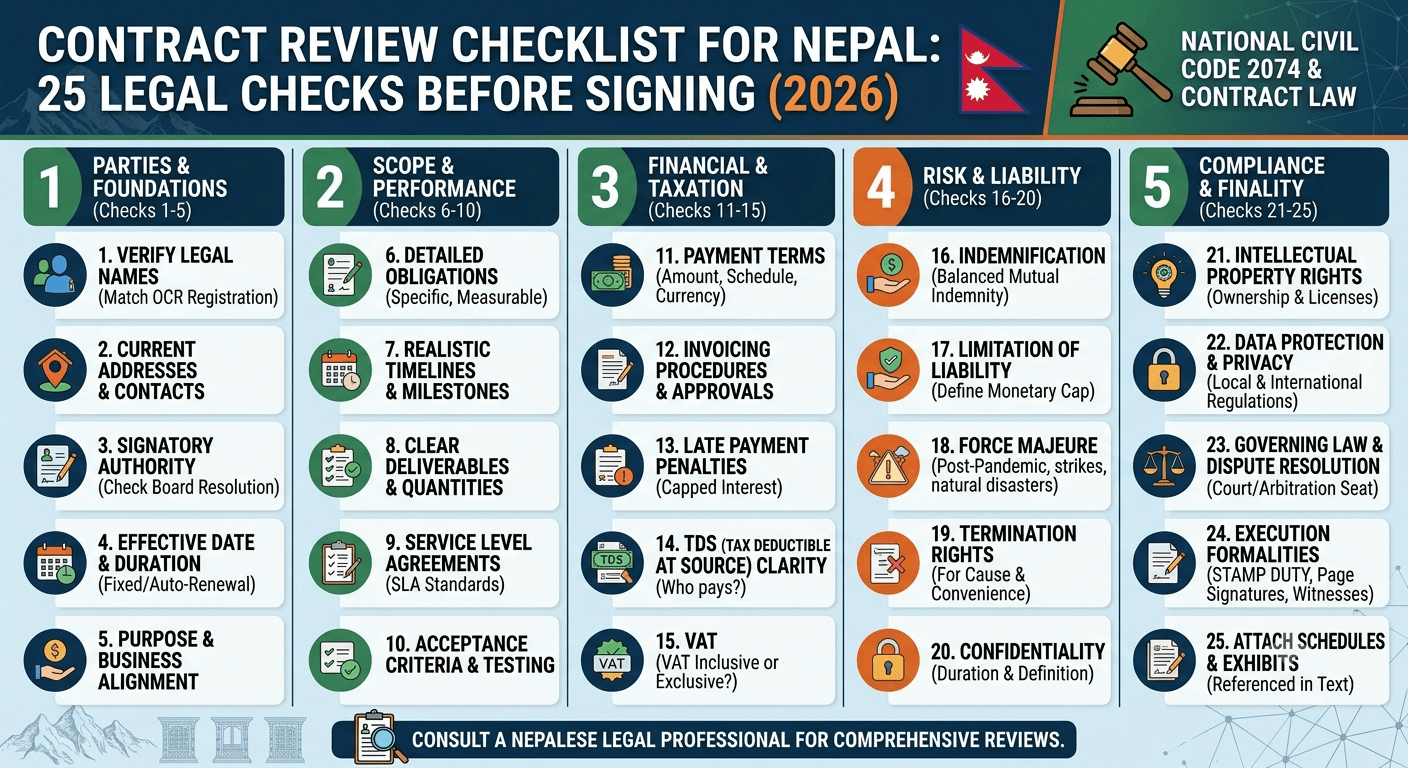
Before signing a contract in Nepal, verify the parties and authority, lawful purpose, scope, acceptance, payment, warranties, confidentiality, intellectual property, indemnity, liability caps, termination, force majeure, compliance, governing law, dispute resolution, execution formalities and claim deadlines.
Key facts
- ✓Contract review tests legal, commercial and operational risk—not only grammar.
- ✓Confirm exact parties and evidence of signatory authority before reviewing clauses.
- ✓Reconcile scope, acceptance, price, tax, milestones and change control.
- ✓Read indemnities together with liability caps, exclusions and insurance.
- ✓Check court or arbitration language, governing law and practical enforcement.
- ✓Record mandatory formalities and limitation periods before execution.
Contract review checklist for Nepal
A contract review tests whether the draft accurately records the deal, allocates risk knowingly and can be performed and enforced under applicable law. It is different from proofreading: a clause can be grammatically correct but legally defective or commercially dangerous.
Use this checklist before signing a vendor, service, supply, lease, loan, employment, shareholder, technology or cross-border agreement. The risk and formalities differ by transaction, so the checklist does not replace tailored legal advice.
1. Verify the correct parties
Confirm exact legal names, registration or identity numbers, legal form and addresses. Check whether the named entity owns the relevant asset, licence or intellectual property and whether a branch, brand or affiliate has been confused with the contracting party.
2. Verify signing authority
Review board resolutions, constitutional documents, delegation and powers of attorney. Section 519 of the National Civil Code identifies lack or excess of representative authority as an enforceability issue.
3. Confirm offer, acceptance and certainty
Check that the final draft reflects an agreed proposal and acceptance and creates definite obligations. Section 504 describes an enforceable agreement and acceptance of a proposal as the basis of a contract.
4. Confirm lawful purpose and capacity
Check that every party is legally capable and that the object is lawful. Section 517 treats contracts involving illegality, prohibited purpose, incapacity, initial impossibility or incurable uncertainty as void.
5. Look for consent problems
Ask whether the agreement resulted from coercion, undue influence, fraud or misrepresentation. Section 518 treats affected contracts as voidable at the option of the harmed party through the court process.
6. Define the scope
Confirm exact goods, services, rights, territory, site, specifications, milestones, dependencies and exclusions. Replace aspirational wording with measurable obligations.
7. Add acceptance criteria
State who tests performance, the review period, deemed acceptance if any, rejection reasons and correction process. Payment should not depend on a subjective standard controlled entirely by one party.
8. Reconcile price and payment
Check currency, tax, invoice documents, due date, milestones, retention, expenses, bank process, late-payment consequence and disputed invoices. Recalculate every percentage and total.
9. Review term and renewal
Identify commencement, conditions precedent, initial term, automatic renewal, renewal notice and expiry. Ensure the dates and notice periods can work together.
10. Review change control
State how scope, schedule, price and specifications can change and who can approve a variation. Informal requests should not silently expand obligations without time or price adjustment.
11. Test representations and warranties
Identify which facts matter, who gives each statement, the knowledge standard, disclosure process, survival and remedy. Delete warranties unrelated to the transaction and add missing reliance facts.
12. Review confidentiality
Check definition, exclusions, permitted recipients, security, compelled disclosure, duration, return or destruction and remedies. Ensure compliance is operationally possible.
13. Review data protection and security
Identify personal or sensitive data, access, hosting, subprocessors, breach notice, retention and deletion. Contractual security promises should match actual systems and insurance.
14. Review intellectual property
Separate background IP from newly created work. Check ownership, licences, territory, duration, sublicensing, moral rights where relevant, third-party components and post-termination rights.
15. Review indemnities
Identify triggers, covered losses, third-party and direct claims, defence control, notice, settlement, mitigation, exclusions and interaction with liability caps. Avoid vague unlimited indemnities.
16. Review limitation of liability
Check aggregate cap, cap basis, excluded claims, indirect-loss wording, multiple contracts and whether the cap applies to indemnities and confidentiality. Compare exposure with contract value and insurance.
17. Review insurance
Confirm type, amount, duration, evidence and claims cooperation. Insurance should support the risk allocation rather than substitute for clear liability drafting.
18. Review suspension and termination
Distinguish termination for breach, insolvency, illegality, convenience and prolonged force majeure. Check cure periods, payment, transition, return of property and survival clauses.
19. Review force majeure
Test event definition, control and foreseeability standards, causation, notice, mitigation, suspension, partial performance and long-stop termination. Economic difficulty alone should not automatically excuse performance.
20. Review compliance and licences
Identify permits, regulator approvals, labour, tax, anti-corruption, environment, consumer, foreign investment and sector rules. Allocate responsibility for obtaining and maintaining each approval.
21. Review governing law
Choose governing law deliberately. For cross-border contracts, section 709 of the Civil Code recognises the parties' choice, while mandatory Nepali rules and public policy may still apply.
22. Review courts or arbitration
Check whether the clause selects courts or arbitration consistently. For arbitration, define seat, institution or rules, tribunal, language, scope, interim relief and service. Avoid mixing incompatible court and arbitration clauses.
23. Check notices and boilerplate
Verify notice addresses, delivery methods and deemed receipt. Review assignment, subcontracting, waiver, severability, entire agreement, amendment, counterparts, relationship and priority of documents.
24. Check execution formalities
Confirm writing, registration, notarisation, witnessing, translation, board approval, regulator consent and electronic-signature requirements. Under section 519, omission of a legally required formality can prevent court enforcement.
25. Check deadlines and limitation
Record contractual notice, claim and cure deadlines. Section 520 generally provides a one-year period for a claim to set aside a voidable contract and two years from accrual of the cause of action for other contract claims, while a void contract can be challenged at any time under that provision. Obtain advice promptly because another law may apply.
Red flags requiring negotiation
Escalate blank schedules, unilateral price changes, one-sided acceptance, unlimited liability, broad indemnity, perpetual obligations, unrestricted data use, assignment without consent, immediate termination without cure and a dispute forum unrelated to the parties or assets.
Do not sign on the assumption that an unfair clause will never be enforced. Negotiate the allocation clearly and keep the approved revision history.
How to record the review
Prepare a issues list separating legal defects, high commercial risks, negotiation points and drafting corrections. Show the clause, consequence, proposed change and business decision owner.
After negotiation, compare the execution version against the agreed redline and confirm every schedule. Store the final signed contract, authority documents, approvals and attachments together.
Legal update and caution
This checklist was reviewed in July 2026 against the National Civil Code, Electronic Transactions Act and Arbitration Act. Contract type and sector can change the analysis, required formalities and limitation period.
Common questions
Frequently asked questions
Official sources
Primary materials used for the legal review of this guide.
- 1.Nepal Law Commission — National Civil Code, 2074 (Sections 504–520)Accessed July 21, 2026
- 2.Nepal Law Commission — Electronic Transactions Act, 2063Accessed July 21, 2026
- 3.Nepal Law Commission — Arbitration Act, 2055Accessed July 21, 2026
Professional assistance
Need professional legal assistance?
Get advocate-led guidance tailored to your matter, documents and compliance requirements.
View related legal service →Editorial and legal review
Reviewed by: Wakil Nepal Legal Team
Last reviewed: July 21, 2026
This guide provides general legal information. Procedures and official requirements can change, and case-specific advice may be necessary.