
Table of contents
- 01Labour law in Nepal
- 02Quick answer
- 03Who is a worker?
- 04Types of employment
- 05Written employment documentation
- 06Remuneration and payroll
- 07Working hours and overtime
- 08Leave and rest
- 09Social security and insurance
- 10Equality and dignity
- 11Health and safety
- 12Grievances and collective relations
- 13Employee evidence checklist
- 14Review note
Quick answer
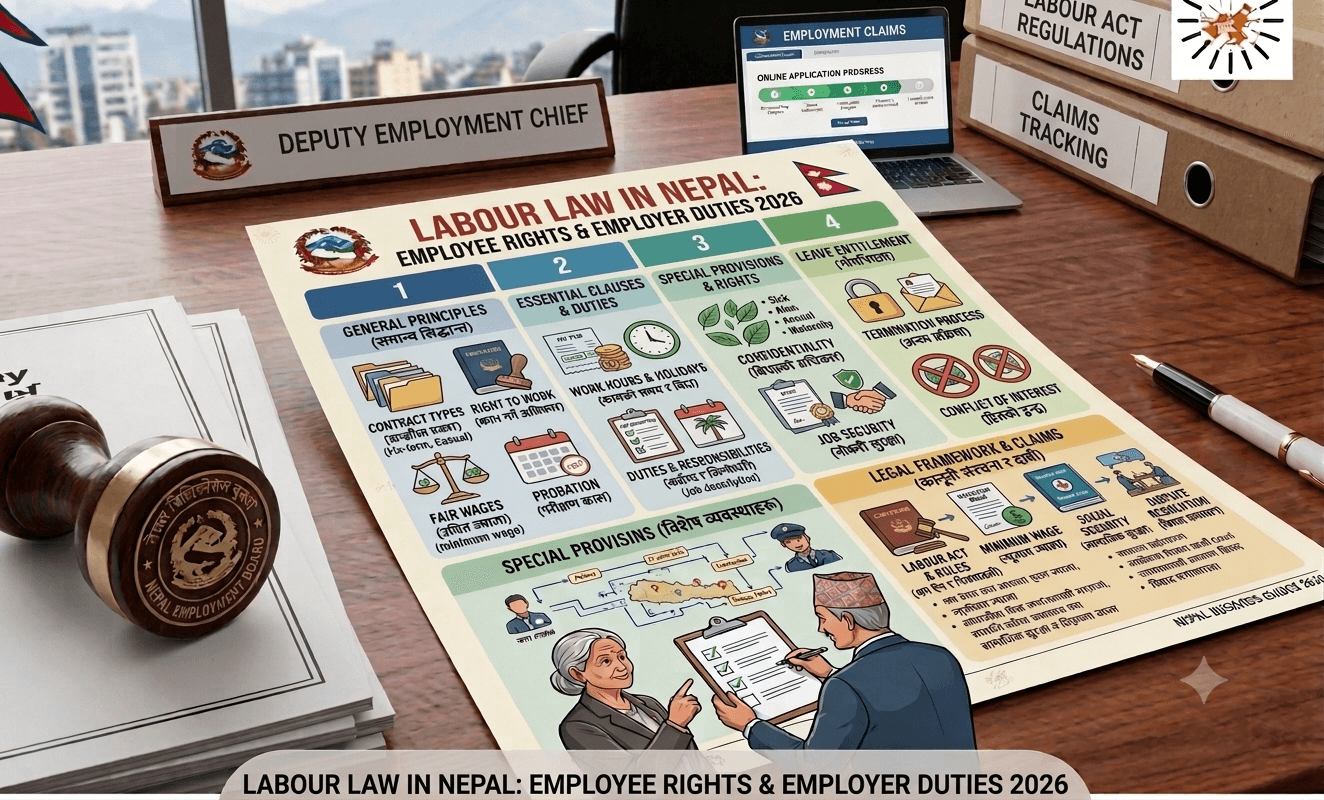
Nepal employers must correctly classify employment, document terms, meet current wage, hours, leave, social-security and safety rules, keep evidence and apply fair workplace procedures. Mandatory rights cannot be contracted away.
Key facts
- ✓The Labour Act looks at the real relationship, not only the job title.
- ✓Regular, work-based, time-based, casual and part-time categories differ.
- ✓Normal work is generally limited to eight hours daily and 48 weekly.
- ✓Minimum remuneration should be checked against the latest official notice.
- ✓Workplace dignity, safety, records and fair grievance procedures are mandatory.
Labour law in Nepal
The principal private-sector employment framework is the Labour Act, 2074 (2017) and Labour Rules, 2075 (2018). Social security, trade unions, bonus, child labour, workplace sexual harassment and sector-specific laws may add obligations.
Quick answer
Employers should classify the real employment relationship, issue accurate written documentation, pay at least the current prescribed remuneration, observe statutory hours, overtime, leave and benefits, enrol and contribute to applicable social-security arrangements, provide a safe and dignified workplace, maintain records and use fair grievance and disciplinary procedures. Employees should preserve their contract, attendance, pay, leave and communication evidence.
Who is a worker?
The Labour Act uses a functional definition covering a person performing physical or intellectual work for remuneration, regardless of job title. Calling someone a consultant, intern, volunteer or partner does not decide the issue if the actual relationship is controlled employment.
Relevant indicators include who controls working hours and method, integration into the organisation, exclusivity, recurring payment, tools, supervision, economic dependence and ability to delegate.
Types of employment
The Act recognises regular, work-based, time-based, casual and part-time employment. Classification should match reality: - regular: ongoing work not genuinely limited to a task or period; - work-based: engagement for completion of specified work; - time-based: engagement for a defined period; - casual: short engagement within the statutory limit; and - part-time: generally 35 hours or less per week.
A fixed end date does not automatically make an ongoing permanent function lawful as repeated time-based employment. Trainee and apprentice arrangements require genuine learning rather than ordinary work under a different label.
Written employment documentation
The appointment letter or agreement should state the parties, role, location, start date, employment category, probation where applicable, hours, remuneration, benefits, leave, reporting, confidentiality, intellectual property, policies, notice and lawful termination procedure.
No contract can reduce mandatory protections. Global templates and handbooks must be adapted to Nepal law. Keep a signed copy in the personnel file and give the worker their copy.
Remuneration and payroll
Pay at least the minimum remuneration currently prescribed by the Government of Nepal for the relevant category. Because minimum rates are periodically revised, verify the latest Gazette or official labour notice instead of relying on an old article.
Maintain payslips, bank or payment evidence, attendance, deductions and payroll returns. Deductions require a lawful basis. Festival allowance, provident fund or SSF, gratuity, insurance and other benefits should be assessed under current law and the employee's coverage.
Working hours and overtime
The Labour Act generally limits work to eight hours per day and 48 hours per week, with a rest interval after continuous work. Overtime is exceptional, subject to statutory limits and premium remuneration. Employers need reliable prior approval and time records; an “all-inclusive salary” label does not automatically erase statutory overtime rights.
Leave and rest
Administer weekly rest, public holidays, home leave, sick leave, maternity and maternity-care leave, mourning leave, substitute leave and other applicable leave. Eligibility, accrual and payment differ by type and circumstances.
Publish a clear leave process, but do not use internal approval rules to remove statutory entitlement. Preserve applications, decisions and balances.
Social security and insurance
Assess employer and worker registration and contributions under the contribution-based Social Security Fund system. Keep enrolment, contribution and benefit records consistent with payroll. Where another statutory provident fund, gratuity or insurance treatment applies, document the legal basis and avoid double counting or gaps.
Equality and dignity
Employment decisions should not unlawfully discriminate. Recruitment, pay, promotion, training, discipline and termination need objective, documented criteria. The Workplace Sexual Harassment (Prevention) Act, 2071 imposes prevention and response duties on managers, including awareness, remedial measures and complaint information.
Retaliation after a complaint creates additional risk. Investigations should be prompt, impartial, confidential as reasonably possible and fair to both complainant and respondent.
Health and safety
Employers must identify hazards, provide safe systems, training, protective equipment and emergency response appropriate to the workplace. Record accidents and corrective action. Employees also have duties to follow lawful safety instructions and use equipment properly.
Grievances and collective relations
Use the internal grievance route and preserve written complaints, meetings and decisions. Trade-union and collective-bargaining rights require separate compliance. If internal resolution fails, the competent Labour and Employment Office, Department of Labour and Occupational Safety or Labour Court may become involved.
Employee evidence checklist
- appointment letter and policies; - attendance and overtime records; - payslips and bank statements; - leave applications and balances; - SSF or benefit records; - warnings, appraisals and grievance documents; - emails or messages lawfully obtained; and - resignation, termination and final-settlement documents.
Review note
This guide was reviewed on 21 July 2026. Minimum remuneration, procedures and notices can change; verify the current official material before acting.
Common questions
Frequently asked questions
Official sources
Primary materials used for the legal review of this guide.
- 1.Nepal Law Commission - Labour Act 2074Accessed July 21, 2026
- 2.Nepal Law Commission - Labour Rules 2075Accessed July 21, 2026
- 3.Social Security Fund - Employer registration systemAccessed July 21, 2026
- 4.Nepal Law Commission - Workplace Sexual Harassment Prevention ActAccessed July 21, 2026
Professional assistance
Need professional legal assistance?
Get advocate-led guidance tailored to your matter, documents and compliance requirements.
View related legal service →Editorial and legal review
Reviewed by: Wakil Nepal Legal Team
Last reviewed: July 21, 2026
This guide provides general legal information. Procedures and official requirements can change, and case-specific advice may be necessary.