
Table of contents
- 01Business licensing in Nepal
- 02Quick answer
- 03Company registration is not an operating licence
- 041. Map the actual business
- 052. Confirm entity and constitutional documents
- 063. Register for tax
- 074. Complete local requirements
- 085. Assess industry registration
- 096. Identify sector-specific licences
- 107. Check environment, labour and products
- 11Typical document set
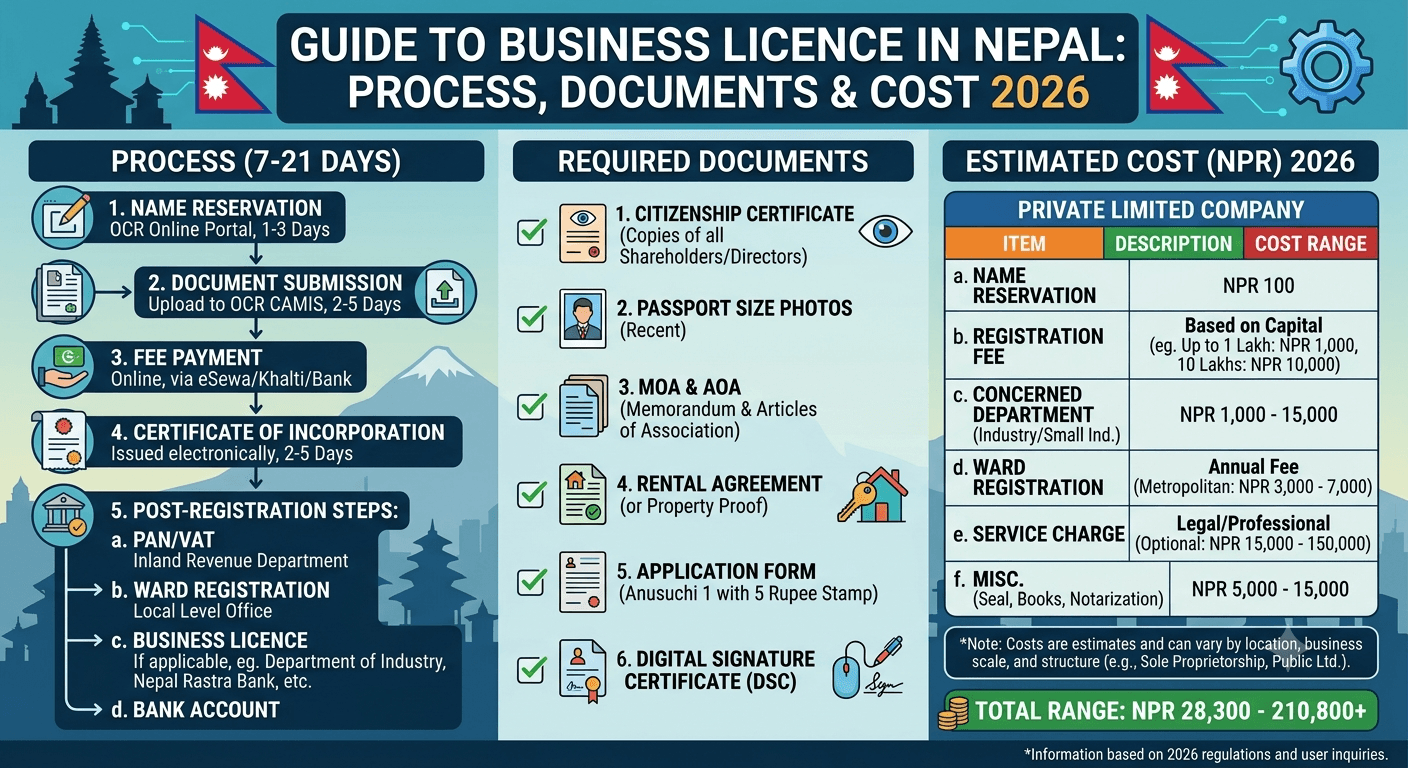
- 12Cost and timeline
- 13Pre-launch checklist
- 14Review note
Quick answer
Nepal has no single master business licence. Map the actual activity, location, ownership and scale, then coordinate entity, tax, local, industry, environmental and sector-specific approvals before operations begin.
Key facts
- ✓Company registration does not authorise every business activity.
- ✓Licence requirements depend on activity, location, ownership and scale.
- ✓PAN, VAT, local registration and sector approval are separate questions.
- ✓Premises and environmental suitability should be checked before launch.
- ✓Every issued licence condition and renewal date belongs in a calendar.
Business licensing in Nepal
Nepal does not issue one universal master licence that authorises every enterprise. A lawful operating package is built from the registrations and approvals applicable to the exact activity, products, location, legal form, ownership, scale, employees and environmental impact.
Quick answer
First create or confirm the legal entity and ensure its registered objectives cover the proposed activity. Obtain the applicable Business PAN or VAT status, complete local business registration and tax requirements, determine whether the activity is an industrial enterprise, and secure every sector, premises, environmental, product or professional approval before launching. Record conditions and renewal dates in a compliance calendar.
Company registration is not an operating licence
An Office of Company Registrar certificate creates a company. It does not automatically permit banking, insurance, telecommunications, health, medicine, food, tourism, education, construction, energy, transport or another regulated activity. A proprietorship or partnership registration similarly does not replace sector approval.
The correct sequence matters. Some regulators require entity and tax documents first; others require location, technical staff, capital, inspection or environmental approval before operations.
1. Map the actual business
Document: - every product and service; - physical and online sales channels; - principal and branch locations; - manufacturing, storage, import or export activity; - ownership and foreign investment; - expected turnover and transaction type; - employees and technical professionals; - machinery, waste, emissions and public-safety risk; and - intended launch date.
Do not rely only on the company name. Regulators assess what the business actually does.
2. Confirm entity and constitutional documents
Review the registration certificate, memorandum and articles, partnership deed or firm record. The stated objects should cover the proposed activity. Prepare board or proprietor authority for applications and confirm authorised signatories.
Foreign-invested businesses may need additional approval sequencing, legalised foreign documents, industry registration and sector eligibility review.
3. Register for tax
IRD's official procedure routes Business PAN and VAT applications through its Taxpayer Portal and verification office. A business needs its own correct taxpayer identity; a company's PAN is separate from a shareholder's personal PAN.
PAN and VAT are not two separate PAN numbers. VAT registration depends on the taxable activity and current legal requirements, including applicable thresholds or mandatory categories. Select business types carefully because they appear in the tax record.
4. Complete local requirements
Municipalities and rural municipalities administer local business registration, business tax and location-based obligations under applicable law and local procedure. Requirements and charges vary by place and classification.
Confirm ward or municipal recommendation, premises evidence, signage, fire, sanitation, building-use or local inspection requirements before signing an inflexible lease or opening.
5. Assess industry registration
The Industrial Enterprises Act, 2076 provides the framework for industrial enterprises. Determine whether the project is an industry, how it is classified, which level of government has jurisdiction and whether registration or permission is required.
A project report may need to describe investment, capacity, products, process, machinery, raw materials, employment, energy, land and environmental impact.
6. Identify sector-specific licences
A licence may be called a permit, approval, registration, recommendation, consent or certificate. Identify the responsible regulator, eligibility criteria, technical-person requirements, capital, premises, inspection, fees, validity and reporting.
Do not begin regulated operations merely because an application has been filed unless the law expressly allows it.
7. Check environment, labour and products
Screen for environmental study or approval before site development. Establish employment contracts, payroll, workplace safety, labour records and social-security compliance. Review standards, labelling, advertising, consumer, packaging, import and product-testing rules.
Typical document set
- entity certificate and constitutional documents; - director, owner or partner identification; - PAN/VAT record and tax documents; - board resolution or authority letter; - lease or title, location map and site plan; - project report and process description; - investment, machinery and capacity details; - technical qualifications and professional registrations; - environmental and safety documents; - foreign investment approvals where applicable; and - current regulator-specific forms and fee receipts.
Cost and timeline
There is no universal fee or deadline. Government charges depend on the municipality, industry classification and regulator. Technical reports, testing, environmental studies, inspections and professional documents add separate cost. Request an estimate only after the licence map is complete.
Pre-launch checklist
1. Confirm entity and permitted objectives. 2. Map activity, location, ownership and scale. 3. Complete PAN/VAT and local registration. 4. Determine industry-registration requirements. 5. Obtain sector and environmental approvals. 6. Complete premises and technical conditions. 7. Review labour, consumer and product duties. 8. Record every condition, report and renewal.
Review note
This guide was reviewed on 21 July 2026. Fees, thresholds, forms and jurisdiction can change; verify every requirement with the competent authority before operating.
Common questions
Frequently asked questions
Official sources
Primary materials used for the legal review of this guide.
- 1.Nepal Law Commission - Industrial Enterprises Act 2076Accessed July 21, 2026
- 2.Inland Revenue Department - Business PAN guidanceAccessed July 21, 2026
- 3.Inland Revenue Department - PAN and VAT guidanceAccessed July 21, 2026
- 4.Nepal Law Commission - E-Commerce Act 2081Accessed July 21, 2026
Professional assistance
Need professional legal assistance?
Get advocate-led guidance tailored to your matter, documents and compliance requirements.
View related legal service →Editorial and legal review
Reviewed by: Wakil Nepal Legal Team
Last reviewed: July 21, 2026
This guide provides general legal information. Procedures and official requirements can change, and case-specific advice may be necessary.