
Table of contents
- 01NGO registration in Nepal
- 02Quick answer
- 031. Choose the correct legal structure
- 042. Assemble at least seven founders
- 053. Clear the name and objectives
- 064. Draft the constitution
- 075. Prepare the DAO documents
- 086. DAO review and certificate
- 097. Complete post-registration steps
- 108. Consider SWC affiliation
- 119. Build compliance from the first day
- 12Practical checklist
- 13Review note
Quick answer
Register a domestic NGO through the competent District Administration Office with at least seven founders, a tailored constitution, committee decisions, local recommendation and district-specific documents. Then complete PAN, governance records and any required SWC process.
Key facts
- ✓The Association Registration Act requires at least seven applicants.
- ✓DAO filing requirements, charges and timing vary by district.
- ✓A tailored constitution prevents governance and funding problems.
- ✓DAO registration, PAN and SWC affiliation are separate steps.
- ✓Annual accounts, audit, reporting and renewal should be calendared immediately.
NGO registration in Nepal
A domestic non-governmental organisation is commonly established as an association under the Association Registration Act, 2034 (1977). Registration is handled by the local authority, ordinarily the Chief District Officer through the relevant District Administration Office (DAO).
Quick answer
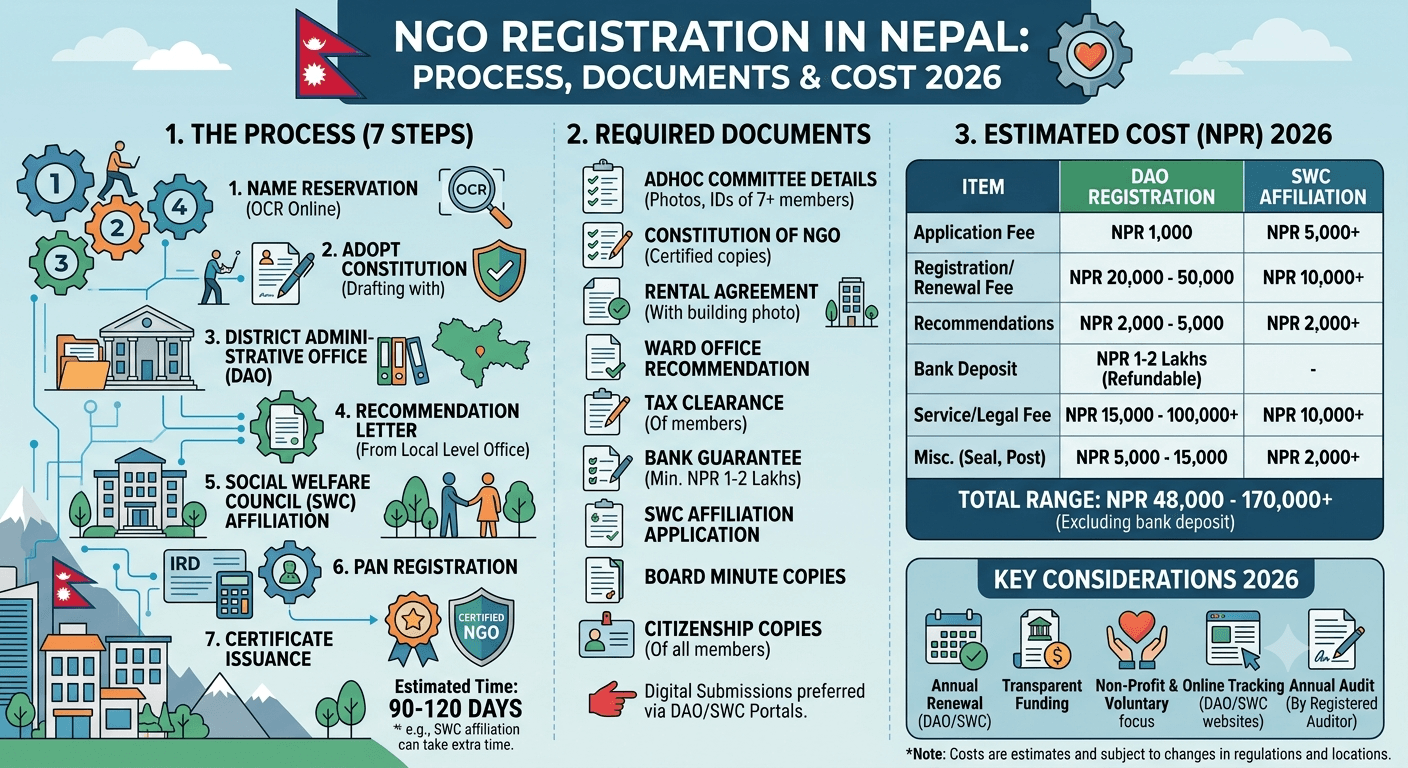
At least seven people establish the association, agree its name, objectives, governing committee, funding sources and office, adopt a constitution, obtain the current local-level recommendation and submit the DAO application with founder details and the district's required supporting documents. After DAO registration, complete the organisation's PAN and other registrations, and assess Social Welfare Council affiliation before conducting social-welfare or externally supported programmes.
1. Choose the correct legal structure
An association, a company not distributing profits, a cooperative, trust or sector-specific institution are not interchangeable. Choose based on the objectives, membership, governance, funding, permitted income and regulator.
The Association Registration Act covers organisations formed for social, religious, literary, cultural, scientific, educational, intellectual, physical, economic, professional and philanthropic development. An NGO should not be designed as a disguised profit-distribution vehicle.
2. Assemble at least seven founders
Section 4 of the Act requires seven or more people to apply. Confirm citizenship, address, occupation, availability and eligibility before putting anyone on the ad hoc committee. The founders should understand their duties rather than merely lending names.
Record the initial meeting decisions: establish the organisation, approve its name and objectives, adopt the constitution, form the ad hoc committee, authorise filing and appoint the responsible signatory.
3. Clear the name and objectives
Check the proposed name with the relevant DAO before final printing. Avoid a name that duplicates or misleadingly resembles an existing association, implies government status or conflicts with law and public order.
Draft objectives that are specific enough to guide activities and budgets but broad enough for realistic growth. If the NGO expects foreign assistance or sector approvals, align the objects with the proposed programmes.
4. Draft the constitution
The constitution should address: - name, registered office and work area; - objectives and permitted activities; - membership admission, rights, discipline and termination; - general assembly and committee composition; - meetings, quorum, voting and minutes; - office-bearer powers and conflicts of interest; - funding, bank operation, accounting and audit; - asset control and non-distribution; - amendment, merger and dissolution; and - treatment of remaining assets after dissolution.
District templates are useful, but copying one without adapting governance can create future deadlock. The Act requires prior approval of the local authority before an approved change of objectives or merger becomes effective.
5. Prepare the DAO documents
The exact checklist varies by district. Current official DAO examples commonly request: - prescribed application signed by committee members; - local-level recommendation; - founding and committee meeting decisions; - four signed copies of the constitution; - names, addresses, occupations, contacts, signatures and photographs of committee members; - self-certified citizenship copies; and - police or conduct verification where requested.
DAO Parsa currently publishes an NPR 1,000 registration charge, but that is a district service entry, not a promise of one nationwide fee. Confirm the current fee, stamp, format and number of copies with the competent DAO.
6. DAO review and certificate
The DAO checks the name, objects, constitution, founders and documents and may request a police report, sector response or correction. Obtain the registration certificate and certified constitution, then verify names, address and registration particulars immediately.
7. Complete post-registration steps
Open the organisation's records, obtain PAN from the Inland Revenue Department, establish a bank mandate, appoint accounting responsibility and preserve minutes, membership and asset registers. Tax-exempt treatment is not automatic merely because an entity calls itself an NGO; obtain current tax advice and comply with withholding, payroll and other obligations.
8. Consider SWC affiliation
Under the Social Welfare Act, a social organisation seeking affiliation applies to the Social Welfare Council with its constitution, committee details and registration information. Affiliation is distinct from DAO registration. Foreign or other assistance for a project requires the applicable SWC proposal and approval process.
9. Build compliance from the first day
The Association Registration Act requires annual accounts with the auditor's report to be sent to the local authority. DAO renewal checklists commonly require audited financial statements, annual progress, tax clearance, committee decision and local recommendation.
Practical checklist
1. Select the correct nonprofit structure. 2. Confirm seven qualified founders. 3. Clear the name and objects. 4. Adopt a tailored constitution and meeting minutes. 5. Obtain the current local recommendation. 6. File the district-specific DAO package. 7. Obtain PAN and set up governance records. 8. Assess SWC affiliation and project approval. 9. Calendar annual audit, reporting and renewal.
Review note
This guide was reviewed on 21 July 2026. DAO requirements differ by district and change over time; verify the competent office's current checklist before filing.
Common questions
Frequently asked questions
Official sources
Primary materials used for the legal review of this guide.
- 1.Nepal Law Commission - Association Registration Act 2034Accessed July 21, 2026
- 2.DAO Parsa - New nonprofit organisation registrationAccessed July 21, 2026
- 3.Ministry of Home Affairs - District Administration OfficesAccessed July 21, 2026
- 4.Social Welfare Council - Official information portalAccessed July 21, 2026
Professional assistance
Need professional legal assistance?
Get advocate-led guidance tailored to your matter, documents and compliance requirements.
View related legal service →Editorial and legal review
Reviewed by: Wakil Nepal Legal Team
Last reviewed: July 21, 2026
This guide provides general legal information. Procedures and official requirements can change, and case-specific advice may be necessary.