
Table of contents
- 01Property registration in Nepal
- 02Quick answer
- 03Main authorities
- 04Step 1: identify the transaction
- 05Step 2: verify the parties
- 06Step 3: conduct title due diligence
- 07Step 4: measure and inspect
- 08Step 5: sale agreement and payment controls
- 09Step 6: deed drafting
- 10Step 7: valuation, tax and charges
- 11Step 8: Land Revenue Office execution
- 12Step 9: post-registration verification
- 13Power of attorney
- 14Review note
Quick answer
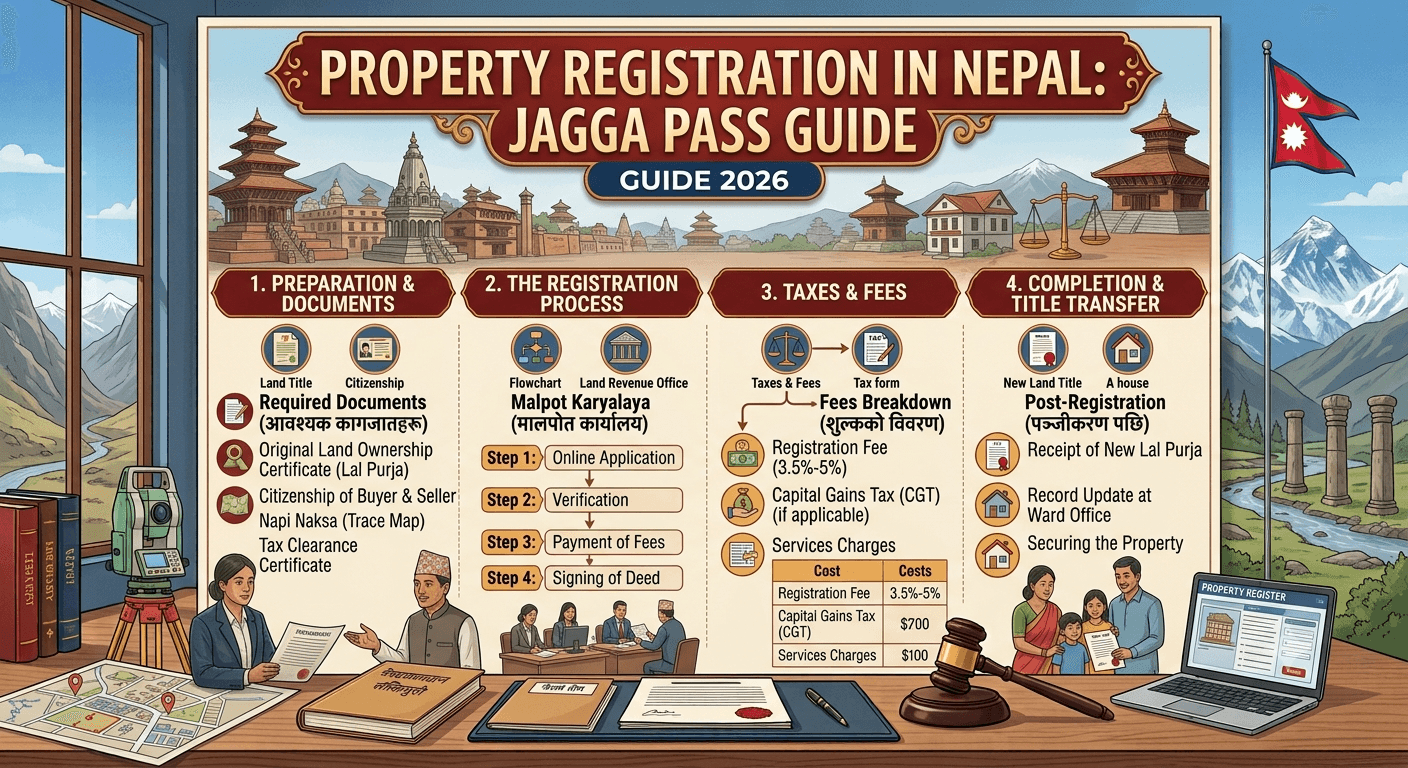
Register Nepal property by verifying title and parcel records, drafting the correct deed, calculating current provincial taxes and charges, executing at the competent Land Revenue Office, and checking Dakhil Kharij and the updated Lalpurja.
Key facts
- ✓Payment or possession alone does not safely complete registered ownership transfer.
- ✓Title, map, field and restriction records should be checked before advance payment.
- ✓The deed must match the real transaction and current office format.
- ✓Provincial rates and current minimum valuation control the official calculation.
- ✓Post-registration Dakhil Kharij and ownership records must be verified.
Property registration in Nepal
Property registration, commonly called jagga pass for a land transaction, is the formal registration of the legally appropriate deed at the competent Land Revenue Office. Payment, possession or an unregistered private agreement alone does not safely complete the ownership transfer.
Quick answer
Verify the registered owner, parcel and restrictions before paying; agree clear commercial terms; prepare the correct deed and tax documents; obtain the current government valuation and provincial charge calculation; ensure every necessary party or authorised representative appears at the Land Revenue Office; complete identity, consent, execution and payment formalities; then verify Dakhil Kharij and the updated ownership record and Lalpurja.
Main authorities
The Land Revenue Office, often called Malpot, maintains land ownership records and performs deed registration, Namasari, Dakhil Kharij and related record work under the Land Revenue Act. The Survey or Napi office maintains cadastral maps, field books, plot registers, measurement and boundary records.
A municipality or rural municipality can be relevant for house, road, land-use, tax and recommendation records. Courts, banks and other authorities matter where there is a restriction, mortgage, dispute, inheritance or company transaction.
Step 1: identify the transaction
Choose the legal instrument from the real transaction: - sale or Rajinama; - gift or Bakaspatra; - family transfer or relinquishment; - partition deed; - inheritance or Namasari; - exchange; - mortgage or release; - court judgment or settlement implementation; or - company or institutional transfer.
Using a gift deed to conceal a sale or stating a false consideration can create tax, fraud, title and enforcement risk.
Step 2: verify the parties
Check citizenship or passport, legal name, address, marital and family status and capacity. For a company, verify registration, constitutional documents, board authority, beneficial approvals, tax status and authorised signatory.
Confirm whether a spouse, coparcener, co-owner, guardian, heir, lender or government authority must consent or participate. A person holding the Lalpurja is not necessarily the only person with a legally relevant interest.
Step 3: conduct title due diligence
Before an advance payment, inspect current official records for: 1. registered owner and ownership share; 2. district, local level, ward, sheet, kitta and area; 3. current Lalpurja and ownership register; 4. cadastral map, field book and plot register; 5. land category, permitted use and road access; 6. Rokka, mortgage, court order or government restriction; 7. tenancy, Guthi, trust, public or special-status issues; 8. tax and land-revenue payment; 9. pending dispute, acquisition or boundary problem; and 10. prior deeds and suspicious recent transfers.
Do not rely only on a photocopy, broker message or online map.
Step 4: measure and inspect
Compare physical possession, boundaries, access, structures and neighbours with the official map and field records. Where area or boundary matters, use a competent survey process and verify whether subdivision or map correction is required.
A house sale also requires building approval, completion or municipal records, utilities and occupancy issues according to the property.
Step 5: sale agreement and payment controls
A preliminary agreement should identify the exact property, title warranties, price, advance, payment milestones, due-diligence conditions, tax allocation, registration date, possession, originals, default, refund and dispute consequences.
Use traceable banking channels and align the stated consideration, legal requirements and tax records. Do not release the full price merely against a photocopied deed or promise of later registration.
Step 6: deed drafting
The deed must use the legally appropriate form and accurate party, parcel, price, boundary and title information. It should address possession, included structures or rights, representations, debt, tax, documents and implementation.
The Land Revenue Office format and current local requirements should be confirmed before the appointment. A private English contract alone may not be the registrable instrument.
Step 7: valuation, tax and charges
Registration fee, service charge, capital-gains or income-tax treatment, local tax and other amounts depend on the province, local level, property, transaction type, consideration, minimum valuation and available concession.
The Department of Land Management and Archive publishes a calculator but expressly notes that the applicable provincial rate controls where figures differ. Obtain a current official calculation; do not rely on an old nationwide percentage.
Step 8: Land Revenue Office execution
The required parties or properly authorised representatives attend with originals, photographs or biometrics and prescribed documents. The office verifies identity, authority, record, valuation, tax and restrictions before deed execution and registration.
Pay only through the official process and retain the deed number, receipt and certified or official documents. Online preparation does not mean the deed has been registered.
Step 9: post-registration verification
Confirm that: - the deed is registered correctly; - Dakhil Kharij removed the previous entry and entered the new right; - the ownership register and Lalpurja match the deed; - kitta, area, share and names are correct; - mortgage or other promised release is recorded; - possession and originals were delivered; and - municipal, utility, company or tax records are updated.
Report an error immediately through the lawful correction procedure.
Power of attorney
A transaction may sometimes be completed by a representative, but the power must specifically authorise the transaction and comply with Nepal execution, registration, notarisation or diplomatic legalisation requirements. Confirm acceptance with the receiving office before signing abroad.
Review note
This guide was reviewed on 21 July 2026. Provincial charges, minimum valuations, office documents and online processes change; verify them immediately before registration.
Common questions
Frequently asked questions
Official sources
Primary materials used for the legal review of this guide.
- 1.Nepal Law Commission - Land Revenue Act 2034Accessed July 21, 2026
- 2.Nepal Law Commission - National Civil Code 2074Accessed July 21, 2026
- 3.Department of Land Management - Registration Rate CalculatorAccessed July 21, 2026
- 4.Survey Department - Mero KittaAccessed July 21, 2026
Professional assistance
Need professional legal assistance?
Get advocate-led guidance tailored to your matter, documents and compliance requirements.
View related legal service →Editorial and legal review
Reviewed by: Wakil Nepal Legal Team
Last reviewed: July 21, 2026
This guide provides general legal information. Procedures and official requirements can change, and case-specific advice may be necessary.