
Table of contents
- 01Inheritance and succession law in Nepal
- 02Quick answer
- 03Main legal framework
- 04Succession begins on death
- 05Partition and succession are different
- 06Identify the heirs
- 07Inventory assets
- 08Inventory liabilities
- 09Preserve the estate
- 10Uncontested process
- 11Disputed succession
- 12Surrendering succession
- 13Where no heir succeeds
- 14Review note
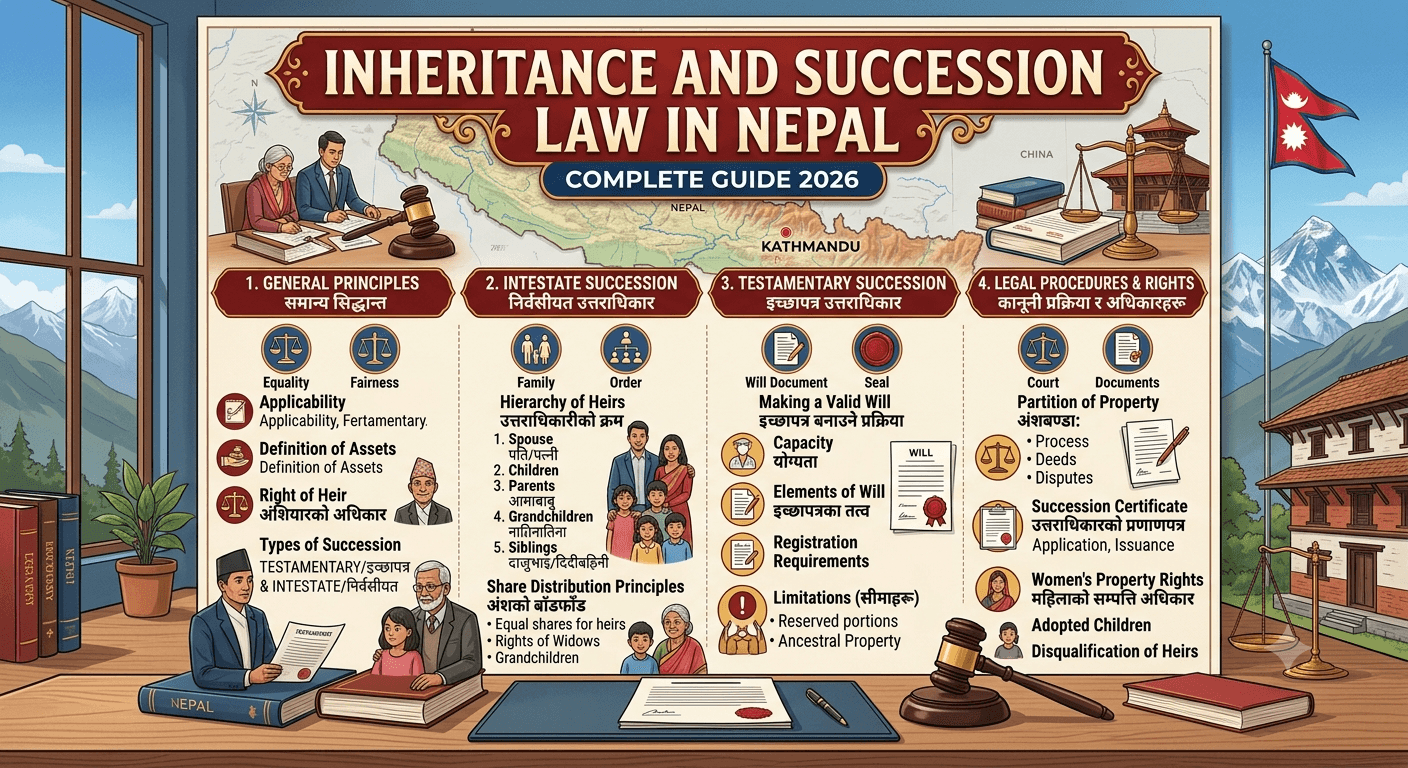
Quick answer
Nepal succession begins on death and transfers the legally established estate to the heir or heirs entitled under the Civil Code. The process requires heir verification, asset and debt review, preservation and separate transfer steps for each asset.
Key facts
- ✓Succession after death is different from partition of common family property.
- ✓The complete family tree and legal priority must be verified before transfer.
- ✓Only the property interest legally belonging to the deceased enters the estate.
- ✓Estate debts require assessment, but heir liability is limited by inherited value.
- ✓Land, bank accounts, shares and other assets require their own transfer procedures.
Inheritance and succession law in Nepal
Succession is the legal transfer of the property, rights and certain obligations of a deceased person to the person or persons entitled under law. It is different from partition of common family property during life, although one estate can involve both questions.
Quick answer
After a death, verify the death and family records, identify every possible heir under the statutory priority, separate the property of the deceased from common family or third-party property, inventory assets and liabilities, preserve the estate, obtain any required local or court documents, settle valid debts within the inherited estate, and complete separate transfer procedures for land, bank accounts, shares and other assets.
Main legal framework
The National Civil Code, 2074 contains the principal succession provisions, including when succession opens, priority among heirs, disqualification, care and maintenance, surrender, liabilities and the position where no heir succeeds. The Civil Procedure Code governs disputed claims, evidence, venue, notice, interim protection and court procedure.
Land, company, banking, tax, foreign-exchange and NRN rules also apply according to the asset and the status of the heir.
Succession begins on death
Succession should not be assumed before death. During life, ownership, partition, gifts, transfers, nominations and management authority are separate questions. A power of attorney generally requires specific review after the principal dies and should not be used casually to transfer estate assets.
Obtain the official death registration and check whether any foreign death certificate requires translation, notarisation or diplomatic legalisation for use in Nepal.
Partition and succession are different
Partition divides common family property among living coparceners under Chapter 10 of the Civil Code. Succession deals with the legal position after death under Chapter 11. Before distributing an estate, determine: - whether the asset was private property of the deceased; - whether it belonged to a common family pool; - whether a prior partition occurred; - whether another person is a co-owner; - whether a mortgage, charge or dispute exists; and - what share actually belonged to the deceased.
Only the legally established estate interest passes through succession.
Identify the heirs
Prepare a complete family tree supported by citizenship, birth, marriage, relationship, adoption, divorce and death records. The statutory order is not safely summarised as one universal equal-share formula. Cohabitation, maintenance, prior family events, competing heirs and disqualification can affect the result.
Do not omit a daughter, overseas relative, separated spouse, adopted relationship or child merely because another family member controls the documents. Equally, a biological or social relationship must still be established in the legally required form.
Inventory assets
Search and document: 1. land and buildings with Lalpurja, deeds, cadastral and tax records; 2. bank accounts, deposits, lockers and loans; 3. shares, partnership interests and company loans; 4. vehicles, jewellery and valuable movables; 5. insurance, employment benefits and pensions; 6. receivables, contracts and intellectual property; 7. foreign assets; and 8. property already sold, gifted, partitioned or pledged.
Use current official records instead of relying only on family possession.
Inventory liabilities
Collect loan agreements, mortgages, guarantees, tax files, utility arrears, litigation and funeral or estate expenses. The Civil Code limits creditor recovery so that an heir should not be required to pay beyond the value of property inherited, but the exact claim, security and estate value must be established.
Do not distribute or sell assets before known liabilities and restrictions are assessed.
Preserve the estate
If there is a real risk of concealment, withdrawal, destruction or unauthorised transfer, gather certified records and obtain advice on a lawful notice, restriction or interim court request. Do not seize property, access accounts unlawfully or create a false deed.
Keep an estate ledger recording possession, rent, income, expense, tax and every transaction after death.
Uncontested process
Where the family tree and assets are clear and all necessary heirs cooperate, the process may include: 1. death and relationship documentation; 2. heir and family verification required by the receiving office; 3. asset-specific application and consent documents; 4. tax, charge or debt clearance where applicable; 5. Land Revenue Office, bank, company or other transfer; and 6. updated ownership and distribution records.
There is no one succession certificate that automatically transfers every category of asset. Confirm what each receiving institution lawfully requires.
Disputed succession
Disputes can concern heirship, parentage, marriage, prior partition, forged documents, hidden assets, unauthorised transfers, debt, possession or statutory disqualification. Identify the correct claim and limitation period before filing.
Preserve originals, obtain certified records and name every necessary party. A settlement should contain complete asset schedules and implementable transfer steps.
Surrendering succession
The Civil Code provides a formal process by which an heir may surrender succession through a written document submitted to the competent local court. This can affect rights and liabilities and should not be confused with an informal family statement or a gift after inheritance.
Obtain advice before signing, especially where debts, minors, overseas property or later claims may exist.
Where no heir succeeds
The Code addresses property where no heir is found or succession is surrendered. After relevant debts and expenses are handled, property can pass according to the statutory local-level process. A person in possession should not treat unclaimed property as personal property.
Review note
This guide was reviewed on 21 July 2026. Heir priority, limitation, document and transfer requirements must be checked from the current Nepali Code and the facts of the estate.
Common questions
Frequently asked questions
Official sources
Primary materials used for the legal review of this guide.
- 1.Nepal Law Commission - National Civil Code 2074Accessed July 21, 2026
- 2.Nepal Law Commission - Civil Procedure Code 2074Accessed July 21, 2026
- 3.Supreme Court of Nepal - Court and Filing InformationAccessed July 21, 2026
Professional assistance
Need professional legal assistance?
Get advocate-led guidance tailored to your matter, documents and compliance requirements.
View related legal service →Editorial and legal review
Reviewed by: Wakil Nepal Legal Team
Last reviewed: July 21, 2026
This guide provides general legal information. Procedures and official requirements can change, and case-specific advice may be necessary.