
Table of contents
- 01Mutual consent and contested divorce
- 02Quick answer
- 03Mutual-consent divorce under Section 93
- 04Contested grounds available to a husband
- 05Contested grounds available to a wife
- 06Pleading the ground
- 07Evidence planning
- 08Safety and sensitive allegations
- 09Conciliation and settlement
- 10One-year provision in Section 98
- 11Overseas spouse
- 12Common mistakes
- 13Decision checklist
- 14Review note
Quick answer
Mutual divorce under Section 93 requires genuine agreement by both spouses. Without consent, the petitioning husband or wife must plead and prove a specific ground under Section 94 or 95 through the contested District Court process.
Key facts
- ✓Mutual consent must remain genuine through the court process.
- ✓Husbands and wives have separately stated contested grounds under Sections 94 and 95.
- ✓A contested petition needs facts and admissible evidence, not labels or rumours.
- ✓Conciliation does not require an unsafe spouse to accept reconciliation.
- ✓Settlement should cover property, payments, children and implementation precisely.
Mutual consent and contested divorce
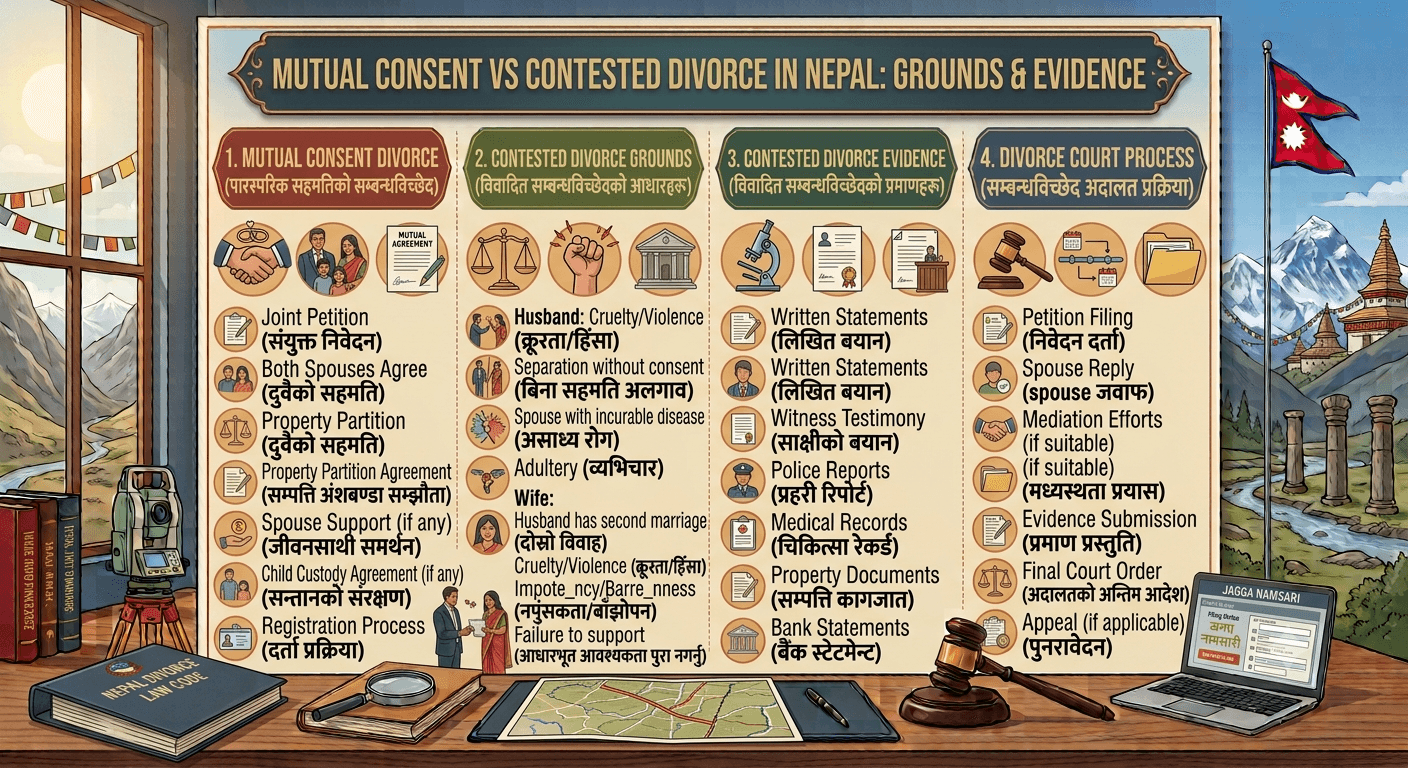
The central question is whether both spouses genuinely consent to divorce. If they do, Section 93 provides the mutual route. If not, the filing spouse must rely on and prove a ground available under Section 94 or 95.
Quick answer
Use mutual consent when both spouses independently agree to end the marriage and can confirm that decision before the court. Use a contested petition when consent is absent and a statutory ground exists. Do not force facts into a ground, manufacture evidence or sign settlement terms without understanding property, maintenance and child consequences.
Mutual-consent divorce under Section 93
Section 93 states that husband and wife may divorce at any time when both desire it. The route does not mean that every financial or child question disappears. A durable settlement should address: - the decision to divorce; - property and debt disclosure; - partition, lump sum, periodic payment or waiver language where lawful; - custody, residence, education, health expenses and visitation; - return of documents and personal property; - implementation deadlines and government-office steps; and - treatment of overseas assets or recognition.
Each spouse should understand the terms and have a real opportunity for independent advice. Consent obtained through threat, deception or concealed assets creates serious risk.
Contested grounds available to a husband
Section 94 permits a husband to seek divorce without his wife consenting in specified situations. In summary, these concern: 1. the wife living separately without consent continuously for at least three years, except where the spouses are lawfully separated after partition or separation of board; 2. deprivation of maintenance or expulsion from the home; 3. an act or scheme causing maiming or other severe physical or mental pain; or 4. a proved sexual relationship with another man.
The exact statutory wording and exceptions matter. Ordinary disagreement or a short separation is not automatically a ground.
Contested grounds available to a wife
Section 95 permits a wife to seek divorce without her husband consenting in specified situations. In summary, these concern: 1. the husband living separately without consent continuously for at least three years, subject to the statutory exception; 2. deprivation of maintenance or expulsion from the home; 3. an act or scheme causing maiming or other severe physical or mental pain; 4. another marriage by the husband; 5. a proved sexual relationship with another woman; or 6. marital rape.
The financial consequences of the ground should be reviewed together with Sections 99–101.
Pleading the ground
A contested petition should state the material events in a clear chronology: what happened, when, where, who observed it, what documents exist and how the facts satisfy the statutory ground. Avoid exaggerated labels without facts.
The respondent should answer each material allegation, state any procedural objection, preserve contrary evidence and identify connected financial, child or safety requests.
Evidence planning
Evidence depends on the ground and may include: - testimony from the parties and persons with direct knowledge; - residence, rent, travel or household records; - bank transfers and evidence of maintenance or deprivation; - medical, police, protection or contemporaneous reports; - letters, messages, email, call or platform records obtained lawfully; - marriage records relevant to another marriage; and - financial documents relevant to relief.
Digital evidence should be preserved in original form with device, account, date and context where possible. A cropped screenshot can omit important context and may be challenged.
Safety and sensitive allegations
Marital rape, serious violence and coercive control require confidential, trauma-informed handling. A person at risk should seek urgent safety, medical and criminal-law advice where appropriate rather than treating divorce as the only remedy.
Do not publish accusations on social media. Public disclosure can harm privacy, children, evidence and related proceedings.
Conciliation and settlement
The court attempts reconciliation under Section 97. Reconciliation is different from settlement: spouses may agree that the marriage cannot continue while negotiating a safe and complete legal settlement.
Settlement can occur at any stage, but it should not conceal violence, defeat the interest of a minor or use vague promises that cannot be implemented.
One-year provision in Section 98
Section 98 addresses divorce after unsuccessful conciliation and contains a proviso concerning divorce after one year from filing when reconciliation is not accepted. Its application should be read with the pleaded ground, evidence and procedure. It is not a shortcut allowing every person to obtain an automatic divorce simply by waiting one year.
Overseas spouse
An overseas party creates questions of jurisdiction, service, evidence, appearance, power of attorney, notarisation and diplomatic legalisation. Do not promise a one-day proxy divorce. The court must be satisfied with lawful procedure and genuine consent or proved grounds.
Common mistakes
- filing mutual consent when one spouse is being pressured; - filing a contested case without matching facts to a statutory ground; - deleting messages or altering digital records; - signing a vague paper outside court; - hiding property or income; - using children to pressure the other spouse; - ignoring service and response deadlines; or - assuming a foreign divorce template applies in Nepal.
Decision checklist
1. Is consent genuine, informed and stable? 2. If not, which exact statutory ground applies? 3. What admissible evidence supports or answers it? 4. Are there urgent safety or protective issues? 5. What property, maintenance and child terms require resolution? 6. Is either party abroad or are foreign documents involved? 7. Can settlement be implemented with precise dates and documents?
Review note
This guide was reviewed on 21 July 2026 against Sections 93–98 of the Civil Code. Obtain advice on the exact Nepali text and current procedure for the facts of the case.
Common questions
Frequently asked questions
Official sources
Primary materials used for the legal review of this guide.
- 1.Nepal Law Commission - National Civil Code 2074Accessed July 21, 2026
- 2.Nepal Law Commission - Divorce Chapter, Sections 93-103Accessed July 21, 2026
- 3.Nepal Law Commission - Civil Procedure Code 2074Accessed July 21, 2026
Professional assistance
Need professional legal assistance?
Get advocate-led guidance tailored to your matter, documents and compliance requirements.
View related legal service →Editorial and legal review
Reviewed by: Wakil Nepal Legal Team
Last reviewed: July 21, 2026
This guide provides general legal information. Procedures and official requirements can change, and case-specific advice may be necessary.