
Table of contents
- 01Residential visas in Nepal
- 02Quick answer
- 03Residential visa is not permanent residence
- 04Investor residential route
- 05Non-business retiree route
- 06Reputation and contribution routes
- 07Document integrity
- 08Application process
- 09Can a residential visa holder work?
- 10Family and dependants
- 11Renewal
- 12Tax and financial residence
- 13Common mistakes
- 14Review note
Quick answer
Nepal offers limited residential-visa routes for qualifying investors, retirees and exceptional applicants. Each requires current statutory eligibility and evidence, and residential status should not be confused with citizenship, guaranteed permanent residence or employment authorization.
Key facts
- ✓Nepal uses the legal category residential visa, not a universal permanent-residence system.
- ✓The official investor route currently refers to qualifying industrial investment of at least USD 100,000.
- ✓The non-business route requires prescribed age or retirement, financial, character and health evidence.
- ✓Residential status does not automatically authorize employment.
- ✓Immigration residence and tax residence are separate legal questions.
Residential visas in Nepal
A residential visa is a limited immigration category for qualifying foreign nationals. It is not automatic permanent residence, citizenship, property ownership or unrestricted permission to work.
Quick answer
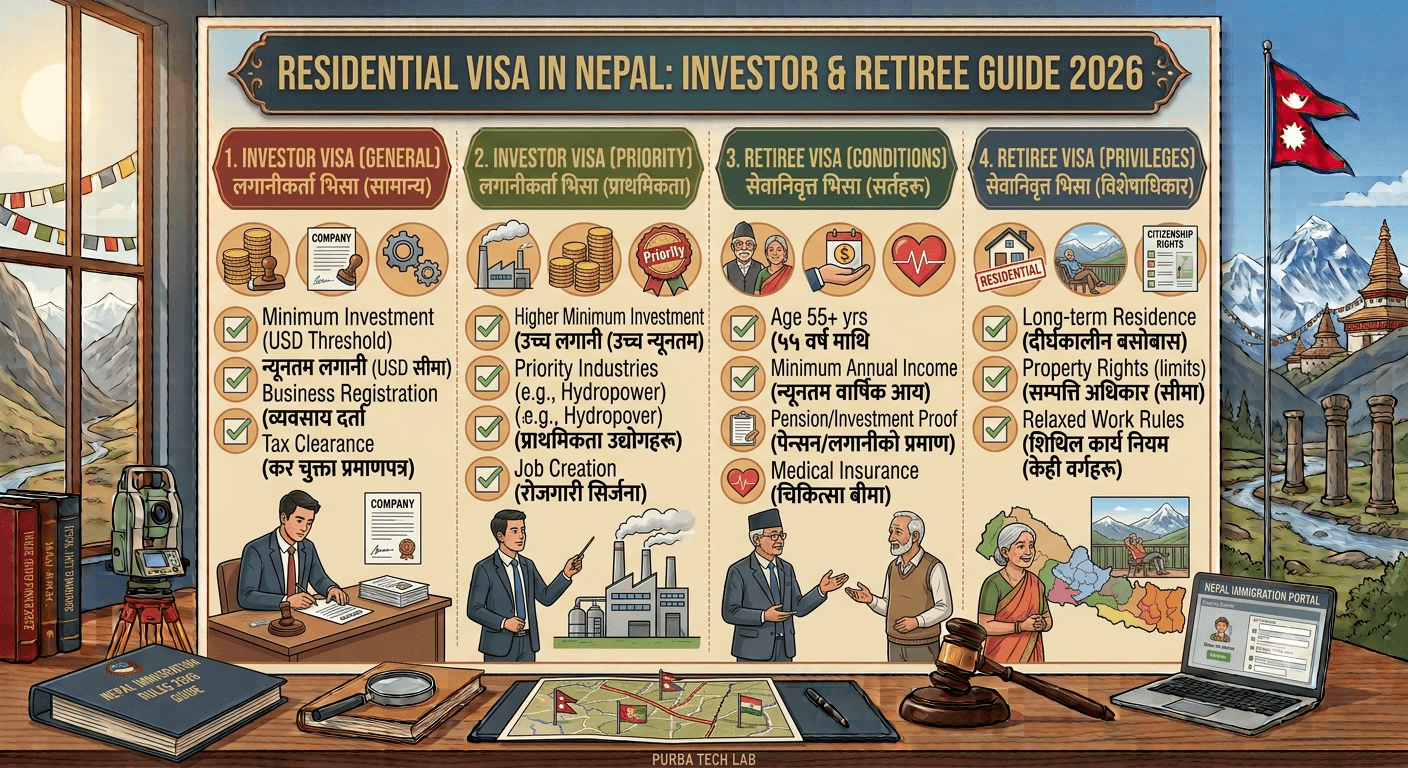
The Department of Immigration lists residential routes for persons of international reputation, persons capable of an outstanding contribution to Nepal, qualifying investors in industrial enterprises, and foreigners intending to live in Nepal without carrying on business. The correct route must be supported with the prescribed recommendation, investment, financial, age, health, character and immigration documents.
Residential visa is not permanent residence
Nepal's official terminology is residential visa. Avoid importing permanent-residency concepts from Canada, Australia, the United States or another country. The visa has its own duration, renewal, fees and conditions under Nepal law.
It does not by itself create Nepal citizenship, political rights, unrestricted land ownership, indefinite status or automatic work authorization.
Investor residential route
The Department currently describes an investor route for a person who has invested at least USD 100,000 or equivalent in a Nepal industrial enterprise. The file commonly involves: - prescribed online application; - company and industry registration; - PAN or VAT and share records; - proof of approved and realised investment; - Department of Industry recommendation; - passport and latest Nepal visa; and - tax clearance and operating evidence for renewal.
The minimum figure and fee schedule must be checked immediately before relying on them. Company incorporation or an unimplemented approval is not necessarily proof of qualifying investment.
Non-business retiree route
The current citizen charter describes a non-business route connected to a foreigner aged 60 or older or retired and intending to live in Nepal without carrying on business. Published documents include: 1. online application receipt; 2. bank statement showing the current prescribed funds; 3. evidence of regular annual income at the published threshold; 4. character certificate; 5. no-objection letter from the home-country embassy; 6. health certificate from the prescribed institution; 7. proof of age or retirement; 8. passport and recent Nepal visa; and 9. expenditure evidence for renewal.
This route is inconsistent with carrying on business. Applicants intending to manage a company, provide services or accept employment should obtain a separate activity and work-status assessment.
Reputation and contribution routes
The Rules also contemplate persons with international reputation or capacity to make an outstanding contribution to Nepal's economic, social or cultural development. These are discretionary, evidence-heavy categories, not substitutes for failing an ordinary investor or retiree route.
Evidence should be objective: recognised achievements, publications, awards, institutional support, proposed contribution and a credible Nepal connection. Obtain guidance from the competent authority before building the file.
Document integrity
Names and birth dates must match the passport. Foreign bank, income, retirement, character, health and civil records may require verification, notarisation, translation or diplomatic legalisation. Confirm the exact receiving-office standard first.
For investor cases, reconcile the investment approval, banking trail, share register, company record, industry record, tax file and applicant identity. A mismatch can affect both the visa and later repatriation or company matters.
Application process
1. Identify the exact residential category and current threshold. 2. Review present Nepal visa, passport validity and immigration history. 3. Obtain the required Department of Industry, ministry or other recommendation. 4. Prepare, translate and legalise documents in the required form. 5. Submit through the current official portal and retain the receipt. 6. Present originals, attend and pay the official fee as directed. 7. Verify category, dates, passport number and conditions after issue. 8. Calendar renewal and continuing-evidence requirements.
Can a residential visa holder work?
Do not assume so. Residence and employment are regulated separately. A residential visa may permit lawful residence while active employment still requires labour authorization and the correct immigration treatment. Investor oversight, directorship, consultancy and employment should be distinguished from one another.
Family and dependants
The availability and form of status for a spouse or child depend on the principal category, current immigration rules and relationship evidence. A dependant's visa does not ordinarily imply permission to work.
Renewal
Continuing eligibility matters. An investor may need updated recommendation, company, industry, share, investment and tax records. A non-business resident may need evidence of income, expenditure, health, passport and compliance. Begin before expiry and disclose material changes.
Tax and financial residence
An immigration residential visa and tax residence are separate legal tests. Long presence in Nepal can affect income tax, banking, foreign-exchange and reporting obligations even if the immigration label is different. Obtain coordinated tax advice.
Common mistakes
- calling the route guaranteed permanent residency; - assuming property purchase alone qualifies; - presenting approved rather than actually evidenced investment; - using a non-business route while working or running a business; - relying on outdated thresholds or fees; - overlooking legalisation of foreign documents; or - assuming residential status automatically covers dependants or employment.
Review note
This guide was reviewed on 21 July 2026 using current Department of Immigration pages. Official pages contain differing fee summaries, so confirm the category, threshold and payable charge directly before filing.
Common questions
Frequently asked questions
Official sources
Primary materials used for the legal review of this guide.
- 1.Department of Immigration - Visa InformationAccessed July 21, 2026
- 2.Department of Immigration - Visa Fees and DocumentsAccessed July 21, 2026
- 3.Department of Immigration - Citizen CharterAccessed July 21, 2026
- 4.Nepal Law Commission - Immigration Rules 2051Accessed July 21, 2026
Professional assistance
Need professional legal assistance?
Get advocate-led guidance tailored to your matter, documents and compliance requirements.
View related legal service →Editorial and legal review
Reviewed by: Wakil Nepal Legal Team
Last reviewed: July 21, 2026
This guide provides general legal information. Procedures and official requirements can change, and case-specific advice may be necessary.