
Table of contents
- 01Company registration document checklist
- 02Core documents required for every company
- 03Documents for Nepali individual promoters
- 04Documents for a Nepali corporate promoter
- 05Memorandum of association requirements
- 06Articles of association requirements
- 07Additional documents for a public company
- 08Additional documents for a company not distributing profits
- 09Additional documents for foreign promoters
- 10Prior approvals for regulated businesses
- 11Documents for converting a private or partnership firm
- 12Formatting and signing requirements
- 13CAMIS upload preparation
- 14Final verification before submission
- 15Legal update and caution
Quick answer
To register a company in Nepal, prepare the prescribed application, memorandum of association, articles of association and certified promoter identification. Corporate promoters need registration and board-authority records; foreign promoters need investment approval and authenticated identity or corporate documents; regulated activities may require prior approval.
Key facts
- ✓Core filing: prescribed application, memorandum of association and articles of association.
- ✓Nepali individual promoters: certified citizenship copies with consistent personal details.
- ✓Corporate promoter: registration certificate, investment resolution, representative authority and identification.
- ✓Foreign promoter: investment approval plus authenticated passport or corporate records and authority documents.
- ✓Regulated objectives may require prior approval from the responsible authority.
- ✓Every name, address, capital figure and share allocation must match across CAMIS and signed documents.
Company registration document checklist
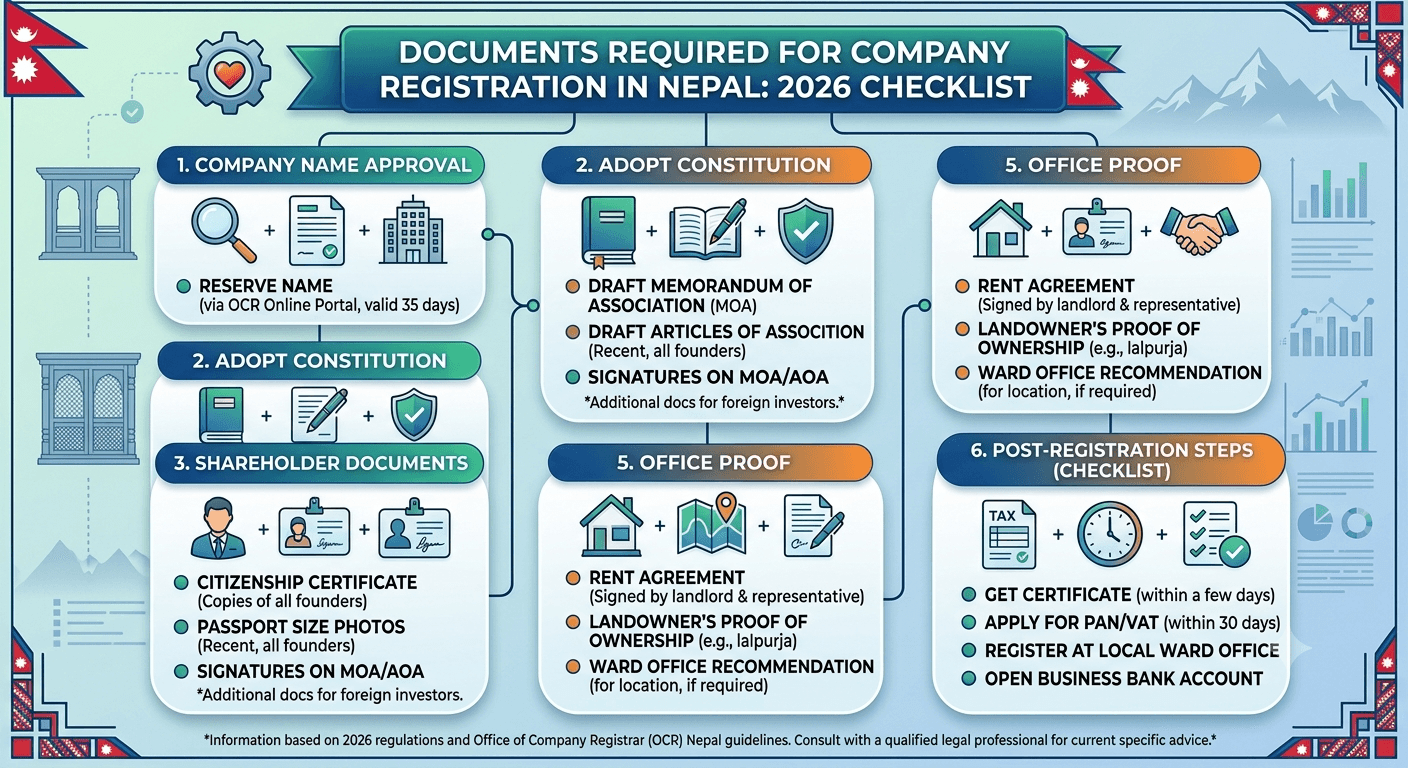
The documents required to register a company in Nepal depend on the company type, the identity of each promoter and whether the proposed activity needs foreign-investment or sector approval. For a standard Nepali-owned private company, the core filing normally includes the prescribed application, memorandum of association, articles of association and certified citizenship copies of the promoters.
The Office of the Company Registrar administers incorporation through its current electronic system. Information entered online must match the signed documents. A correct checklist therefore covers both the files to upload and the consistency of names, addresses, identification numbers, capital and share allocations across the entire application.
Core documents required for every company
Prepare the prescribed company-registration application. The OCR guidance identifies Schedule 1 as the general application form and provides separate prescribed constitutional forms according to company type.
Prepare two copies of the memorandum of association in the applicable form: Schedule 9 for a single-shareholder private company, Schedule 10 for another private company, Schedule 11 for a public company and Schedule 12 for a company not distributing profits.
Prepare two copies of the articles of association: Schedule 14 for a private company, Schedule 15 for a public company and Schedule 16 for a company not distributing profits. The memorandum states the company's fundamental objectives and capital structure, while the articles govern its internal management.
Include certified identification documents for every promoter and any prior approval or licence required for the proposed objective. If the promoters have entered into a unanimous agreement for a private company, or a pre-incorporation agreement for a public company, include a copy where applicable.
Documents for Nepali individual promoters
Each Nepali individual promoter should provide a clear certified copy of their citizenship certificate. The name in Nepali and English, citizenship number, issuing district, permanent address and other identity details should be entered consistently in CAMIS and the constitutional documents.
Each promoter must properly execute the memorandum and articles. OCR guidance requires promoter signatures on the relevant pages and clear promoter particulars, subscribed share numbers and witness information. Follow the current prescribed form and execution instructions rather than relying on an old template.
Where a promoter acts through an authorised person in a situation permitted by the applicable procedure, prepare the authority document and the representative's identification. Confirm whether personal appearance or verification is currently required before filing.
Documents for a Nepali corporate promoter
When an existing Nepali company will subscribe for shares, provide a copy of its company-registration certificate. Prepare a board resolution approving the investment, stating how much and in what manner it will invest, and naming the person authorised to represent it in the proposed company.
Include a certified citizenship copy of the authorised representative. The investing company's name, registration number, decision date, investment amount and authorised person's details must agree across the resolution, online application, memorandum and share allocation.
Depending on the transaction and current OCR review, evidence describing the corporate promoter's financial position or authority to make the investment may also be requested. Confirm case-specific requirements before submission.
Memorandum of association requirements
The memorandum of association should state the approved company name, registered-office jurisdiction, objectives, authorised capital, share structure, promoter details and the shares each promoter agrees to subscribe for. Objectives should be lawful, clear and consistent with any regulatory approval.
Do not insert unrelated objectives simply to avoid future amendments. Broad or regulated objectives may trigger clarification or require prior approval. Capital figures and promoter share totals must reconcile exactly throughout the filing.
Articles of association requirements
The articles of association establish the rules for shares, transfers, calls, meetings, voting, directors, officers, accounts and other internal matters. They must match the selected company type and the memorandum.
For a closely held company, consider whether the standard form sufficiently addresses founder control, reserved decisions, transfer restrictions, deadlock, investor rights and exits. Any tailored provisions must remain consistent with the Company Act and the memorandum.
Additional documents for a public company
A public company generally requires at least seven promoters and the public-company forms prescribed by OCR. Include any agreement made between the promoters before incorporation. The capital structure must comply with the Company Act and any higher requirement imposed by sector law or a regulator.
Public fundraising is not authorised merely by incorporation. If the company plans to issue securities to the public, separate securities-law filings and approvals apply. A public company must also satisfy the requirements for approval to commence transactions after incorporation.
Additional documents for a company not distributing profits
Use the memorandum and articles prescribed for a company not distributing profits and provide certified citizenship records for the promoters. OCR guidance generally requires at least five promoters.
The objectives and governance documents must reflect the non-distribution rule. Income and savings must be used for the stated objectives rather than paid to members as dividends or private profit. Additional registrations may apply depending on the organisation's activities and funding model.
Additional documents for foreign promoters
Foreign investment requires approval from the competent authority under the prevailing foreign-investment framework before or as required for company incorporation. Include a copy of the investment approval or licence. For a joint-venture industrial company, OCR guidance also refers to Department of Industry approval and the joint-venture agreement.
A foreign individual promoter generally provides a certified or authenticated passport copy. A foreign corporate promoter generally provides its certificate of incorporation, constitutional documents, investment decision, nomination or authority for its representative, and the representative's passport.
Foreign documents may require authentication and Nepali translation. The exact authentication chain depends on the issuing country, document and current government practice. Confirm the requirements before arranging notarisation, consular steps or translation.
Prior approvals for regulated businesses
If the company's objectives cover an activity requiring approval or a licence, include the relevant prior approval where the law or regulator requires it. Regulated areas can include banking, financial services, insurance, securities, telecommunications, education, health, travel, energy and other controlled activities.
OCR incorporation creates the legal entity but does not itself authorise a regulated activity. The wording of the objectives should match the approval, and the company should not begin the controlled business until all required licences are effective.
Documents for converting a private or partnership firm
To convert an existing private firm or partnership firm into a company, OCR guidance identifies additional documents: the promoters' conversion agreement, the renewed firm-registration certificate, a copy of the income-tax registration certificate and evidence of tax clearance or consent.
Review the transfer of assets, liabilities, contracts, employees, licences and tax positions separately. Company incorporation alone may not automatically transfer every right or obligation of the former firm.
Formatting and signing requirements
Use the latest forms published by OCR. The memorandum and articles should be clear, durable and prepared in the language and format required by the current guidance. OCR guidance states that documents for a foreign-investment company may be prepared in English but should also be accompanied by a Nepali translation.
Check that every required page is signed and that witness names, addresses and signatures are complete. Scans should be legible, correctly oriented and complete. Avoid compressed files that make citizenship details, signatures or stamps unreadable.
CAMIS upload preparation
Before uploading, create a single verified promoter-data sheet containing the spelling of every name, identification number, address, email, phone number, share quantity and investment amount. Use it to check every CAMIS field and every signed document.
Use descriptive internal filenames, retain clean final copies and do not upload superseded drafts. Review the complete submission before sending it because mismatched versions are a common cause of OCR observations and correction rounds.
Final verification before submission
Confirm that the company name has been approved and appears identically everywhere. Reconcile authorised capital, issued or subscribed capital, face value, share counts and each promoter's allocation. Confirm that all objectives are supported by any required approval.
Verify identification validity, signatures, witnesses, board resolutions, representative authority, translations and authentication. Make sure the application contains no blank mandatory field and that every uploaded file opens correctly.
Legal update and caution
This checklist was reviewed in July 2026 against current OCR registration guidance, CAMIS materials and foreign-investment information. The exact documents can change with company type, promoter profile, objective, regulator and government procedure. Check the latest official forms and obtain case-specific advice before filing.
Common questions
Frequently asked questions
Official sources
Primary materials used for the legal review of this guide.
- 1.Office of the Company Registrar — Company Registration DocumentsAccessed July 21, 2026
- 2.Office of the Company Registrar — Prescribed Application FormsAccessed July 21, 2026
- 3.Office of the Company Registrar — CAMIS New Registration ManualAccessed July 21, 2026
- 4.Nepal Law Commission — Company Act, 2063Accessed July 21, 2026
- 5.Department of Industry — Foreign Investment in a New IndustryAccessed July 21, 2026
Professional assistance
Need professional legal assistance?
Get advocate-led guidance tailored to your matter, documents and compliance requirements.
View related legal service →Editorial and legal review
Reviewed by: Wakil Nepal Legal Team
Last reviewed: July 21, 2026
This guide provides general legal information. Procedures and official requirements can change, and case-specific advice may be necessary.