
Table of contents
- 01Managing patent rights in Nepal
- 02Quick answer
- 03Confirm the chain of title
- 04Patent term and renewal
- 05Transfers and record changes
- 06Patent licensing
- 07Authorised use and DOI record
- 08Monitor possible infringement
- 09Respond proportionately
- 10If you receive a patent complaint
- 11Foreign and PCT limitations
- 12Portfolio management checklist
- 13Review note
Quick answer
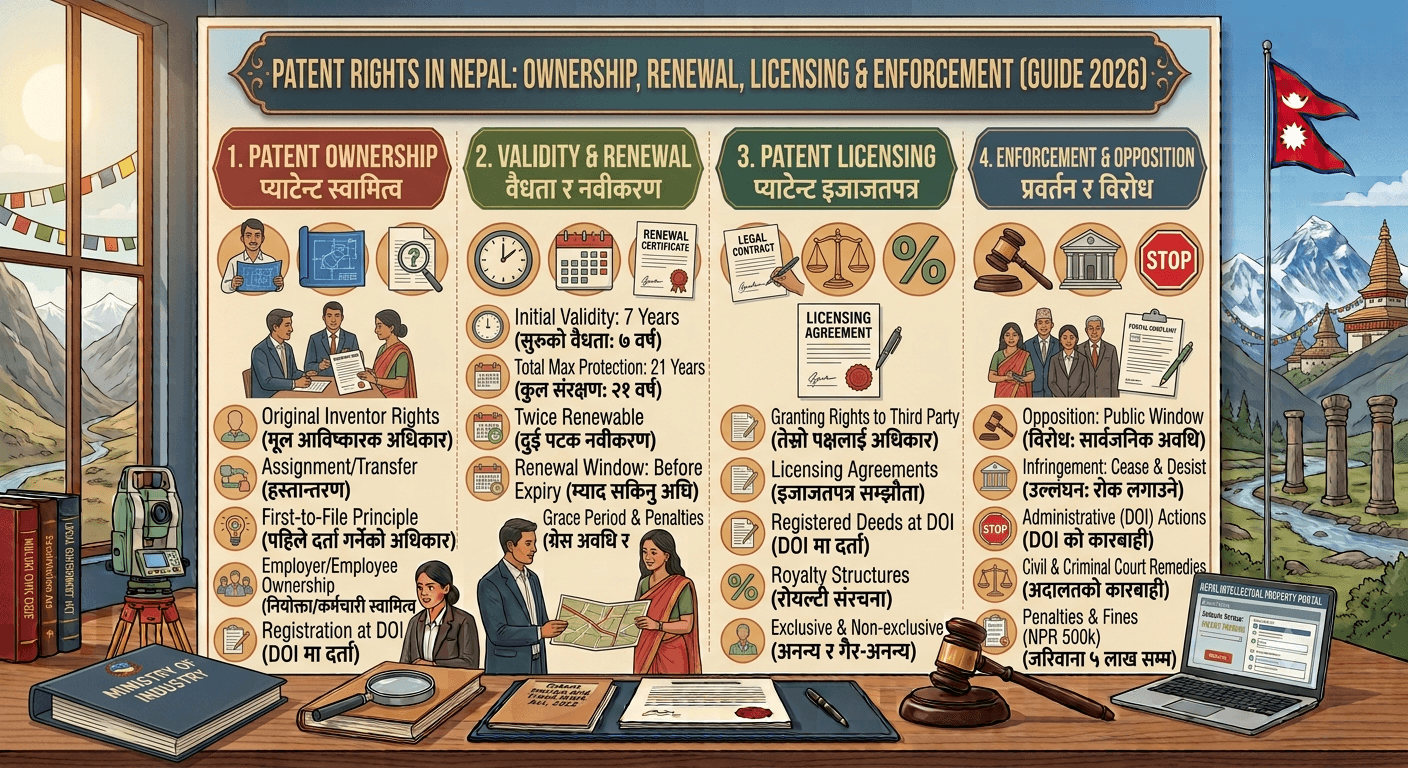
A Nepal patent lasts seven years from registration and can be renewed twice for seven years each. Preserve ownership records, complete DOI renewals and record changes, use detailed licences, and verify valid claims and evidence before enforcement.
Key facts
- ✓The maximum term is 21 years only if both seven-year renewals are completed.
- ✓DOI currently publishes first and second renewal fees of NPR 5,000 and NPR 7,500.
- ✓Assignments and licences should align with the DOI record where required.
- ✓Infringement is analysed against claims, not the patent title or general idea.
- ✓Foreign rights and PCT filings do not automatically create Nepal protection.
Managing patent rights in Nepal
Patent value depends on more than receiving a certificate. The owner must preserve title, track renewal deadlines, control licences, record transfers where required and distinguish infringement analysis from commercial assumptions.
Quick answer
A Nepal patent initially lasts seven years from registration and may be renewed twice for further seven-year periods, giving a possible total of 21 years if every renewal is validly completed. DOI's published fee schedule lists NPR 5,000 for the first renewal and NPR 7,500 for the second. Ownership transfers, record amendments and authorised use should be documented and handled with DOI as applicable.
Confirm the chain of title
Maintain a record from each inventor to the current owner. Relevant documents may include employment agreements, founder IP assignments, contractor deeds, research or university agreements, succession documents, merger records and acquisition schedules.
Inventorship should not be rewritten merely to reflect investment or seniority. Ownership can transfer, but the factual inventor record and legal ownership record serve different purposes.
Patent term and renewal
Section 12 of the current Act provides an initial seven-year patent term from registration and permits renewal twice for seven years each. Calendar the expiry and prepare renewal well in advance rather than relying on a grace mechanism.
DOI's current checklist asks for an application, original patent certificate, renewal-fee receipt and power of attorney where applicable. For a foreign patent, it also lists evidence that the home registration has been renewed.
The published schedule currently lists NPR 5,000 for the first patent renewal and NPR 7,500 for the second. Confirm the live amount, deadline and required original documents before filing.
Transfers and record changes
A patent may be transferred, but the transaction should clearly identify the registration, specification, territory, included improvements, effective date, consideration, warranties and responsibility for renewals and disputes.
DOI's citizen charter currently lists a joint application, agreement or transaction document, evidence supporting the amendment and fee receipt for ownership transfer or record amendment. The published patent transfer fee is NPR 5,000 and record-amendment fee is NPR 2,000. Verify the classification of the requested change.
Patent licensing
A licence grants permission without necessarily transferring ownership. It should address: - exact patents, applications and know-how; - exclusive, sole or non-exclusive scope; - products, field of use and Nepal territory; - manufacture, import, sale and sublicensing rights; - upfront fees, royalties, reports and audit rights; - technical assistance and confidential information; - improvements and newly created IP; - quality, regulatory responsibility and warranties; - infringement control and cost allocation; - term, termination and post-termination inventory; and - dispute resolution and applicable law.
An exclusive licence should state whether the owner retains any right to practise the invention and who controls enforcement or settlement.
Authorised use and DOI record
The Act addresses transfer and authorised use. A private contract and the public administrative record should not contradict each other. Confirm whether DOI recordal or approval is required for the particular assignment, licence or authorised-use arrangement.
Technology-transfer and foreign-investment rules may separately apply where a foreign party, royalty, technical services or cross-border payment is involved.
Monitor possible infringement
Monitor competing products, import channels, tenders, exhibitions, catalogues and technical publications. Preserve dated product samples, invoices, advertisements, web pages, photographs and the patent file.
Infringement analysis compares the accused product or process with the patent claims, not simply the title, abstract or commercial idea. Technical expert evidence may be necessary.
Respond proportionately
Before alleging infringement, confirm the patent is in force, ownership is current and the relevant claim can be mapped to reliable evidence. Review defences, licences, invalidity risk and whether another patent creates freedom-to-operate concerns.
Possible responses include evidence preservation, confidential technical inquiry, commercial negotiation, licence proposal, formal notice, administrative complaint or court action. The best route depends on urgency, evidence and business objective.
If you receive a patent complaint
Preserve the complaint, product versions, technical drawings, development history, supplier terms and search records. Do not destroy evidence or make technical admissions before claim analysis. Consider design-around, licence, validity challenge, settlement and litigation risk.
Foreign and PCT limitations
A Nepal patent is territorial. Foreign patents do not automatically create Nepal rights, and a Nepal patent does not provide protection abroad. Nepal is not currently a PCT contracting state, so international portfolios need deliberate national and convention planning.
Portfolio management checklist
1. Store the certificate and exact registered claims securely. 2. Maintain the inventor-to-owner chain of title. 3. Calendar the seven-year term and both possible renewals. 4. Record transfers and relevant changes promptly. 5. Audit licences, royalties, quality and sublicensing. 6. Monitor markets and preserve infringement evidence. 7. Review freedom to operate before launch or expansion. 8. Coordinate patents with designs, trademarks, copyright and confidentiality.
Review note
This guide was reviewed on 21 July 2026. Renewal, recordal and enforcement are fact-sensitive; confirm the current DOI procedure and obtain advice before acting.
Common questions
Frequently asked questions
Official sources
Primary materials used for the legal review of this guide.
- 1.Department of Industry - Citizen CharterAccessed July 21, 2026
- 2.Department of Industry - Industrial Property SectionAccessed July 21, 2026
- 3.Department of Industry - Patent fee schedule and Act textAccessed July 21, 2026
- 4.WIPO INSPIRE - Nepal patent-system profileAccessed July 21, 2026
Professional assistance
Need professional legal assistance?
Get advocate-led guidance tailored to your matter, documents and compliance requirements.
View related legal service →Editorial and legal review
Reviewed by: Wakil Nepal Legal Team
Last reviewed: July 21, 2026
This guide provides general legal information. Procedures and official requirements can change, and case-specific advice may be necessary.