
Table of contents
Quick answer
For a Nepal partition or road-access dispute, verify every ownership share and parcel, map present use and the claimed route, preserve historical evidence, and document a registrable settlement or seek precise partition, possession, access and interim relief.
Key facts
- ✓Physical family occupation is not always a completed legal partition.
- ✓Access claims require the source, route, dimensions and affected parcels to be proved.
- ✓Long use alone does not automatically establish ownership or every claimed access right.
- ✓A settlement should include a technical plan and required registration steps.
- ✓A judgment must be followed by execution, survey and land-record implementation.
Partition, access and possession disputes in Nepal
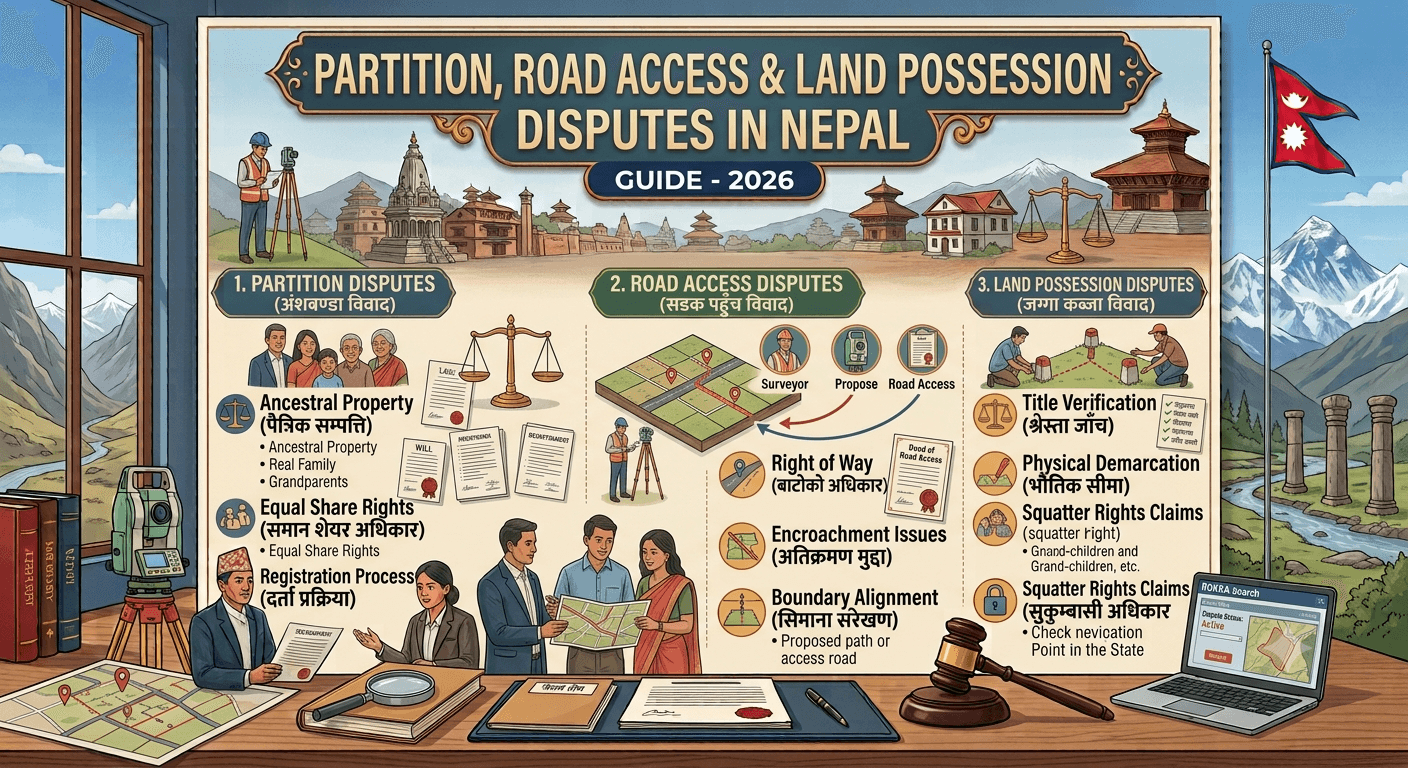
Many land cases are not pure ownership disputes. The parties may agree who owns the land but disagree about division, occupation, road access, use of a common courtyard, water or drainage, rent, construction or delivery of possession.
Quick answer
Identify each party's registered and family-law interest, map the whole property and claimed route, document present possession and historic use, and check deeds, partition records, cadastral documents and public-road records. Then choose a registered partition or access settlement where possible; otherwise seek the precise declaration, partition, possession, injunction or enforcement remedy from the competent forum.
Family and co-owner partition
Prepare a complete property and liability inventory before proposing shares. Verify whether property is private or common, how and when it was acquired, earlier partitions or relinquishments, living coparceners, deceased members and successors, gifts or sales, mortgages and property omitted from records.
Physical occupation of a house or field does not by itself establish a final partition. An informal family understanding may also fail to update title or protect later purchasers. A settlement should identify every kitta, share, access, structure, debt and implementation step and be registered where required.
Possession between co-owners
One co-owner occupying a particular area does not necessarily own that area exclusively. Review the legal shares, consent, prior family arrangement, income and expenses, exclusions and improvements. Do not forcibly lock out another claimant or demolish a structure while rights are disputed.
Possible solutions include use arrangements pending partition, rent or income accounting where legally justified, a physical partition, sale and division where permitted, or other court-directed relief.
Road access and right of way
Determine whether the claimed route is: - a public road shown in official or local records; - an express right in a deed or registered instrument; - an easement or access right arising under law; - a common or family route; - temporary permission; or - merely a route used without a legal right.
Map the width, length, entry points, dominant and affected parcels, structures and alternative access. Gather historic maps, deeds, subdivision approvals, building permits, local records, photographs and witness evidence. Long use is relevant but does not automatically prove every claimed width or legal basis.
Blocked access
Document the blockage immediately without confrontation. Identify whether it is a gate, wall, excavation, parked object, construction or change to a public road. Preserve earlier and current images and seek advice about urgent interim relief if access to a home, business, farm or emergency service is materially affected.
A local discussion can resolve practical facts, but a recommendation or mediation note should not be mistaken for a final registrable right or enforceable title decision.
Occupation and adverse possession
Nepal's Civil Code distinguishes ownership from possession and contains specific adverse-possession provisions, including conditions, time requirements and exclusions for government, public, community and Guthi land. Secret, forceful or legally permitted occupation should not be casually labelled adverse possession.
Because legal character and time calculation are fact-sensitive, neither tax receipts nor long occupation alone should be presented as automatic ownership.
Settlement design
A durable settlement should include: 1. verified parties and authority; 2. cadastral references and a signed technical plan; 3. exact shares, boundaries and access dimensions; 4. structures, utilities, water and drainage; 5. possession-delivery dates; 6. tax, survey, registration and construction costs; 7. removal or modification work; 8. default and enforcement terms; and 9. required registration and record updates.
Litigation and interim relief
The claim must distinguish title, partition, access and possession and request compatible relief. Depending on the facts, the court may need to determine shares, divide property, protect access or possession, restrain transfer or construction, direct removal, award compensation, or enforce a final settlement or judgment.
After judgment, complete execution, survey, registration and Dakhil Kharij steps. Winning a declaration without implementing the land record and physical handover can leave the dispute unresolved.
Review note
This guide was legally reviewed on 21 July 2026. Family status, deeds, survey history, public-road records, limitation and local facts require individual review.
Common questions
Frequently asked questions
Official sources
Primary materials used for the legal review of this guide.
- 1.Nepal Law Commission - National Civil Code 2074Accessed July 21, 2026
- 2.Nepal Law Commission - Land Survey and Measurement Act 2019Accessed July 21, 2026
- 3.Nepal Law Commission - National Civil Procedure Code 2074Accessed July 21, 2026
- 4.Nepal Law Commission - Land Revenue Act 2034Accessed July 21, 2026
Professional assistance
Need professional legal assistance?
Get advocate-led guidance tailored to your matter, documents and compliance requirements.
View related legal service →Editorial and legal review
Reviewed by: Wakil Nepal Legal Team
Last reviewed: July 21, 2026
This guide provides general legal information. Procedures and official requirements can change, and case-specific advice may be necessary.