Table of contents
- 01NGO and INGO compliance in Nepal
- 02Quick answer
- 031. DAO renewal
- 042. SWC affiliation and annual report
- 053. INGO agreements and projects
- 064. Audit and financial controls
- 075. Tax compliance
- 086. Governance and constitution
- 097. Funding and project approval
- 108. Employees, volunteers and safeguarding
- 119. Branches and local coordination
- 1210. Closure and asset handling
- 13Annual compliance calendar
- 14Review note
Quick answer
NGO and INGO compliance requires coordinated annual audit, tax, DAO, SWC, project and governance records. Use an entity-specific calendar because requirements vary by district, constitution, tax status, funding and agreement.
Key facts
- ✓Annual accounts and an auditor’s report must be sent to the local authority.
- ✓SWC-affiliated organisations have separate annual reporting obligations.
- ✓INGOs must track General and Project Agreement conditions and expiry.
- ✓Nonprofit status does not eliminate payroll, withholding or other tax duties.
- ✓Governance, funding, staff and branch changes require documented approvals.
NGO and INGO compliance in Nepal
Registration is the beginning of an organisation's legal duties. NGOs and INGOs should operate a single compliance calendar covering the regulator, registered constitution, fiscal year, tax, projects, donors, staff, banking and governing-body decisions.
Quick answer
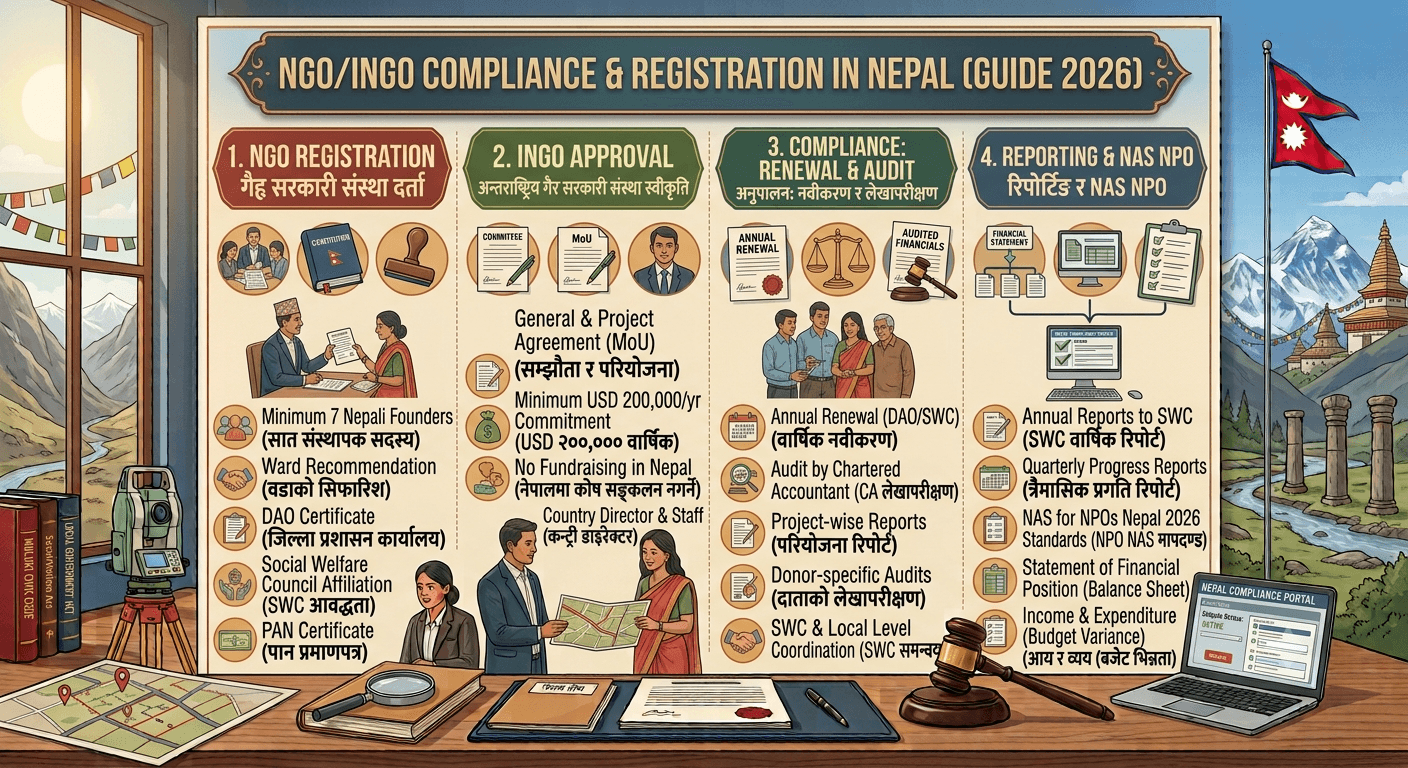
A Nepal NGO ordinarily prepares annual accounts and audit, progress report, tax clearance, committee decision and local recommendation for DAO renewal, while an SWC-affiliated organisation also files the applicable annual report and project information. An INGO must additionally track its General Agreement, every Project Agreement, donor funds, evaluations, staff and visa conditions. Requirements vary by entity, district and agreement.
1. DAO renewal
The Association Registration Act requires the management committee to send annual accounts with the auditor's report to the local authority. Official DAO renewal checklists commonly request: - prescribed renewal application; - committee decision approving renewal; - audited financial statements; - annual progress report; - auditor licence and renewal evidence; - tax-clearance evidence; and - recommendation from the relevant local level.
Confirm deadline, fee, late charge, stamp and supporting copies with the registered DAO. Do not assume another district's checklist applies.
2. SWC affiliation and annual report
Section 23 of the Social Welfare Act requires an SWC-affiliated social organisation to submit an annual report showing its work with the audit report within six months after the fiscal year ends. SWC affiliation and renewal records should match the DAO certificate, constitution, committee and office details.
Foreign assistance requires the applicable project proposal and approval under the Social Welfare Act. Do not treat affiliation alone as approval for every grant.
3. INGO agreements and projects
Track General Agreement and Project Agreement commencement, expiry, budget, districts, sectors, counterpart organisations, reporting dates, evaluation and amendment approvals. Maintain an agreement register linking each obligation to evidence and an accountable officer.
Material changes in location, activities, funding, duration or partner may require prior consent. Avoid retroactive regularisation as a routine practice.
4. Audit and financial controls
Use an auditor qualified for the engagement and maintain vouchers, procurement files, payroll, bank reconciliations, asset registers, advances, partner expenditure and donor restrictions. Separate unrestricted, restricted and project funds in the accounting records.
The governing body should review audit findings and document corrective action. A clean audit opinion does not replace compliance with the approved project budget or procurement terms.
5. Tax compliance
Nonprofit status does not eliminate all tax duties. Assess PAN, tax-exemption status, withholding, payroll, consultant payments, rent, imports, VAT and donor-funded procurement under current law. Obtain tax clearance where required and reconcile returns with audited accounts.
Avoid promising donors that every grant or purchase is automatically exempt. Exemption depends on current law, approval and the transaction.
6. Governance and constitution
Hold general assembly and committee meetings on time; preserve notices, attendance, agendas, conflicts and signed minutes. Conduct elections or appointments under the registered constitution and update regulators where necessary.
Changes to objectives or merger require the statutory approval process. Changes to name, address, committee, bank mandate or authorised signatories should be recorded with the appropriate authority rather than only in internal minutes.
7. Funding and project approval
Before accepting a new grant, verify donor identity, source, restricted purpose, approved banking channel, SWC/project approval, sanctions risk, reporting and asset disposition. Ensure the donor contract does not require unlawful conduct or conflict with the approved Project Agreement.
8. Employees, volunteers and safeguarding
Use lawful employment or volunteer documentation, payroll controls, workplace policies, safeguarding and complaint mechanisms. Foreign personnel require the applicable recommendation, work authorisation and immigration status. Protect beneficiary and employee data.
9. Branches and local coordination
Opening a district branch can require a separate DAO process. Current DAO examples ask for committee decision, constitution and certificate copies, local recommendation, local officer citizenship, tax clearance, PAN and SWC affiliation evidence. Verify each district.
10. Closure and asset handling
Follow the constitution, law, donor restrictions and agreements when closing a project or organisation. Address employee termination, creditors, records, bank accounts, unspent grants, equipment and remaining assets. Do not distribute charitable assets privately.
Annual compliance calendar
1. Close accounts and reconcile every project. 2. Complete audit and governing-body review. 3. File tax returns and obtain applicable clearance. 4. Prepare annual narrative and project reports. 5. Renew DAO registration and SWC affiliation as applicable. 6. Review General and Project Agreement deadlines. 7. Update committee, office, branch and bank records. 8. Review employment, visas, assets and donor restrictions.
Review note
This guide was reviewed on 21 July 2026. Compliance depends on the registered district, constitution, tax status and SWC agreements; verify the current filing requirements for each organisation.
Common questions
Frequently asked questions
Official sources
Primary materials used for the legal review of this guide.
- 1.Nepal Law Commission - Association Registration Act 2034Accessed July 21, 2026
- 2.Nepal Law Commission - Social Welfare Act 2049Accessed July 21, 2026
- 3.DAO Darchula - Nonprofit organisation renewalAccessed July 21, 2026
- 4.Social Welfare Council - Official information portalAccessed July 21, 2026
Professional assistance
Need professional legal assistance?
Get advocate-led guidance tailored to your matter, documents and compliance requirements.
View related legal service →Editorial and legal review
Reviewed by: Wakil Nepal Legal Team
Last reviewed: July 21, 2026
This guide provides general legal information. Procedures and official requirements can change, and case-specific advice may be necessary.