
Table of contents
- 01Choosing an employment or contractor structure
- 02Quick answer
- 03Regular employment
- 04Work-based employment
- 05Time-based or fixed-term employment
- 06Casual employment
- 07Part-time employment
- 08Employee or independent contractor?
- 09Trainee and apprentice arrangements
- 10Remote and platform workers
- 11Foreign workers
- 12Decision checklist
- 13Review note
Quick answer
Choose the contract from the real work: regular for ongoing roles, work-based for defined completion, time-based for a genuine period, casual within seven days monthly, part-time within 35 weekly hours, and consultancy only for genuine independence.
Key facts
- ✓Contract labels do not override the real nature of the work.
- ✓Fixed-term employees retain statutory employment rights during the term.
- ✓Casual work is limited to seven days or less in a month.
- ✓Part-time work is generally 35 hours or less per week.
- ✓Misclassification creates labour, SSF, tax, benefit and exit exposure.
Choosing an employment or contractor structure
The correct document follows the actual relationship. A company cannot convert an employee into an independent contractor simply by changing the heading, and it should not use a fixed-term contract for work that is genuinely ongoing without a proper reason and structure.
Quick answer
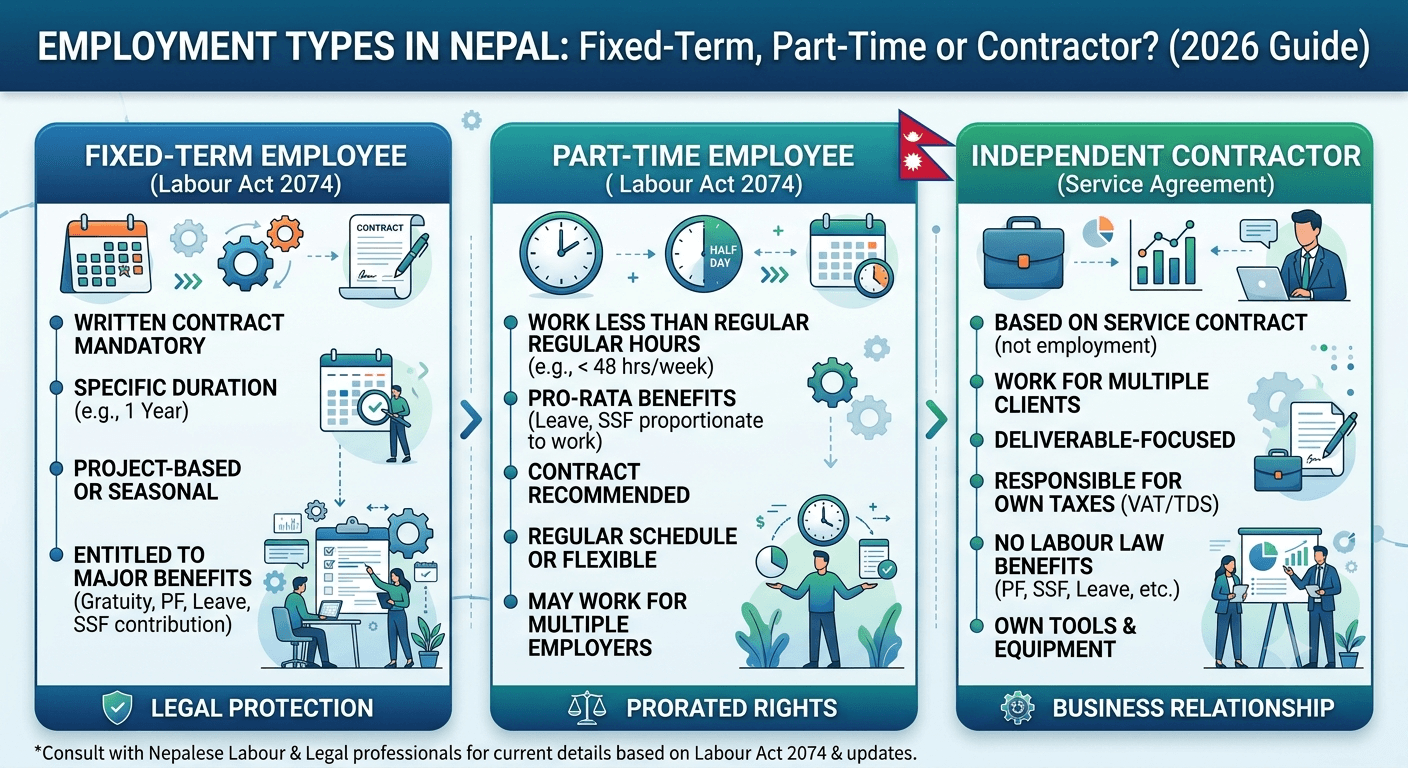
Use regular employment for ongoing roles; work-based employment for a defined job that ends on objective completion; time-based employment for a genuine fixed period; casual employment for no more than seven days in a month; and part-time employment for 35 hours or less per week. Use a consultancy only where the provider genuinely operates independently rather than as a controlled worker integrated into the employer.
Regular employment
Regular employment is the residual category: work not genuinely falling within work-based, time-based or casual employment. It suits ongoing operational roles such as finance, administration, engineering, sales or management where the business needs the function continuously.
The contract should cover long-term responsibilities, grade, probation, pay, benefits, policies, reviews, notice and lawful exit. Calling the role “permanent” does not guarantee employment can never end; termination still follows law.
Work-based employment
This category is tied to completion of specified work or service. Define the deliverable, scope, objective completion, acceptance, dependencies, reporting and handover. Avoid an employer-controlled indefinite task list disguised as a single project.
Completion should be objectively verifiable. If the worker moves continuously from one ordinary assignment to another, regular status may become the real issue.
Time-based or fixed-term employment
This is employment for a defined period. State the legitimate start and end dates, project or funding context, renewal, early termination, extension and benefits. The worker remains an employee with applicable statutory rights during the term.
Do not copy an “automatic termination without dues” clause. Expiry, non-renewal and early termination require separate analysis. Repeated renewals for an ongoing role increase classification and expectation risk.
Casual employment
The statutory definition covers work for seven days or less in one month. Written employment agreement is not generally required for this category, but the employer should still keep identity, work, attendance, rate, payment and safety records.
Using the casual label beyond the statutory pattern can create misclassification and unpaid-benefit exposure.
Part-time employment
Part-time work is generally 35 hours or less per week. State days, hours, availability, additional work, leave, proportional remuneration and benefits. Pay should be based on comparable full-time remuneration for work of the same nature and level.
The Labour Act restricts preventing a part-time worker from working elsewhere. Any conflict, confidentiality or availability restriction should therefore be narrow and legally reviewed.
Employee or independent contractor?
An independent contractor ordinarily controls how services are delivered, bears business risk, may serve several clients, supplies tools, invoices for deliverables and can organise substitutes subject to the contract. An employee is commonly integrated, personally performs work, follows hours and supervision and receives recurring remuneration.
No single factor decides every case. Review: - control over time, place and method; - integration into the organisation; - exclusivity and economic dependence; - ability to delegate; - tools, expenses and commercial risk; - payment by salary or deliverable; - leave and benefit treatment; - performance management and discipline; and - how the parties actually behave.
Misclassification can create wage, leave, SSF, tax, benefit, termination and record liabilities. An invoice and consultancy agreement are not a complete defence.
Trainee and apprentice arrangements
A genuine training relationship should have a curriculum, supervision, learning objectives, duration and evaluation. It should not be used to obtain ordinary productive work without employment rights. If a trainee is later employed by the same employer, the Act contains specific treatment affecting probation.
Remote and platform workers
Remote location does not determine status. A worker using their own laptop from home can still be an employee when control and integration point that way. Assess Nepal tax, labour, data, safety and cross-border issues separately.
Foreign workers
A foreign national may require labour permission, recommendation and immigration status in addition to a Nepal-compliant agreement. A consultant visa label or overseas payment does not necessarily resolve Nepal employment classification.
Decision checklist
1. Is the function genuinely ongoing? 2. Is there an objective project or period? 3. Who controls schedule and method? 4. Can the person serve others and delegate? 5. Who bears commercial risk and supplies tools? 6. How are pay, leave and benefits handled? 7. Does actual practice match the proposed document? 8. What happens at completion, expiry or exit?
Review note
This guide was reviewed on 21 July 2026. Classification depends on facts and should be reassessed whenever the role or working pattern changes.
Common questions
Frequently asked questions
Official sources
Primary materials used for the legal review of this guide.
- 1.Nepal Law Commission - Labour Act 2074Accessed July 21, 2026
- 2.Nepal Law Commission - Labour Rules 2075Accessed July 21, 2026
- 3.Department of Labour and Occupational SafetyAccessed July 21, 2026
Professional assistance
Need professional legal assistance?
Get advocate-led guidance tailored to your matter, documents and compliance requirements.
View related legal service →Editorial and legal review
Reviewed by: Wakil Nepal Legal Team
Last reviewed: July 21, 2026
This guide provides general legal information. Procedures and official requirements can change, and case-specific advice may be necessary.