
Table of contents
- 01Copyright protection in Nepal
- 02Quick answer
- 03What works are protected?
- 04Who is the author and who owns the rights?
- 05Economic and moral rights
- 06How long does copyright last?
- 07Does a copyright notice help?
- 08Why register if protection is automatic?
- 09International protection
- 10Rights audit checklist
- 11Review note
Quick answer
Nepal copyright generally protects original expression automatically. Ownership depends on authorship and applicable employment, commission, assignment or succession rules; voluntary registration records a claim but does not replace the underlying contracts.
Key facts
- ✓Original expression is protected; bare ideas and general data are excluded.
- ✓Authorship and ownership may differ, so written contributor agreements matter.
- ✓Economic rights and moral rights should be analysed separately.
- ✓The general life-plus-50 rule has work-specific exceptions.
- ✓Nepal has been a Berne Convention member since 11 January 2006.
Copyright protection in Nepal
The Copyright Act, 2059 (2002) protects original intellectual creations expressed in a form. The law separates economic rights, moral rights and neighbouring rights relating to performances, sound recordings and broadcasts.
Quick answer
An original work generally receives copyright protection without a registration form or copyright notice. The first legal task is therefore not simply filing: it is identifying the author, the owner, the protected expression and the contracts governing contributors. Voluntary registration can document the claim but does not replace a valid chain of title.
What works are protected?
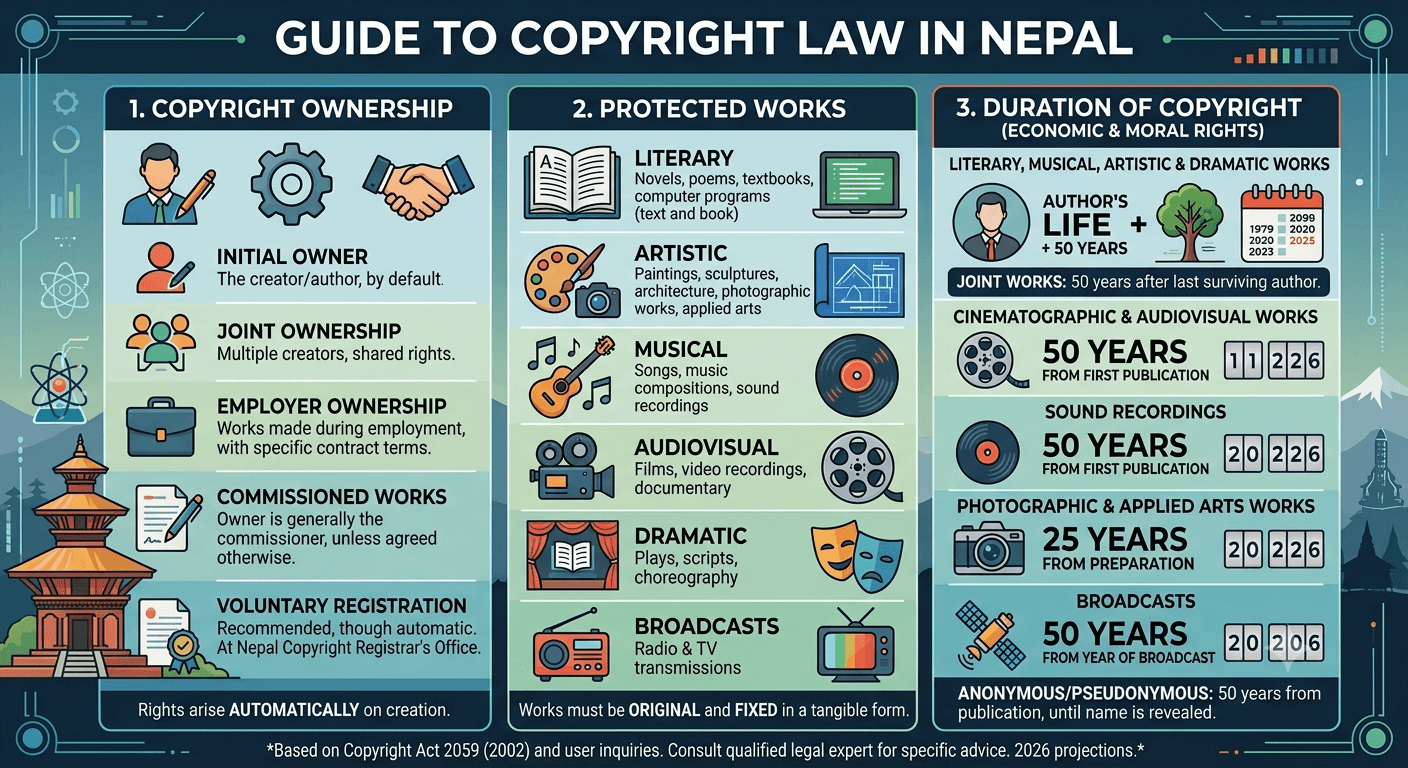
The Act's definition includes books, pamphlets, articles and research; dramatic and musical works; audiovisual works; drawings, paintings, sculpture, architecture and photographs; applied art; illustrations, maps and plans; computer programs; and databases that are original in selection or arrangement.
A title or idea alone is not protected in the same way as the completed expression. The Act excludes ideas, religions, news, concepts, principles, court judgments, administrative decisions, methods of operation, folk songs, folk tales, proverbs and general data. A brand name may instead require trademark analysis; an invention may require patent analysis.
Who is the author and who owns the rights?
The natural person who creates the work is ordinarily the author. Ownership can be affected by employment, commissioning, joint creation, audiovisual production, assignment and succession provisions. Do not assume that payment to a freelancer automatically transfers every copyright.
Businesses should use written agreements that identify the work, delivery, economic rights, territory, duration, media, exclusivity, further licensing, credit, warranties and payment. Maintain a contributor register for software, photographs, video, music and marketing content.
Economic and moral rights
Economic rights control uses such as reproduction, translation, adaptation, arrangement, sale, distribution, rental, importation, public exhibition, performance, broadcasting and communication to the public, subject to the Act.
Moral rights protect the author's connection with the work, including attribution and objection to prejudicial distortion or mutilation. A commercial licence to exploit a work should therefore address credit and permitted editing, not merely payment.
How long does copyright last?
Duration depends on the work and circumstances. As a general rule, economic rights in a work last during the author's life and for 50 years after death. The Act contains specific rules for joint, anonymous or pseudonymous, applied-art, photographic and audiovisual works, and for works published after the author's death. Related rights have their own periods.
Because classification and publication dates affect the calculation, do not apply one headline term mechanically. Record author identities, death dates where relevant, completion, first publication and public-release dates.
Moral-right duration and treatment should be checked separately from economic-right duration.
Does a copyright notice help?
A notice is not generally a condition of protection, but it is useful. A practical notice identifies the owner and year, followed by licensing or contact information. Add metadata and watermarks only where appropriate; preserve high-resolution originals and project files.
Why register if protection is automatic?
Registration can create a dated official record of the work and claimant. It may support due diligence, licensing discussions and evidence management. It cannot make copied content original, transfer a freelancer's rights to a client or eliminate valid third-party claims.
International protection
Nepal joined the Berne Convention with effect from 11 January 2006. International protection is jurisdiction-specific: ownership, term, exceptions, remedies and procedure should be assessed in each relevant country.
Rights audit checklist
- inventory every important work and version; - name the authors and contributors; - locate employment, commission and assignment contracts; - document third-party licences and expiry dates; - preserve dated creation and publication evidence; - decide which priority works merit registration; and - set rules for licensing, attribution and enforcement.
Review note
This guide was reviewed on 21 July 2026. It provides general information, not a conclusion on ownership or term for a particular work.
Common questions
Frequently asked questions
Official sources
Primary materials used for the legal review of this guide.
- 1.Nepal Law Commission - Copyright Act 2059Accessed July 21, 2026
- 2.Nepal Copyright Registrar - Copyright Act and RulesAccessed July 21, 2026
- 3.WIPO - Nepal accession to the Berne ConventionAccessed July 21, 2026
Professional assistance
Need professional legal assistance?
Get advocate-led guidance tailored to your matter, documents and compliance requirements.
View related legal service →Editorial and legal review
Reviewed by: Wakil Nepal Legal Team
Last reviewed: July 21, 2026
This guide provides general legal information. Procedures and official requirements can change, and case-specific advice may be necessary.