
Table of contents
- 01Contract drafting in Nepal
- 02Why professional contract drafting matters
- 03Contract formation under Nepal law
- 04Identify the parties correctly
- 05Define the scope and deliverables
- 06Draft clear payment terms
- 07Representations, warranties and undertakings
- 08Confidentiality and data
- 09Intellectual property clauses
- 10Indemnity and limitation of liability
- 11Duration, suspension and termination
- 12Force majeure and change in law
- 13Governing law and dispute resolution
- 14Electronic contracts and signatures
- 15Review formalities before signing
- 16Contract drafting process
- 17Common drafting mistakes
- 18Legal update and caution
Quick answer
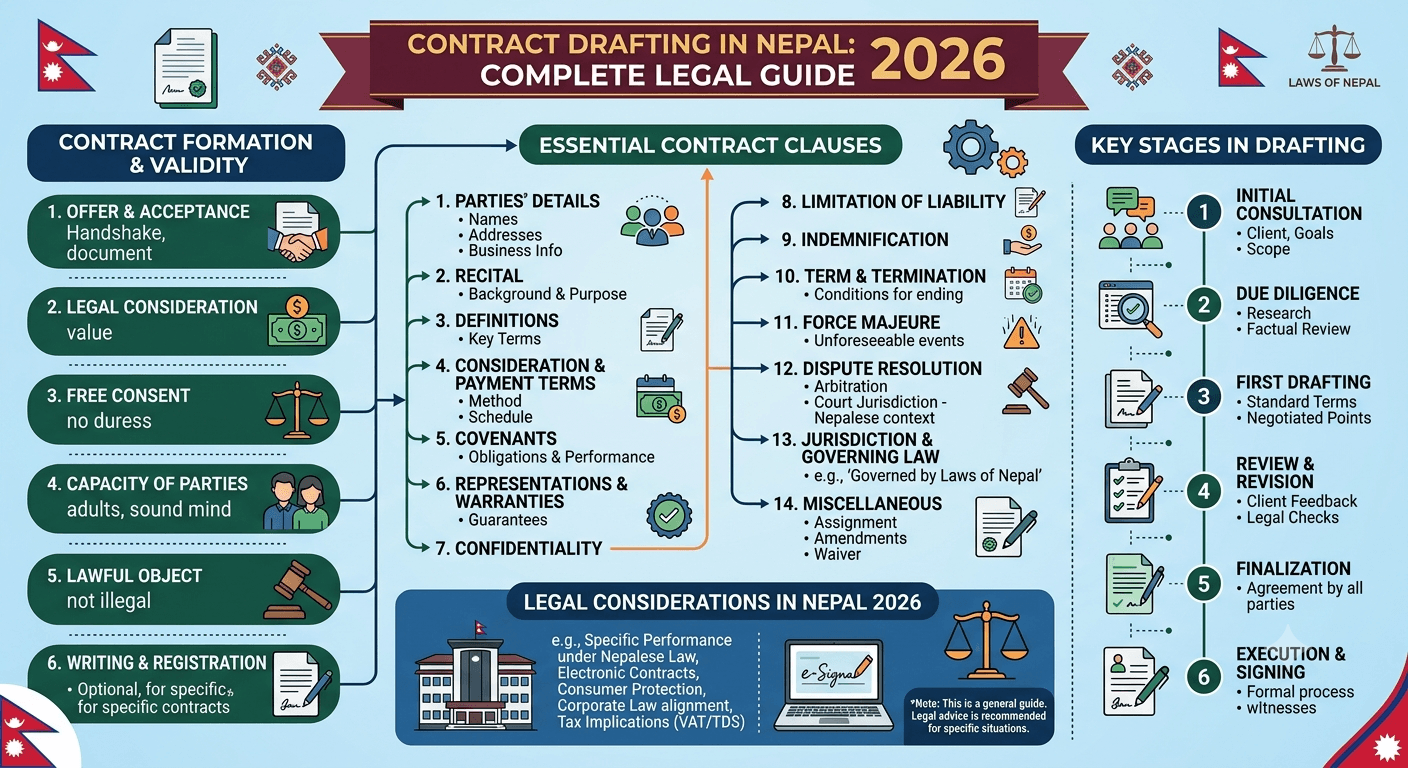
Contract drafting in Nepal converts a commercial deal into clear, lawful and enforceable obligations. A properly drafted agreement identifies the parties and authority, defines scope and payment, allocates liability, addresses confidentiality and intellectual property, and provides workable termination, governing-law and dispute-resolution terms.
Key facts
- ✓Current general framework: Part 5 of Nepal's National Civil Code, 2074.
- ✓Use exact legal party names and verify every signatory's authority.
- ✓Define scope, acceptance, price, tax, payment timing and change control precisely.
- ✓Coordinate warranties, indemnities, liability caps, insurance and remedies.
- ✓Choose court or arbitration clauses based on the actual transaction and enforcement needs.
- ✓Check mandatory writing, registration, approval and execution formalities before signing.
Contract drafting in Nepal
Contract drafting is the process of converting a commercial arrangement into clear, lawful and workable obligations. A useful contract should identify the parties and authority, define the transaction, allocate operational and financial risk, explain how performance will be measured, and provide a practical route for change, termination and disputes.
General contract law in Nepal is now principally contained in Part 5 of the National Civil Code, 2074. Older references to the Contract Act, 2056 should not be used as the current general framework. Sector laws, company law, labour law, land law, foreign-investment rules, tax rules and regulatory licences may add transaction-specific requirements.
Why professional contract drafting matters
A contract is not improved merely by being long. Problems usually arise because a copied template describes the wrong transaction, leaves key terms undefined, gives the signer inadequate authority, omits acceptance criteria, allocates unlimited liability or creates a dispute clause that cannot be used efficiently.
Good drafting begins with the commercial facts. The lawyer should understand what each party will deliver, when and where performance occurs, how payment is calculated, what can go wrong and what outcome the client needs if the relationship ends.
Contract formation under Nepal law
Section 504 of the National Civil Code provides that an agreement enforceable by law between two or more persons to do or not do an act is a contract. A contract is formed when the person receiving a proposal communicates acceptance, creating a binding legal relationship between the parties.
The final document should show a definite offer and acceptance, sufficiently certain obligations, legally capable parties, lawful purpose and genuine consent. A signature page cannot repair an agreement whose essential subject matter is impossible, unlawful or too uncertain to understand.
Identify the parties correctly
Use each party's exact legal name, registration or identification details, address and legal form. Distinguish a company from its shareholder, director, brand, branch or affiliated entity. Confirm whether a sole proprietor contracts personally or through a registered firm.
For a company, verify incorporation status and the board, constitutional or delegated authority of the signer. If an agent signs, describe the principal and retain the power of attorney or authority document. Section 519 of the Civil Code addresses enforceability problems where a representative acts without authority or beyond granted authority.
Define the scope and deliverables
Describe the goods, services, licence, works or rights with enough detail to measure performance. Use specifications, service levels, milestones, locations, dependencies and objective acceptance criteria where appropriate.
Avoid relying on proposals, emails or technical schedules without defining their contractual status. State the order of precedence if the main agreement and attachments conflict.
Draft clear payment terms
State the price or calculation method, currency, taxes, invoicing requirements, payment deadline, bank details process, retention, reimbursement and consequences of disputed invoices or delay. Link milestone payments to objectively verifiable deliverables.
For cross-border payments, consider withholding tax, foreign-exchange approval, technology-transfer or service-payment rules. A commercial payment promise may still require regulatory documentation.
Representations, warranties and undertakings
Representations describe facts on which a party relies. Warranties allocate responsibility if those facts are wrong. Undertakings govern future conduct. Draft each category deliberately rather than using a copied list unrelated to the transaction.
Common topics include legal existence, authority, licences, ownership, intellectual property, compliance, financial information and absence of conflicting obligations. Specify the knowledge standard, disclosure process, survival period and remedy.
Confidentiality and data
Define confidential information, permitted use, authorised recipients, security, compelled disclosure, exclusions, return or destruction and survival. Make the clause workable for employees, advisers, cloud providers and regulators.
If personal data, health information, financial records or cross-border systems are involved, address applicable privacy, cybersecurity, access and incident duties separately. A generic confidentiality sentence may not allocate operational data risk.
Intellectual property clauses
Identify pre-existing intellectual property and new work created under the contract. State ownership, licence scope, territory, duration, sublicensing, modification, source materials, third-party components and what happens after termination.
Payment for development does not always answer every ownership or licence question. Technology-transfer, trademark, copyright, patent and foreign-exchange approvals may apply to particular cross-border arrangements.
Indemnity and limitation of liability
An indemnity should identify the covered claim, trigger, losses, exclusions, defence control, notice, settlement authority and mitigation. Do not accept unlimited language without understanding the exposure.
A limitation clause should address aggregate caps, excluded claims, indirect or consequential loss, multiple claims and interaction with indemnities, warranties and insurance. The allocation must remain lawful and commercially supportable.
Duration, suspension and termination
State the commencement date, initial term, renewal, notice and any conditions precedent. Distinguish suspension from termination and termination for cause from termination for convenience.
Define material breach, cure periods, insolvency, illegality, prolonged force majeure and regulatory failure. Explain accrued rights, final payment, transition, return of property, data handling and clauses that survive termination.
Force majeure and change in law
List the event standard, causation, notice, mitigation, suspension and long-stop consequences. Do not assume every difficult or expensive event excuses performance.
Change-in-law clauses should allocate who bears new compliance cost, whether price or schedule can be adjusted and when either party may terminate. Regulated and long-term projects require particular care.
Governing law and dispute resolution
For domestic contracts, state Nepali governing law and the competent forum where appropriate. For cross-border agreements, section 709 of the Civil Code recognises the parties' selection of governing law, subject to mandatory rules and public policy.
Choose courts or arbitration based on enforceability, confidentiality, urgency, cost, expertise, assets and transaction value. An arbitration clause should specify seat, rules or procedure, tribunal, language and scope consistently with the Arbitration Act, 2055.
Electronic contracts and signatures
The Electronic Transactions Act, 2063 recognises electronic records and gives legal recognition to digital signatures completed under its statutory process. Maintain accessible, reliable records showing the final version, authentication, dispatch, receipt and acceptance.
Do not assume every typed name, scanned signature or click has the same evidential strength as a statutorily verified digital signature. Also check whether another law requires writing, registration, witnessing or a particular execution form.
Review formalities before signing
Section 519 of the Civil Code provides that a contract required by law to be written may not be court-enforceable if it is not written. The same concern applies where mandatory formalities, procedures or registration have not been completed.
Identify all transaction-specific requirements: board approval, regulator consent, notarisation, witness, registration, government filing, tax document, translation or stamping where applicable. Do not add formalities by habit or omit them because a template did.
Contract drafting process
Start with a written term sheet or instruction list. Verify the parties, authority and regulatory context. Draft the commercial clauses first, then risk, boilerplate and schedules. Conduct defined-term, cross-reference, number, date and consistency checks.
Share a risk summary with the client, record commercial decisions, negotiate controlled revisions and produce a clean execution copy. Keep the signed document, authority records and final attachments together.
Common drafting mistakes
Common mistakes include incorrect party names, undefined deliverables, contradictory dates, missing payment triggers, unlimited liability, incomplete termination effects, copied foreign-law clauses, defective arbitration language and attachments that were never finalised.
Another serious error is treating legal review as formatting. A visually polished contract may still be void, voidable, unenforceable or commercially impractical.
Legal update and caution
This guide was reviewed in July 2026 against the National Civil Code, Electronic Transactions Act and Arbitration Act. Contract requirements depend on the transaction and sector. Obtain transaction-specific review before signing or relying on a limitation, indemnity, restraint, dispute or cross-border clause.
Common questions
Frequently asked questions
Official sources
Primary materials used for the legal review of this guide.
- 1.Nepal Law Commission — National Civil Code, 2074 (Contracts)Accessed July 21, 2026
- 2.Nepal Law Commission — Electronic Transactions Act, 2063Accessed July 21, 2026
- 3.Nepal Law Commission — Arbitration Act, 2055Accessed July 21, 2026
Professional assistance
Need professional legal assistance?
Get advocate-led guidance tailored to your matter, documents and compliance requirements.
View related legal service →Editorial and legal review
Reviewed by: Wakil Nepal Legal Team
Last reviewed: July 21, 2026
This guide provides general legal information. Procedures and official requirements can change, and case-specific advice may be necessary.